
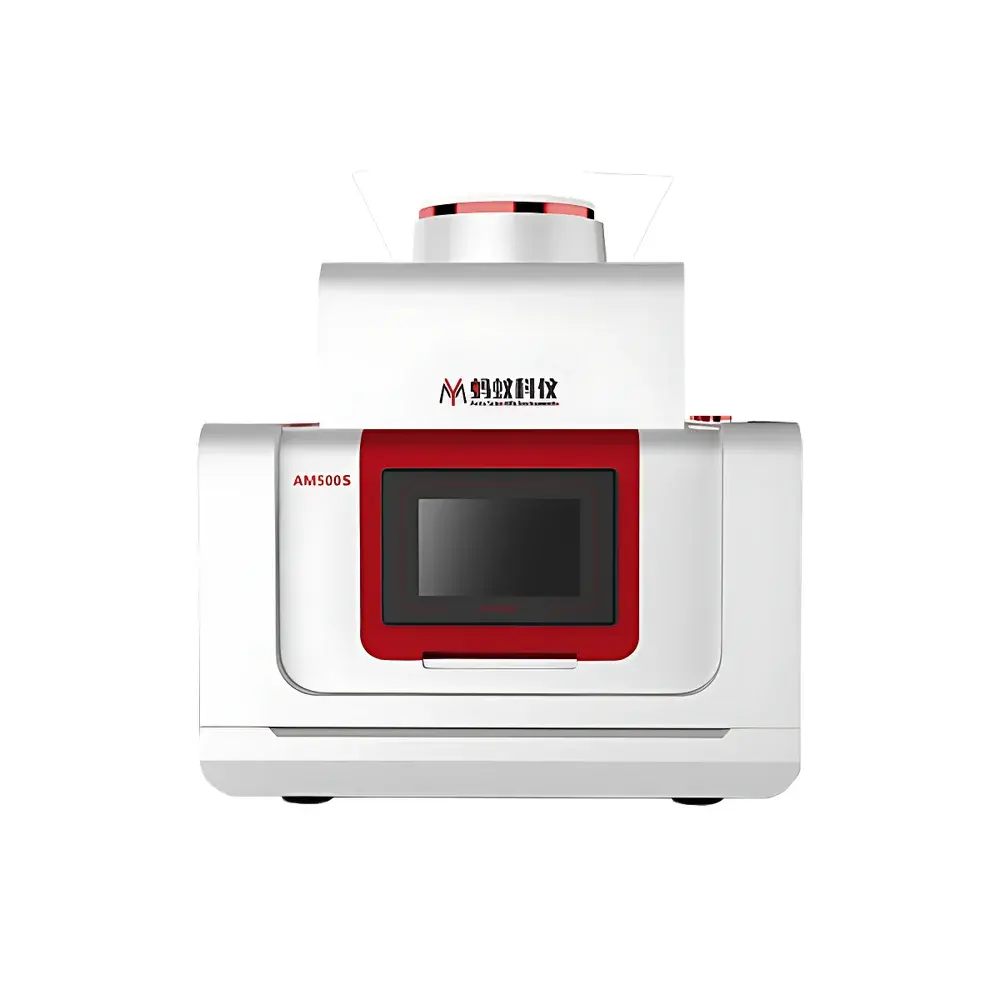
Ants Scientific Instruments AM500S High-Speed Rotational Grinder
| Brand | Ants Scientific Instruments |
|---|---|
| Origin | Beijing, China |
| Manufacturer Type | Authorized Distributor |
| Product Category | Domestic |
| Model | AM500S |
| Instrument Type | Rotational Grinder |
| Output Particle Size | < 40 µm |
| Feed Particle Size | ≤ 10 mm |
| Batch Processing Capacity | < 4500 mL (with cyclone separator) |
| Rotational Speed Range | 6000 – 20,000 rpm |
| Rotor Diameter | 100 mm |
| Peripheral Rotor Speed | 31 – 103 m/s |
| Sieve Ring Diameter | 105 mm |
| Sieve Aperture Options | Trapezoidal holes (0.08, 0.12, 0.2, 0.25, 0.5, 1.0, 1.5 mm) |
| Rotor Tooth Configurations | 6-, 12-, and 24-tooth |
| Rotor & Sieve Materials | Stainless steel or titanium |
| Collection Vessels | 1 L stainless steel, nylon, or PTFE trays |
| Operating Environment | 10–40 °C, 10–90% RH, 220 V / 50 Hz |
Overview
The Ants Scientific Instruments AM500S High-Speed Rotational Grinder is an engineered solution for rapid, reproducible, and analysis-neutral size reduction of diverse laboratory samples. It operates on a dual-stage comminution principle: first, centrifugal acceleration drives feed material outward onto high-velocity rotor blades for primary impact fragmentation; second, particles undergo controlled shearing and attrition between the rotating blade edges and a stationary sieve ring—only particles smaller than the selected aperture exit the grinding chamber into the collection vessel. This “in-and-out” residence time—typically under 10 seconds—minimizes thermal accumulation and mechanical degradation, making the AM500S particularly suitable for thermolabile, fibrous, elastic, or heterogeneous matrices where compositional integrity must be preserved during sample preparation. Its design adheres to core principles of mechanical process engineering: predictable energy input via precise rotational speed control (6000–20,000 rpm), geometrically defined stress zones (rotor–sieve gap, blade geometry, aperture shape), and containment integrity aligned with ISO 17025-compliant laboratory safety protocols.
Key Features
- Two-stage grinding mechanism ensures efficient particle size reduction while minimizing heat generation and oxidation risk.
- Digitally controlled variable-speed drive with real-time rpm display and overload indicator—enables optimization for soft, medium-hard, brittle, fibrous, or viscoelastic materials.
- Modular rotor–sieve assembly with quick-release bayonet mount: facilitates tool-free disassembly, cleaning, and cross-contamination prevention between batches.
- Anti-splash feed funnel and pneumatically engaged auto-locking chamber seal prevent dust emission and ensure operator safety per IEC 61000-6-4 EMC and EN 61000-6-2 immunity standards.
- Interlocked safety system: motor disables when lid is open; lid remains locked during operation and releases automatically post-grinding cycle.
- Optional accessories include programmable auto-feeder for unattended sequential processing and high-efficiency cyclone separator for continuous large-batch throughput up to 4500 mL per run.
Sample Compatibility & Compliance
The AM500S accommodates a broad spectrum of sample types—including biological tissues, plant fibers, polymers, pharmaceutical tablets, foodstuffs, and composite materials—without requiring pre-drying or chemical pretreatment. Its compatibility with cryogenic grinding (using liquid nitrogen-cooled feed funnels and chamber jackets) supports ASTM E2821-22 and USP guidelines for low-temperature milling of heat-sensitive analytes. All wetted parts are constructed from certified 316 stainless steel or medical-grade titanium, compliant with FDA 21 CFR Part 11 requirements for material traceability and surface finish (Ra ≤ 0.8 µm). The instrument’s closed-loop architecture meets GLP/GMP environmental monitoring criteria for particulate containment (ISO 14644-1 Class 8 background environment).
Software & Data Management
While the base AM500S operates via intuitive front-panel digital interface, optional Ethernet-enabled firmware supports integration into LIMS environments via Modbus TCP or OPC UA protocols. All operational parameters—including speed setpoint, runtime, overload events, and lid status—are timestamped and logged with audit-trail capability, satisfying FDA 21 CFR Part 11 electronic record requirements. Optional software packages provide batch reporting templates aligned with ISO/IEC 17025 clause 7.8.2 (reporting of measurement uncertainty) and enable export of metadata in CSV or XML format for downstream statistical process control (SPC) analysis.
Applications
- Routine homogenization of botanical extracts prior to HPLC or GC-MS analysis.
- Preparation of uniform powder blends for XRD, SEM-EDS, or laser diffraction particle sizing (e.g., Malvern Mastersizer).
- Cryomilling of protein-rich tissues or enzymatic samples to preserve native conformation prior to proteomic workflows.
- High-throughput comminution in QC labs supporting ISO 9001-certified manufacturing processes for nutraceuticals and dietary supplements.
- Fragmentation of composite polymer films for FTIR spectral library development.
FAQ
What is the minimum achievable particle size with the AM500S?
With the finest trapezoidal sieve (0.08 mm) and optimized 24-tooth rotor at 20,000 rpm, D90 values consistently fall below 40 µm for most brittle and semi-fibrous materials—verified by laser diffraction (ISO 13320) post-processing.
Can the AM500S be used for wet grinding?
No—the system is designed exclusively for dry or cryogenic grinding. Liquid introduction risks rotor imbalance, bearing damage, and non-compliance with IP54 ingress protection rating.
Is validation documentation available for GMP environments?
Yes—Ants Scientific Instruments provides IQ/OQ protocol templates, material certificates of conformance (CoC), and factory calibration reports traceable to NIST standards upon request.
How often does the rotor require recalibration or maintenance?
Rotor dynamic balance is factory-certified and requires no field recalibration; routine maintenance includes biannual inspection of blade wear (via micrometer measurement against OEM tolerances) and replacement of O-rings every 12 months or 500 operating hours.
Does the instrument support remote monitoring?
When equipped with the optional network module, real-time status (rpm, temperature, lid lock, error codes) and historical logs can be accessed via secure HTTPS interface compatible with enterprise IT security policies.



