
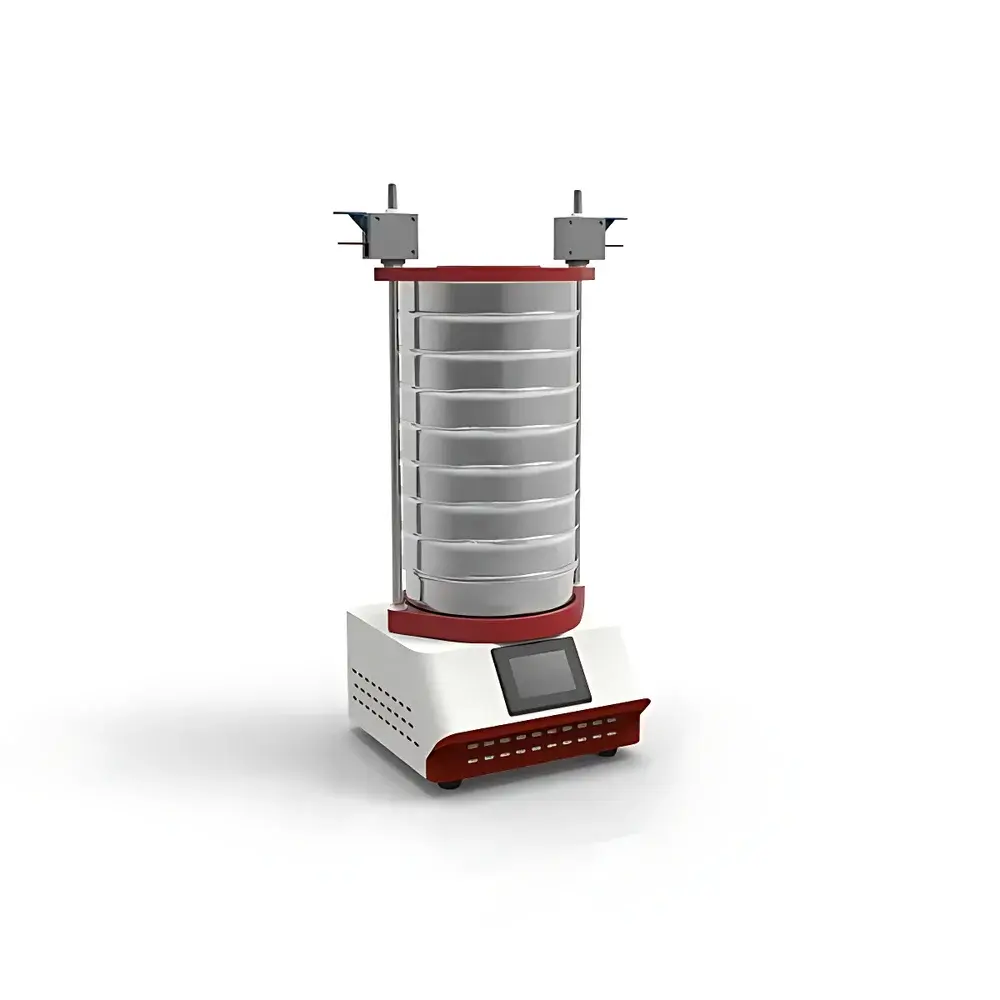
Ants Scientific Instruments AF100S 3D Oscillatory Sieve Analyzer
| Brand | Ants Scientific Instruments |
|---|---|
| Origin | Beijing, China |
| Manufacturer Type | Authorized Distributor |
| Origin Category | Domestic (China) |
| Model | AF100S |
| Principle | Electromagnetically Driven 3D Oscillatory Sieving |
| Measurement Range | 20 µm – 25 mm |
| Max. Sample Load | 6 kg |
| Max. Sieve Stack Levels | 9 |
| Sieve Diameters Supported | 100 mm / 150 mm / 200 mm / 300 mm |
| Amplitude Adjustment Range | 0.2–3 mm |
| Sieving Time Range | 1–99 min |
| Intermittent Pause Interval | 5–99 s |
| Parameter Memory Slots | 9 |
| Dry & Wet Sieving Capability | Yes |
| Wet Sieve Module | Plug-in Design |
| Sieve Material Options | Stainless Steel, Nylon |
| Max. Sieve Tower Mass | 10 kg |
| Display | Large LCD Touchscreen |
| Fastening Mechanism | Ergonomic Quick-Clamp System |
Overview
The Ants Scientific Instruments AF100S 3D Oscillatory Sieve Analyzer is an electromagnetically driven particle sizing instrument engineered for precise, reproducible dry and wet sieving of powders, granular materials, and suspended solids. Unlike conventional linear or circular vibratory sievers, the AF100S employs a proprietary 3D oscillatory motion—combining horizontal orbital displacement with vertical lifting—generating a controlled “throwing” effect that ensures uniform sample dispersion across the sieve surface and minimizes particle agglomeration or blinding. This dual-axis excitation mechanism significantly enhances separation efficiency, especially for cohesive, fine, or moisture-sensitive materials within the 20 µm to 25 mm range. Designed for laboratory and QC environments requiring regulatory traceability and method consistency, the AF100S conforms to fundamental principles outlined in ISO 2591-1, ASTM E11, and USP , supporting both routine quality control and method development workflows.
Key Features
- Electromagnetic 3D oscillation system delivering synchronized horizontal and vertical motion for superior particle stratification and throughput.
- Modular sieve tower configuration supporting up to 9 stacked sieves—compatible with standard diameters: 100 mm, 150 mm, 200 mm, and 300 mm—enabling scalable sample volume handling from micro-samples to 6 kg bulk loads.
- Plug-in wet sieving module with integrated water manifold and drainage port; fully detachable for rapid cleaning and cross-contamination prevention.
- Ergonomic quick-clamp lid system enabling tool-free sieve stack assembly and disassembly in under 10 seconds—reducing operator fatigue and minimizing setup variability.
- Programmable operation interface with touchscreen LCD: stores up to 9 user-defined methods including amplitude (0.2–3 mm), total duration (1–99 min), and intermittent pause intervals (5–99 s) to support standardized multi-step protocols.
- Multi-material sieve compatibility: stainless steel (for abrasion resistance and chemical inertness) and nylon (for electrostatic-sensitive or brittle particles).
Sample Compatibility & Compliance
The AF100S accommodates a broad spectrum of particulate systems—including pharmaceutical excipients, metal powders, agricultural seeds, mineral aggregates, polymer granules, soil fractions, and detergent formulations—whether in dry, damp, or aqueous suspension states. Its mechanical design permits full compliance with GLP documentation requirements when paired with external audit-ready software (e.g., LIMS integration via RS-232/USB). While not intrinsically certified for hazardous area use, the unit meets IEC 61000-4 EMC standards and carries CE marking per Machinery Directive 2006/42/EC. All wet-sieving operations are compatible with deionized water, ethanol, and low-concentration surfactant solutions—subject to material compatibility verification per sieve mesh specification.
Software & Data Management
The AF100S operates as a standalone instrument with embedded firmware controlling all motion parameters, timing logic, and memory management. No proprietary PC software is required for basic operation; however, optional data export (CSV format) via USB port enables traceable reporting for internal SOPs or external audits. Parameter recall history—including date/time stamp, amplitude setting, duration, and active sieve configuration—is retained in non-volatile memory for ≥10,000 cycles. For regulated environments (e.g., FDA-regulated manufacturing), the device supports 21 CFR Part 11-compliant workflows when interfaced with validated third-party laboratory information management systems (LIMS) that provide electronic signature, audit trail, and role-based access control.
Applications
- Pharmaceutical: Granule size distribution analysis pre-compression; excipient classification per USP ; blend uniformity assessment.
- Materials Science: Metal powder characterization for additive manufacturing feedstock qualification (ASTM F3049); ceramic green body particle grading.
- Agriculture & Food: Seed sizing and purity testing; flour and starch particle fractionation; fertilizer granule classification per ISO 8978.
- Geotechnical & Environmental: Soil texture analysis (sand/silt/clay separation); sediment grain-size distribution per ASTM D422.
- Chemicals & Polymers: Catalyst support particle screening; pigment dispersion grading; recycled plastic flake sizing.
FAQ
What sieve diameters does the AF100S support?
The instrument accepts standard analytical sieves with diameters of 100 mm, 150 mm, 200 mm, and 300 mm—allowing flexibility in sample mass and resolution requirements.
Can the AF100S perform both dry and wet sieving in a single run?
No—dry and wet modes are mutually exclusive per operational cycle. The wet module must be physically installed prior to aqueous sieving; removal is required for dry operation.
Is calibration traceable to national standards?
The AF100S does not include built-in metrological calibration; users must verify sieve mesh integrity using certified reference standards (e.g., NIST-traceable test powders or optical microscope verification per ISO 9276-2).
How is data integrity ensured during extended sieving protocols?
All parameter sets and execution logs are stored in internal flash memory with power-fail protection—no data loss occurs during unexpected shutdowns.
What maintenance is required for long-term reliability?
Routine inspection of electromagnetic actuator coupling, periodic cleaning of guide rails and clamp surfaces, and annual verification of amplitude linearity using a calibrated laser vibrometer are recommended per manufacturer’s service schedule.



