
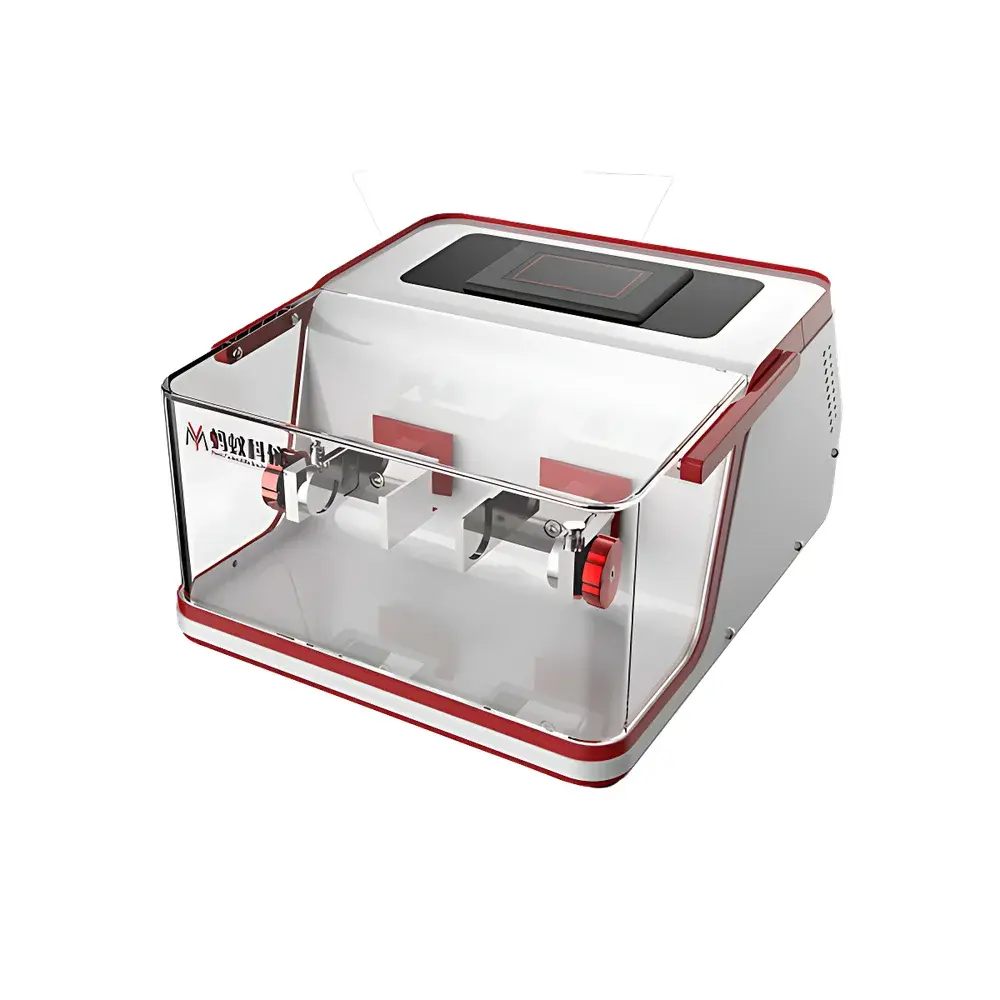
Ants Scientific Instruments AM100S High-Throughput Horizontal Vibratory Ball Mill
| Brand | Ants Scientific Instruments |
|---|---|
| Origin | Beijing, China |
| Model | AM100S |
| Instrument Type | Vibratory Ball Mill |
| Sample Applicability | Soft, brittle, elastic, fibrous, and moderately hard materials |
| Feed Size | ≤15 mm |
| Final Particle Size | ~5 µm (sub-micron achievable under optimized conditions) |
| Throughput Capacity | 6 × 100 mL (using multi-well adapter) |
| Vibration Frequency Range | 1–35 Hz (60–2100 rpm) |
| Grinding Time Setting | 1 s – 99 h 59 min 59 s |
| Display | LCD touchscreen interface |
| Number of Programmable Methods | 10 |
| Dual Grinding Platforms | Yes |
| Safety Features | Electromagnetic interlock, auto-centering mechanism, mechanical safety lock |
| Grinding Vessel Options | 5–80 mL volumes |
| Adapter Configurations | Up to 96-well (1.2 mL), with PTFE, stainless steel, or aluminum construction |
| Grinding Media Diameters | 0.1–30 mm |
Overview
The Ants Scientific Instruments AM100S High-Throughput Horizontal Vibratory Ball Mill is an engineered solution for rapid, reproducible sample homogenization and particle size reduction in analytical laboratories. It operates on the principle of horizontal arcuate radial vibration—where grinding jars undergo controlled oscillatory motion along a horizontal plane. This induces high-frequency inertial impacts between grinding media (balls) and samples, enabling efficient comminution through repeated collision, shear, and friction forces. Unlike vertical shaker mills that rely primarily on gravitational acceleration, the AM100S’s dual-platform horizontal vibration architecture ensures uniform energy distribution across multiple vessels simultaneously, minimizing thermal buildup and maximizing throughput consistency. Its design supports applications requiring strict contamination control, cryogenic processing, and high-reproducibility batch preparation—making it particularly suitable for genomic sample prep, pharmaceutical QA/QC, environmental matrix digestion, and advanced materials development.
Key Features
- Dual independent grinding platforms enable parallel processing of up to 6 × 100 mL samples using high-capacity adapters—or up to 2 × 45 mL in standard jars—significantly reducing turnaround time per batch.
- Programmable digital control system with LCD touchscreen interface allows precise setting of vibration frequency (1–35 Hz), total grinding duration (1 s to 99 h 59 min 59 s), intermittent cycles, and pause intervals—ensuring method traceability and inter-laboratory repeatability.
- Auto-centering alignment mechanism and mechanical safety lock guarantee rapid, error-free jar positioning and secure clamping—critical for maintaining consistent energy transfer and operator safety during high-speed operation.
- Integrated electromagnetic safety interlock halts operation immediately upon lid opening or abnormal load detection, compliant with IEC 61000-6-2/6-4 EMC standards and aligned with laboratory risk mitigation protocols.
- Modular grinding vessel ecosystem includes eight material options (stainless steel, chrome steel, zirconia, agate, tungsten carbide, PTFE, etc.)—enabling selection based on hardness, chemical resistance, and elemental purity requirements (e.g., agate or zirconia for heavy-metal-free soil analysis per ISO 11464).
- Multi-format adapter support—from 2 mL × 48-well to 1.2 mL × 96-well configurations—facilitates high-throughput lysis of biological tissues for DNA/RNA extraction workflows adhering to MIQE and CLSI MM19-A guidelines.
- Hermetically sealed jar systems prevent cross-contamination between samples and retain volatile components during wet or cryogenic grinding—essential for VOC-sensitive matrices and forensic trace evidence handling.
Sample Compatibility & Compliance
The AM100S accommodates a broad spectrum of sample types: soft (e.g., plant leaves, polymers), brittle (ceramics, pharmaceutical tablets), fibrous (grains, textiles), elastic (rubber, gels), and moderately hard materials (minerals, ores). Feed size must not exceed 15 mm; optimal results are achieved with pre-crushed input. Final particle size typically reaches ~5 µm, with sub-micron outcomes attainable using fine grinding media (e.g., 0.1–1.5 mm zirconia beads) and extended dwell times under inert atmosphere or liquid nitrogen cooling. All grinding vessels comply with FDA 21 CFR Part 11–ready data logging when paired with optional software modules. The instrument meets CE marking requirements for electrical safety (EN 61000-1-2) and mechanical stability (EN ISO 12100), and its material-contact components conform to USP <661.1> for extractables profiling in pharmaceutical applications.
Software & Data Management
While the AM100S operates as a standalone benchtop unit with embedded firmware, it supports optional PC-based software for GLP/GMP-compliant data acquisition. This module records timestamped parameters—including frequency, duration, load status, and method ID—for each run, generating audit-trail-ready CSV reports compatible with LIMS integration. Ten user-defined methods can be stored locally with password protection, supporting SOP-driven workflows in regulated environments. Optional USB export enables traceable method transfer between instruments across multi-site laboratories.
Applications
- Biological: Rapid cell disruption for nucleic acid isolation from blood, tissue, or microbial cultures—validated for compatibility with Qiagen, Zymo, and Norgen Biotek kits.
- Agricultural & Environmental: Homogenization of soil, sediment, and plant biomass prior to heavy metal analysis (EPA Method 6010D) or organic contaminant extraction (ISO 10383).
- Pharmaceutical: Uniform blending of active pharmaceutical ingredients (APIs) with excipients and particle size reduction for dissolution testing (USP <711>).
- Materials Science: Preparation of nanocomposite precursors, ceramic green bodies, and catalyst supports requiring narrow PSD distributions.
- Forensics: Trace-level evidence pulverization without thermal degradation—critical for GC-MS analysis of illicit substances or accelerants.
- Food Safety: Representative subsampling and comminution of heterogeneous food matrices (spices, dairy powders, meat products) for mycotoxin or pathogen detection (ISO/IEC 17025-accredited labs).
FAQ
What is the maximum recommended feed particle size?
The maximum allowable feed size is ≤15 mm. Smaller initial particles (<5 mm) significantly improve grinding efficiency and final particle size uniformity.
Can the AM100S perform cryogenic grinding?
Yes—compatible with liquid nitrogen-cooled jars and PTFE or stainless steel adapters. Pre-chilling samples and media is required for thermolabile biomolecules.
Is the instrument suitable for regulatory-compliant environments?
It supports 21 CFR Part 11–aligned electronic records when used with optional validated software; mechanical safety features meet ISO 13857 guarding requirements.
How does the dual-platform design affect reproducibility?
Independent drive control per platform eliminates cross-talk interference, ensuring identical kinetic energy delivery across all vessels—critical for ISO 5725-2 precision validation.
Which grinding media are recommended for heavy-metal-free analysis?
Agate and yttria-stabilized zirconia jars and balls are certified for ultra-trace elemental analysis (e.g., EPA 200.8); tungsten carbide is excluded due to potential W leaching.



