
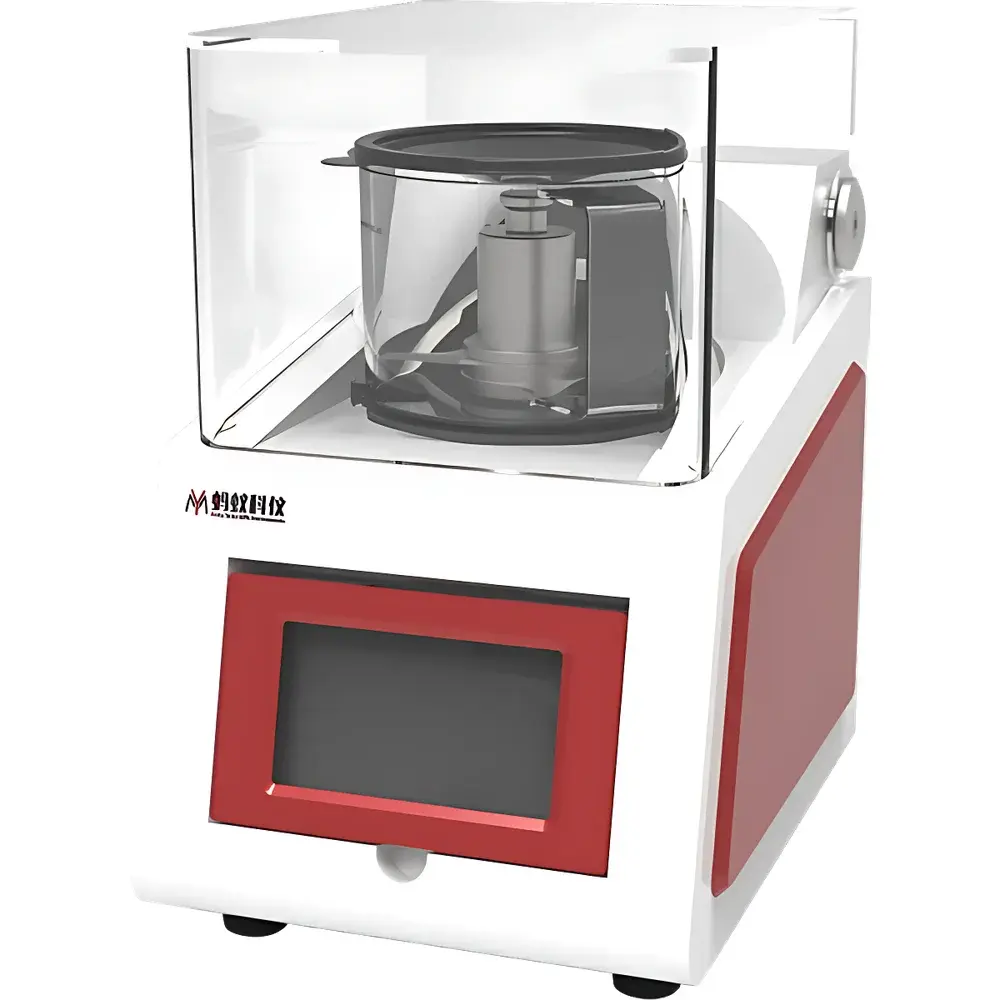
Ants Scientific Instruments AM600S Blade Grinder for Food and Agricultural Applications
| Brand | Ants Scientific Instruments |
|---|---|
| Origin | Beijing, China |
| Manufacturer Type | Authorized Distributor |
| Country of Origin | China |
| Model | AM600S |
| Instrument Type | Blade Grinder |
| Sample Compatibility | Soft, elastic, fibrous, semi-hard, high-moisture, high-oil, and high-fat samples |
| Feed Size | 10–50 mm |
| Output Particle Size | ~300 µm (range: 10–500 µm) |
| Batch Capacity | 1 L |
| Rotational Speed | 1,000–15,000 rpm (customizable) |
| Grinding Chamber Volume | 1 L |
| Chamber Materials | Stainless steel, polypropylene (PP), polycarbonate (PC) |
| Blade Types | Dual-edge stainless steel (standard & serrated), titanium option available |
| Blade Geometry | Two-blade asymmetric configuration (offset horizontal planes), incorporating both cutting and crushing surfaces |
| Operating Modes | Forward rotation, reverse rotation, intermittent, momentary (pulse), and linked parameter sequences |
| Time Setting Range | 1 s – 5 min (digital display) |
| Stored Protocols | 4 or 9 user-defined methods |
| Safety Features | Interlocked lid switch (instant stop on opening), mechanical safety lock |
| Sterilization Compatibility | All grinding assemblies autoclavable (121 °C, 2 bar, steam sterilization) |
| Environmental Operating Conditions | 0–40 °C, 20–70% RH, 220 V / 50 Hz |
Overview
The Ants Scientific Instruments AM600S Blade Grinder is an engineered solution for rapid, reproducible sample comminution and homogenization in food science, agricultural research, and quality control laboratories. It operates on the principle of high-shear mechanical attrition—utilizing a dynamically balanced, off-axis dual-blade rotor rotating at speeds up to 15,000 rpm within a sealed grinding chamber. This configuration generates controlled turbulent flow and localized shear gradients that simultaneously fracture, cut, and impact particulate matter, enabling consistent particle size reduction across heterogeneous biological matrices. Unlike planetary ball mills or cryogenic grinders, the AM600S delivers efficient processing without thermal degradation or cross-contamination risk when handling moisture- or lipid-rich specimens—including fresh fruits, leafy vegetables, muscle tissue, seafood, nuts, dried fruits, cereals, and oilseeds. Its design prioritizes operational robustness, regulatory traceability, and method reproducibility under routine laboratory conditions.
Key Features
- Asymmetric two-blade rotor with staggered horizontal positioning—featuring differentiated cutting (sharp) and crushing (blunt) surfaces for adaptable coarse and fine grinding outcomes
- Serrated stainless-steel blade variant optimized for high-fat, high-viscosity samples (e.g., avocado, cheese, oily seeds), minimizing agglomeration and improving dispersion uniformity
- Modular, plug-and-play grinding assemblies—including stainless steel, PP, and PC chambers—each fully autoclavable (121 °C, 2 bar, saturated steam) to meet GLP/GMP hygiene requirements
- Digital interface with high-resolution LCD display supporting time-programmed operation (1 s–5 min), multi-step protocol storage (4 or 9 presets), and synchronized parameter linking
- Multi-mode operation: forward/reverse rotation, pulse (momentary), intermittent cycling, and programmable sequence execution for method optimization
- Integrated safety architecture including lid-actuated electromagnetic brake, mechanical interlock, and real-time motor load monitoring to prevent overload or unbalanced operation
- Tool-free chamber mounting system enabling rapid assembly/disassembly and complete sample recovery—minimizing retention loss below 0.5% w/w
Sample Compatibility & Compliance
The AM600S accommodates diverse feedstock categories defined by physical state and compositional complexity: dry powders (e.g., grains, spices), hydrated tissues (e.g., tomato, lettuce), viscoelastic solids (e.g., cured meat, tofu), fibrous plant matter (e.g., stems, husks), and emulsion-prone materials (e.g., fish paste, nut butters). Its performance aligns with common analytical pre-treatment standards—including ASTM D5686 (grain particle size analysis), ISO 6497 (feed sampling and preparation), and AOAC 984.27 (food fat extraction protocols)—where representative sub-sampling and homogeneity are prerequisites. All wet-contact components comply with FDA 21 CFR §177.1520 (PP), §177.1550 (PC), and EN 10204:2004 Type 3.1 material certification for stainless steel (AISI 304/316). The instrument supports audit-ready workflows through timestamped parameter logging and user-accessible protocol archives.
Software & Data Management
While the AM600S operates via embedded firmware without external PC dependency, its digital control module records all executed parameters—including speed, duration, direction, mode, date/time stamp, and user ID (if enabled via optional access control)—into non-volatile memory. Data export is supported via USB-C interface (optional firmware upgrade), generating CSV-formatted logs compatible with LIMS integration and statistical process control (SPC) platforms. Protocol files adhere to ICH M7-compliant metadata tagging (sample ID, operator, instrument ID, calibration status) and support version-controlled revision history. Firmware updates maintain backward compatibility and include cybersecurity patches aligned with IEC 62443-4-2 requirements for laboratory-connected devices.
Applications
- Routine QC grinding of cereal grains prior to NIR spectroscopy or proximate analysis (moisture, protein, ash)
- Homogenization of composite food matrices for pesticide residue testing (e.g., QuEChERS extract preparation)
- Preparation of uniform test portions from heterogeneous agricultural commodities (e.g., blended fruit batches, mixed seed lots)
- Cell disruption and organelle release in plant tissue for metabolomic profiling or enzyme activity assays
- Particle size standardization in feed formulation R&D to assess digestibility and nutrient bioavailability
- Pre-analytical processing for DNA/RNA extraction from fatty or fibrous botanicals where bead-beating induces shearing artifacts
FAQ
What types of samples are unsuitable for the AM600S?
Samples with excessive hardness (e.g., bone fragments, mineralized shells, ceramic contaminants) or extreme viscosity (e.g., undiluted honey above 40 °C) may cause premature blade wear or motor stalling. Pre-screening or dilution is recommended.
Can the AM600S be used for cryogenic grinding?
No—the instrument is not rated for sub-zero ambient operation or liquid nitrogen exposure. For cryo-applications, dedicated cryo-grinders with refrigerated housings are advised.
Is validation documentation available for GxP environments?
Yes—IQ/OQ templates, calibration certificates for speed and timer accuracy, and material traceability dossiers are provided upon request for regulated labs.
How often should blades be replaced?
Under typical food QC usage (≤50 cycles/week), stainless-steel blades retain functional geometry for ≥1,200 grinding cycles; titanium variants extend service life by 3×. Visual inspection for edge deformation or micro-cracking is advised every 200 cycles.
Does the AM600S comply with electrical safety standards?
Yes—it conforms to IEC 61010-1:2010 (Ed. 3.0) for laboratory equipment, including protection against electric shock, mechanical hazards, and abnormal temperature rise, certified by CNAS-accredited third-party testing.



