
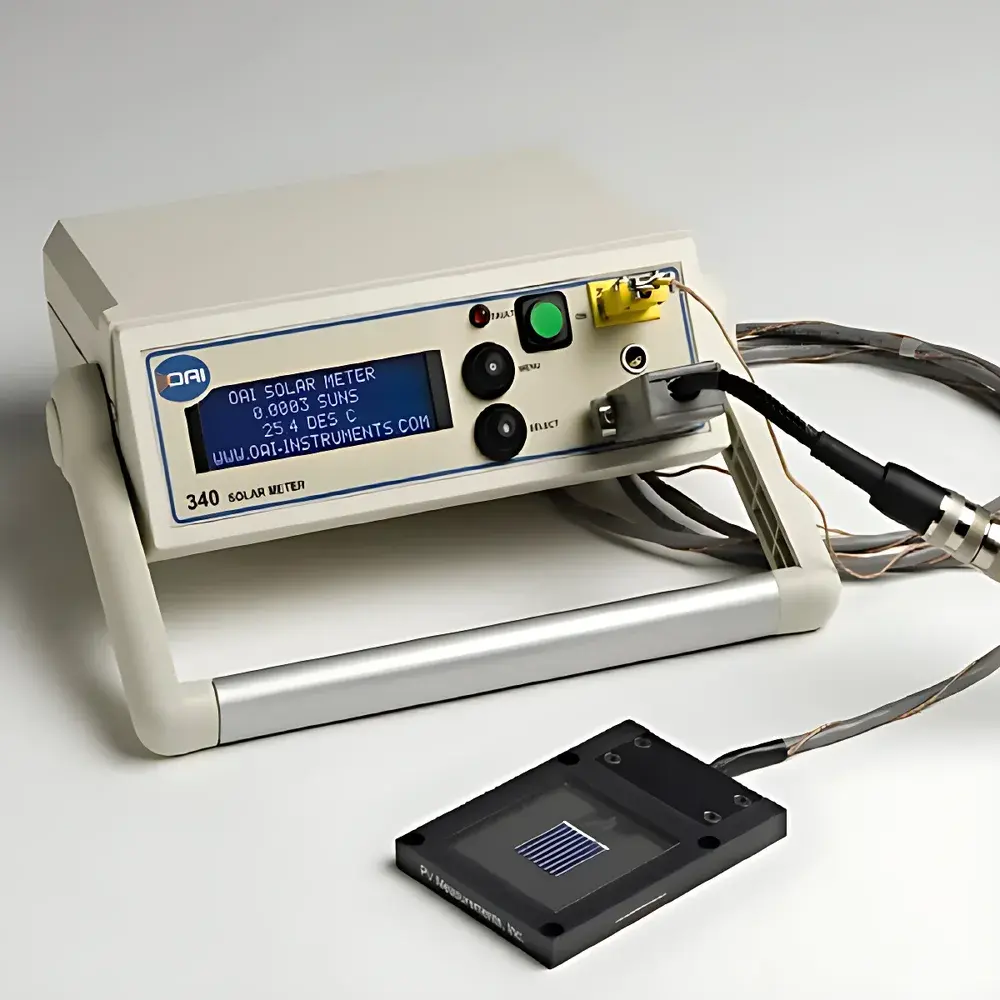
OAI TriSOL Solar Power Meter
| Brand | OAI |
|---|---|
| Origin | USA |
| Model | TriSOL Solar Power Meter |
| Measurement Unit | suns (1 sun = 1000 W/m² at AM1.5G, 25°C) |
| Calibration Traceability | NIST-accredited per ISO/IEC 17025, traceable to NREL |
| Reference Cell Standard | IEC 60904-2 |
| Temperature Input | Dual-channel — Type-K thermocouple & RTD (100 Ω Pt) |
| Data Interface | USB 2.0 |
| Power Supply | AC adapter or rechargeable Li-ion battery |
| Temperature Display | °C / °F selectable |
| Readout Modes | Continuous & peak-hold |
| Peak Averaging | User-configurable window |
| Compliance | GLP-compliant data logging, FDA 21 CFR Part 11–ready software architecture |
Overview
The OAI TriSOL Solar Power Meter is a precision irradiance measurement instrument engineered for calibration and performance validation of solar simulators used in photovoltaic (PV) device testing, R&D, and quality assurance laboratories. It operates on the principle of calibrated reference cell photometry—measuring spectral-weighted irradiance in standardized “suns” units, where 1 sun corresponds to 1000 W/m² under AM1.5G spectrum at 25°C. Unlike generic radiometers, the TriSOL integrates a certified reference photovoltaic cell as its primary sensor, ensuring spectrally matched response to real PV devices. This enables direct correlation between irradiance reading and expected short-circuit current (Isc) in test cells—critical for accurate I-V curve characterization and efficiency reporting per IEC 61215, IEC 60904-1, and ASTM E927 standards.
Key Features
- Integrated NIST-traceable reference cell compliant with IEC 60904-2, assembled with spectrally selective window and temperature-compensated design
- Dual independent thermal input channels supporting both Type-K thermocouples and 100 Ω platinum RTDs for simultaneous cell and ambient temperature monitoring
- Real-time display of reference cell metadata—including cell type (e.g., Si, GaAs), active area, window material (e.g., BK7, fused silica), and thermal sensor configuration
- USB 2.0 interface enabling high-fidelity data acquisition and synchronization with I-V testers or automated test platforms
- Configurable peak-hold mode with user-defined averaging window for transient irradiance assessment during flash or pulsed simulator operation
- Flexible power architecture: operable via universal AC adapter or field-deployable rechargeable lithium-ion battery pack
- On-device temperature readout in °C or °F with ±0.5°C accuracy over 0–70°C range
Sample Compatibility & Compliance
The TriSOL Solar Power Meter is compatible with all Class AAA, AA, and A solar simulators per IEC 60904-9. Its reference cell is pre-calibrated for AM1.5G, AM0, and custom spectral conditions; additional reference cells (e.g., for multi-junction or perovskite applications) may be loaded without system recalibration. All calibration certificates are issued by an ISO/IEC 17025-accredited laboratory and traceable to NREL’s primary standard reference cells. The instrument supports GLP and GMP workflows through audit-ready data logging, timestamped measurement records, and secure user-access controls in its desktop software environment.
Software & Data Management
The TriSOL Desktop Application provides full control over measurement parameters, real-time graphing, and export of time-stamped irradiance and temperature datasets in CSV and Excel-compatible formats. It implements electronic signature capability and audit trail functionality aligned with FDA 21 CFR Part 11 requirements. Raw data files include embedded metadata—cell serial number, calibration date, spectral mismatch correction factor, and thermal sensor ID—ensuring full traceability across laboratory information management systems (LIMS). Batch export and report generation templates support routine QA documentation per ISO 17025 clause 7.8.
Applications
- Calibration and verification of continuous-wave and pulsed solar simulators in PV module and cell manufacturing facilities
- Validation of spectral match, spatial uniformity, and temporal stability per IEC 60904-9 Annexes A–C
- In-situ temperature-corrected irradiance normalization during I-V curve tracing and maximum power point tracking (MPPT)
- Reference cell qualification and inter-laboratory comparison studies under IEA-PVPS Task 12 protocols
- Field deployment for outdoor solar simulator commissioning and aging test chamber monitoring
- Education and training labs requiring metrologically sound, standards-aligned irradiance instrumentation
FAQ
What does “1 sun” mean, and how is it defined?
1 sun is defined as 1000 W/m² total irradiance under the AM1.5G reference spectrum at 25°C cell temperature, as specified in IEC 60904-3. The TriSOL reports irradiance directly in suns, eliminating unit conversion errors.
Can I use my own reference cell with the TriSOL meter?
Yes—the TriSOL supports user-loaded reference cells provided they comply with IEC 60904-2 mechanical and electrical interface specifications. Each cell requires individual calibration coefficient entry in software.
Is the TriSOL suitable for pulsed solar simulator measurement?
Yes. Its peak-hold mode captures maximum irradiance within configurable time windows (10 ms to 10 s), making it suitable for flash-type simulators when used with appropriate triggering synchronization.
How often does the reference cell require recalibration?
Annual recalibration is recommended per ISO/IEC 17025 guidelines. OAI offers factory recalibration services with NIST-traceable certificates and uncertainty budgets.
Does the TriSOL meet regulatory requirements for accredited testing labs?
Yes. Its hardware design, software architecture, and documentation package support compliance with ISO/IEC 17025, IEC 61215, UL 1703, and FDA 21 CFR Part 11 for regulated PV certification environments.
Related Products







