JFP MPT Manual Pull Tester
| Brand | JFP |
|---|---|
| Origin | France |
| Type | Manual Pull Testing System for Wire Bond Strength Evaluation |
| Measurement Principle | Mechanical Force Transduction via Precision Dial Gauge |
| Test Modes | Destructive and Non-Destructive Pull Testing |
| Vertical Travel Range | 10–150 mm (Coarse) + Micrometer-Driven Fine Adjustment (0.1 mm resolution) |
| Hook Tip Diameter | 15–50 µm |
| Max Test Wire/Die Bond Diameter | 200 µm |
| Z-Axis Control | Manual Handwheel |
| Damping Mechanism | Adjustable Mechanical Damping to Suppress Vibration Artifacts |
| Preset Force Threshold | User-Adjustable for Non-Destructive Mode |
| Compliance | Designed to Support ISO/IEC 17025 Traceability Requirements (Manual Recording Pathway) |
| Optional Accessories | High-Precision XYZ+Theta Stage (25 × 25 mm travel, 1 µm resolution |
Overview
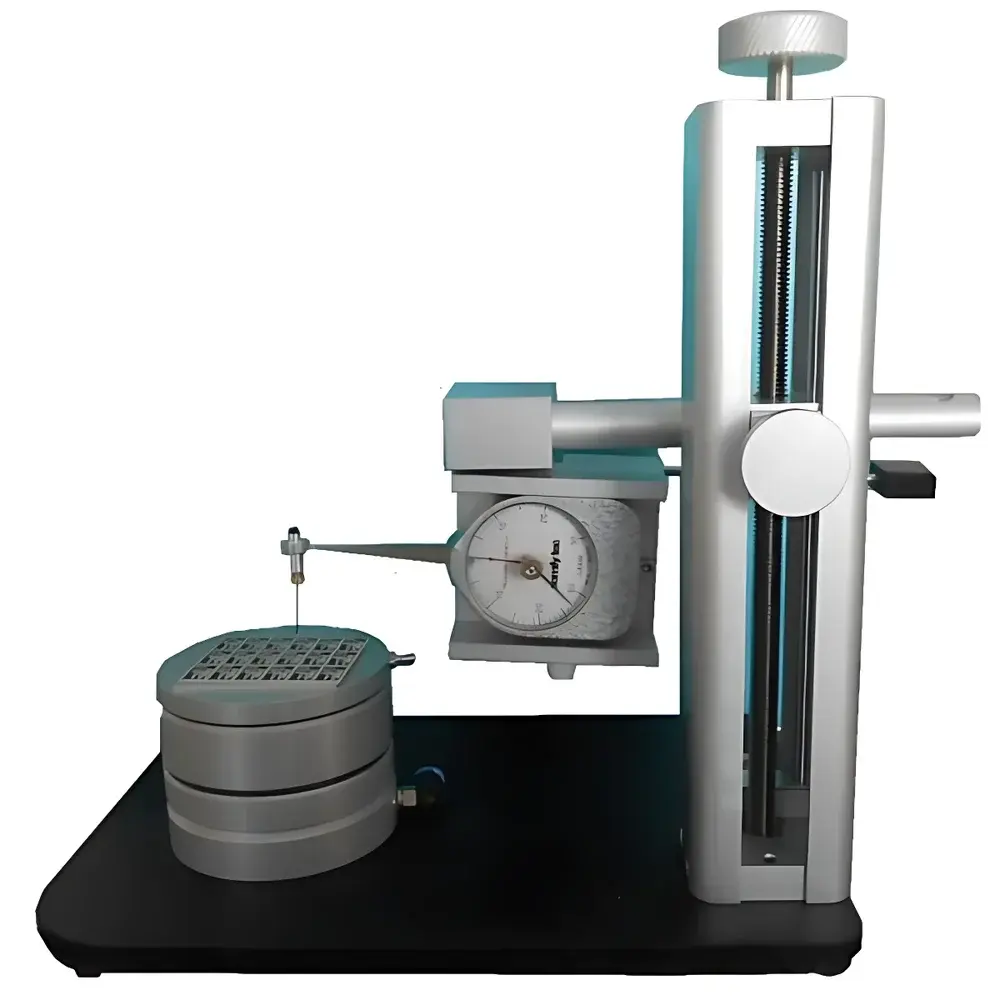
The JFP MPT Manual Pull Tester is a compact, benchtop mechanical force measurement system engineered for quantitative evaluation of wire bond and die attach integrity in semiconductor packaging and microelectronics assembly processes. It operates on the principle of calibrated mechanical transduction—applying controlled tensile load via a precision-machined hook assembly while measuring displacement and peak force through a high-stability analog dial indicator. Unlike motorized or servo-controlled testers, the MPT relies on manual actuation with deliberate operator control over loading rate and endpoint detection—making it particularly suited for low-volume R&D labs, failure analysis (FA) workflows, and process qualification where deterministic, repeatable manual intervention is preferred over automated sequences. Its dual-mode capability—supporting both destructive pull-to-failure and non-destructive threshold-limited testing—enables correlation between bond strength and functional reliability without compromising sample integrity during screening.
Key Features
- Integrated dual-mode testing: Switch seamlessly between destructive pull-to-failure and pre-set non-destructive pull verification using adjustable mechanical stop limits.
- High-resolution vertical positioning: Coarse travel range of 10–150 mm enables rapid setup across diverse package heights; fine adjustment via knurled micrometer wheel delivers 0.1 mm repeatability for precise hook alignment.
- Micro-hook compatibility: Interchangeable fine-tip hooks with diameters optimized for 15–50 µm gold/aluminum wires; optional heavy-duty hooks support up to 200 µm diameter leads or solder bump shear assessment.
- Vibration-damped mechanical architecture: Built-in damping mechanism suppresses transient oscillations during load application—critical for stable peak-force capture in manual operation.
- Z-axis manual handwheel control: Ergonomic, backlash-free drive ensures consistent loading velocity and tactile feedback during critical bond rupture events.
- ISO/IEC 17025-aligned documentation pathway: Designed for integration into accredited lab quality systems—supports traceable manual data recording with defined operator signature fields, test date/time stamps, and specimen ID logging.
Sample Compatibility & Compliance
The MPT accommodates a broad spectrum of semiconductor interconnect geometries—including wedge/wedge, ball/wedge, and ribbon bonds—across QFN, SOIC, BGA, and custom leadframe packages. Its open-frame design permits direct access to bond sites under optical inspection. While not an automated data-acquisition instrument, the system’s mechanical stability, calibrated force transmission path, and consistent hook geometry meet foundational metrological requirements outlined in JEDEC JESD22-B116 (Wire Bond Pull Test Standard) and IPC-9701A (Performance Test Methods for SMT Interconnects). When operated within documented SOPs—including environmental controls (23 ± 2°C, 45–55% RH), periodic dial gauge calibration per ISO 9001 procedures, and operator certification—the MPT supports GLP-compliant bond strength trending and internal process capability studies (Cpk analysis).
Software & Data Management
The JFP MPT is a hardware-only platform with no embedded firmware or digital interface. All measurements are recorded manually from the analog dial gauge (typically graduated in grams-force or centinewtons), requiring external documentation in laboratory notebooks or LIMS-integrated spreadsheets. To satisfy audit readiness under ISO/IEC 17025 Clause 7.5.2 (Technical Records), users are advised to implement standardized templates capturing: specimen ID, bond type/location, hook specification, applied force value, failure mode (e.g., “ball lift”, “heel crack”, “pad cratering”), and operator initials. Optional accessories—including the XYZ+Theta precision stage and SMZ-168 stereo microscope—enhance positional repeatability and visual verification but do not introduce digital data streams. For labs requiring electronic records, third-party USB-digital calipers or force sensor upgrades may be integrated externally, though such modifications fall outside JFP’s certified configuration scope.
Applications
- Qualification of new wire bonding parameters (power, time, force, ultrasonic energy) during NPI ramp-up.
- Root cause analysis of bond lift-offs observed in thermal cycling or humidity testing.
- Comparative strength assessment across different wire materials (Au, Al, Cu) and plating conditions.
- Validation of adhesive cure profiles in die-attach processes involving conductive epoxies or solder preforms.
- Teaching and training modules for semiconductor packaging technicians—emphasizing hands-on understanding of bond mechanics and failure morphology.
- Pre-shipment sampling for high-reliability aerospace or medical device assemblies where statistical process control mandates manual verification protocols.
FAQ
Does the MPT provide digital output or USB connectivity?
No—the MPT is a purely mechanical analog instrument. Force values must be read visually from the dial gauge and transcribed manually.
Is calibration certification included with purchase?
JFP supplies a factory calibration report traceable to national standards (COFRAC-accredited lab in France); annual recalibration is recommended per ISO/IEC 17025 requirements.
Can the MPT perform shear testing?
No—it is configured exclusively for tensile pull testing; dedicated shear testers (e.g., Dage 4000 series) are required for lateral bond strength evaluation.
What maintenance is required?
Monthly cleaning of the vertical guide rails with lint-free cloth and light machine oil; biannual inspection of dial gauge zero stability and hook tip wear under microscope.
Is operator training available?
Yes—JFP offers on-site or virtual training covering JEDEC-compliant test execution, failure mode recognition, and record-keeping best practices aligned with ISO/IEC 17025 Clause 7.7.