
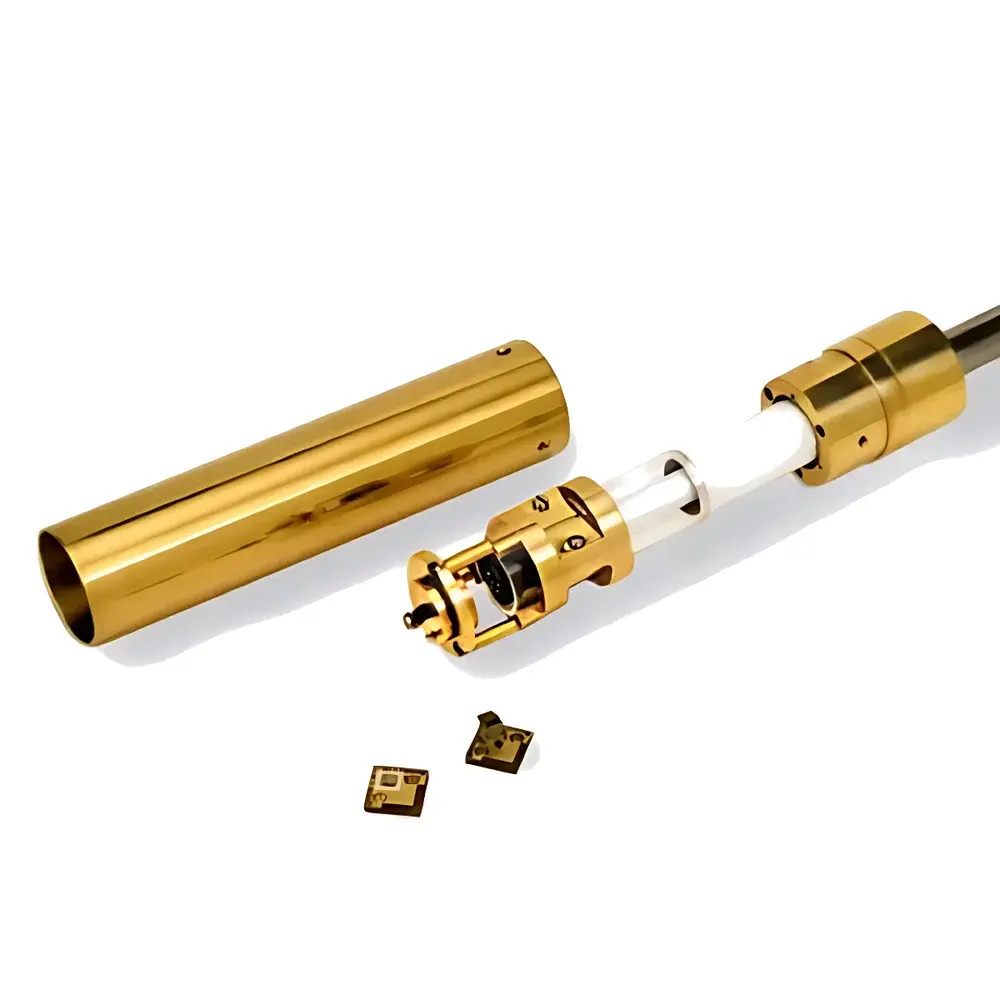
NanoMagnetics LT-SHPM/STM Low-Temperature Scanning Hall Probe and Tunneling Microscope
| Brand | NanoMagnetics |
|---|---|
| Origin | United Kingdom |
| Manufacturer Type | Authorized Distributor |
| Origin Category | Imported |
| Model | LT-SHPM/STM |
| Pricing | Available Upon Request |
| Temperature Range | 10 mK – 400 K |
| Magnetic Field Range | Up to 20 T |
| Spatial Resolution (Z) | 50–800 nm (stick-slip approach) |
| Scan Range (XY) | Ø3 mm |
| Z-Travel | 10 mm |
| Sample Dimensions | Max. 15 × 15 × 5 mm |
| Magnetic Noise Floor | 10 µT/√Hz @ 300 K, 100 nT/√Hz @ 77 K, 10 nT/√Hz @ 4 K |
| Compatibility | PPMS®, dry magnet systems, dilution refrigerators (DRs), He-3 cryostats |
| Optional Module | 3D-SHPM for vectorial magnetic field mapping |
Overview
The NanoMagnetics LT-SHPM/STM is a dual-mode, ultra-low-temperature scanning probe instrument engineered for quantitative nanoscale magnetic characterization under precisely controlled cryogenic and high-field conditions. It integrates two complementary operational modes: Scanning Hall Probe Microscopy (SHPM) and Scanning Tunneling Microscopy (STM), both operating within a shared mechanical and thermal architecture. The system leverages the quantum-limited sensitivity of miniaturized Hall sensors—fabricated from high-mobility 2DEG GaAs/AlGaAs heterostructures—to detect local magnetic induction with sub-10 nT/√Hz noise performance at base temperature (≤4 K). In SHPM mode, it measures Bz (perpendicular component) or full 3D vector fields (with optional 3D-SHPM head) via angularly resolved raster scanning. In STM mode, it provides atomic-resolution topographic imaging and local electronic density-of-states mapping on conductive surfaces. Designed for integration with industry-standard cryogenic platforms—including Quantum Design PPMS®, BlueFors dilution refrigerators, and custom He-3 or dry magnet systems—the LT-SHPM/STM enables correlative structural, electronic, and magnetic measurements across a continuous temperature range from 10 mK to 400 K and magnetic fields up to 20 T.
Key Features
- Dual-mode operation: Simultaneous or sequential SHPM and STM functionality within one vacuum-compatible, vibration-isolated probe head
- Ultra-low magnetic noise floor: 10 nT/√Hz at 4 K, enabling detection of weak stray fields from skyrmions, vortices, or domain walls in low-dimensional magnets
- Quantitative vector field mapping: Optional 3D-SHPM module delivers calibrated Bx, By, and Bz components with <1° angular resolution at 77 K (LN2) and below
- Wide thermal envelope: Fully functional from millikelvin (10 mK) to 400 K, supporting phase-transition studies, thermal hysteresis analysis, and Curie/Néel temperature mapping
- Modular cryostat interface: Standard flange-mount design compatible with PPMS® 9 T/16 T inserts, Oxford Instruments Teslatron PT, and custom DR/He-3 systems
- Precision sample positioning: Stick-slip piezo actuator with 10 mm Z-range and Ø3 mm XY scan area; step resolution adjustable between 50 nm and 800 nm
- Sample handling: Accommodates specimens up to 15 × 15 × 5 mm; includes in-situ tip exchange and alignment capability
Sample Compatibility & Compliance
The LT-SHPM/STM supports a broad class of solid-state magnetic and quantum materials, including thin-film heterostructures (e.g., Co/Pt multilayers), van der Waals magnets (CrI3, Fe3GeTe2), superconductors (NbSe2, FeTe), topological insulators (Bi2Se3), and spintronic devices. Its non-invasive SHPM mode preserves sample integrity without requiring electrical contact or surface metallization—critical for air-sensitive or insulating specimens. All control firmware and data acquisition modules comply with ISO/IEC 17025 traceability requirements for metrological instruments. The system’s software architecture supports audit trails and user access logs aligned with GLP and FDA 21 CFR Part 11 principles for regulated R&D environments. Calibration protocols follow ASTM E2525 (Standard Guide for Magnetic Force Microscopy) and IEC 60404-14 (Magnetic materials — Part 14: Methods of measurement of magnetic properties of magnetic thin films).
Software & Data Management
Control and analysis are executed via NanoMagnetics’ proprietary CryoScan™ software suite, built on a deterministic real-time Linux kernel (PREEMPT_RT) to ensure sub-millisecond timing synchronization between scanner motion, field ramping, and sensor readout. The software provides synchronized multi-channel acquisition (topography, Bz, dI/dV, differential conductance), automated B-H loop extraction at user-defined locations, and batch-processing pipelines for large-area magnetic mosaic stitching. Raw data are stored in HDF5 format with embedded metadata (temperature, field, time stamp, calibration coefficients) to ensure FAIR (Findable, Accessible, Interoperable, Reusable) compliance. Export options include ASCII, TIFF, and MTEX-compatible ODF files for crystallographic texture correlation. Remote monitoring and scripting support Python API (pyCryoScan) and MATLAB Instrument Control Toolbox interfaces.
Applications
- Imaging magnetic domain structure and dynamics in ferromagnetic, antiferromagnetic, and ferrimagnetic thin films under variable T and H
- Quantifying vortex lattice symmetry and pinning behavior in type-II superconductors
- Mapping stray fields from skyrmion lattices and chiral domain walls in Dzyaloshinskii-Moriya interaction (DMI)-driven systems
- Correlating local electronic structure (via STM dI/dV mapping) with nanoscale magnetic contrast (via SHPM) in heterostructured oxides
- Validating micromagnetic simulations by extracting quantitative exchange stiffness and anisotropy parameters from experimental B-H loops
- Characterizing write-head field profiles and bit-pattern fidelity in next-generation heat-assisted magnetic recording (HAMR) media
FAQ
What cryogenic systems is the LT-SHPM/STM certified to interface with?
The system ships with standard CF-100 and CF-63 flange kits for direct integration with Quantum Design PPMS® platforms, BlueFors LD/DR series, Leiden Cryogenics CF-1000, and custom-built He-3 or dry magnet cryostats.
Can the 3D-SHPM option be retrofitted to an existing LT-SHPM/STM installation?
Yes—3D-SHPM is offered as a field-upgradeable module, requiring only mechanical reconfiguration of the probe head and firmware update; no vacuum break is necessary.
Is STM mode operational at all temperatures within the 10 mK–400 K range?
STM is fully functional from 4 K to 300 K; below 4 K, thermal drift and quantum tunneling constraints may require optimized tip-sample bias and feedback gain settings—detailed in the CryoScan™ Operator Manual.
How is magnetic field calibration performed?
Calibration uses NIST-traceable Helmholtz coils and reference samples (e.g., NiFe thin films with known coercivity) across three field ranges: low-field (±10 mT), medium-field (±1 T), and high-field (up to 20 T), with linearity verified per ISO 10012.
Does the system support in-situ magnetic field sweeps during scanning?
Yes—field-ramped SHPM/STM imaging is supported at rates up to 100 mT/s, with synchronized data capture at user-defined field steps and dwell times.




