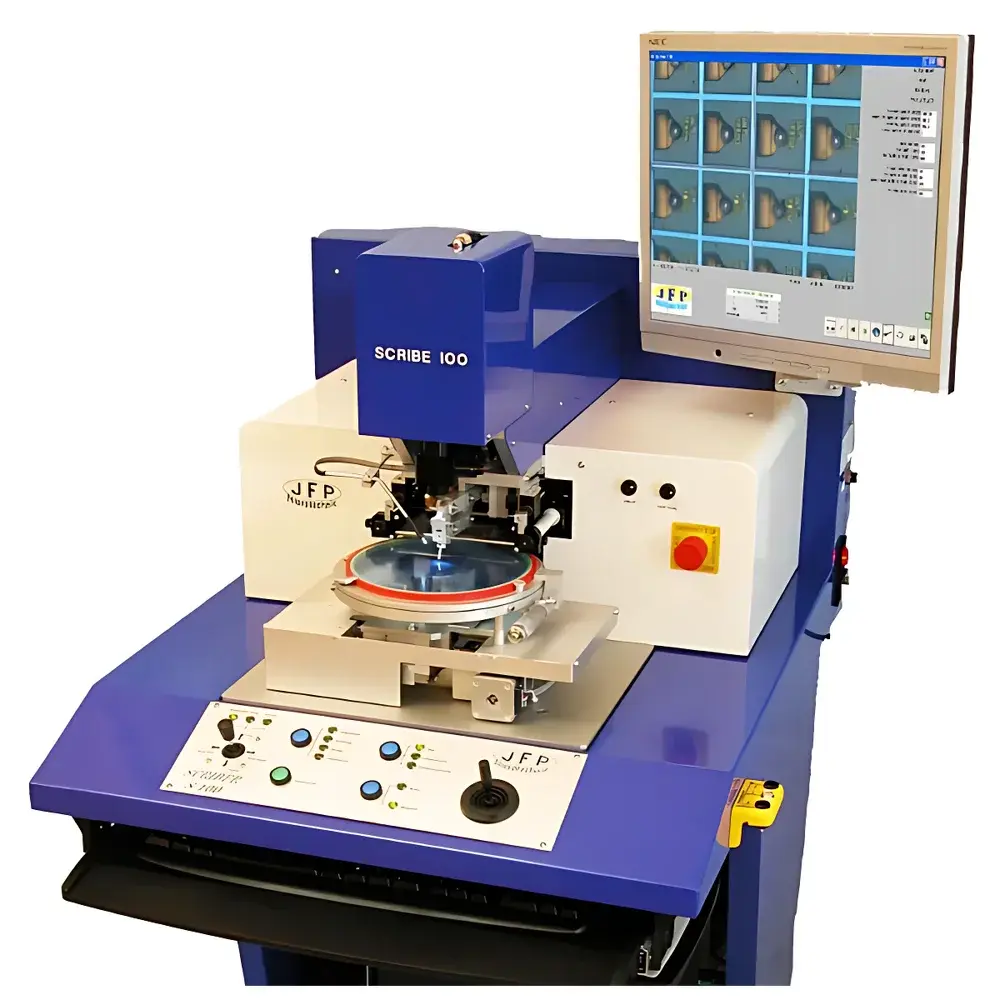
JFP S100 Semi-Automatic Scribe & Break System
| Brand | JFP |
|---|---|
| Origin | France |
| Model | S100 Semi-Automatic Scribe & Break System |
| Scribing force range | 10–80 g (constant-weight mechanism, optional auxiliary weights) |
| Diamond scribe tip | adjustable angle and rotational orientation |
| Wafer chuck capacity | up to 4-inch diameter |
| Die size compatibility | 100 µm × 100 µm minimum to 10 mm × 10 mm maximum |
| Wafer thickness tolerance | ≥50 µm |
| XY stage resolution | 0.23 µm |
| Optical imaging system | 22″ TFT display + ultra-HD color camera |
| Digital zoom | ×10 electronic |
| Break mode | manual or programmable auto-actuation |
| Break mechanism | top rubber clamping + bottom linear blade actuation |
| Control interface | 7″ capacitive touchscreen |
| Y-axis scribing speed | 0.1–20 mm/s |
| Power supply | 100/230 VAC, 1 kW |
| Pneumatic supply | 70 psi |
| Vacuum requirement | full vacuum (100%), 15 L/min flow rate |
| Dimensions (W×D×H) | 650 × 820 × 1500 mm (25 × 32 × 60 in) |
| Weight | 70 kg |
Overview
The JFP S100 Semi-Automatic Scribe & Break System is an engineered solution for controlled dicing of brittle semiconductor substrates—including silicon, gallium arsenide (GaAs), silicon carbide (SiC), and other compound wafers—where mechanical sawing introduces unacceptable chipping, thermal stress, or contamination. Unlike rotary dicing saws that rely on abrasive cutting, the S100 implements a two-stage process: precision scribing followed by controlled fracture along crystallographic planes. This method preserves edge integrity, minimizes subsurface damage, and eliminates coolant residue—critical for MEMS, RF devices, optoelectronics, and high-reliability IC packaging workflows. The system operates on a rigid granite base with vibration-damped isolation, ensuring micron-level repeatability during both scribing and break stages. Its design prioritizes operator safety, process traceability, and compatibility with cleanroom Class 1000 environments.
Key Features
- Micron-Resolved Motion Control: High-resolution XY translation stage (0.23 µm step resolution) enables precise alignment of scribe lines relative to fiducials or device features—even for sub-200 µm die geometries.
- Programmable Scribing Parameters: Adjustable scribing force (10–80 g), Y-axis speed (0.1–20 mm/s), touch-down velocity, scribe length, and repeat count—all stored per recipe and accessible via intuitive 7″ touchscreen interface.
- Optical Alignment Suite: Integrated ultra-HD color camera, ×10 electronic zoom, coaxial LED illumination, and crosshair-reticle scribe tip visualization support both manual alignment and region-based automated positioning.
- Controlled Fracture Architecture: Dual-mode break station employs top-mounted elastomeric clamping and bottom-actuated linear blade to induce clean, low-stress cleavage without lateral shear forces—preserving die sidewall morphology and reducing microcrack propagation.
- Wafer Handling Flexibility: Vacuum chuck accommodates wafers up to 4 inches (100 mm) in diameter; supports thicknesses ≥50 µm; includes manual 90° rotation and micrometer-driven angular fine-tuning for off-axis scribe patterns.
- Robust Mechanical Design: All critical axes utilize hardened steel guideways and backlash-free drive mechanisms; Z-axis tilt adjustment allows optimization of scribe angle for anisotropic materials.
Sample Compatibility & Compliance
The S100 is validated for use with standard semiconductor wafers processed under JEDEC and SEMI standards. It accommodates bare and tape-mounted dies, including those on UV-curable or thermal-release dicing tapes. Minimum die size (100 µm × 100 µm) meets requirements for advanced photonics and power module fabrication. The system complies with CE Machinery Directive 2006/42/EC and conforms to ISO 14001 environmental management principles. Vacuum and pneumatic interfaces meet ISO 8573-1 Class 3 purity specifications. While not FDA-certified as a medical device, its non-contact scribing and particle-minimized break mechanism align with ISO 13485 clean manufacturing prerequisites where applicable.
Software & Data Management
The embedded control firmware supports recipe-based operation with full parameter logging—including scribe position, force, speed, break cycle count, and timestamped die ID entries. All operational data are exportable via USB 2.0 to CSV or XML formats for integration into MES or QMS platforms (e.g., Siemens Opcenter, Rockwell FactoryTalk). Audit trails record user login, parameter changes, and emergency stop events—supporting GLP/GMP-aligned documentation practices. The system does not require external PC connectivity for routine operation but offers optional Ethernet port for remote diagnostics and firmware updates.
Applications
- Dicing of GaAs and InP wafers for laser diode and photodetector arrays
- Low-damage separation of SiC power devices prior to packaging
- Prototyping and low-volume production of MEMS sensors requiring intact edge profiles
- Back-grinding compatible scribing for thin-wafer (<100 µm) handling
- Research-grade cleaving of 2D material heterostructures (e.g., graphene/h-BN stacks) mounted on temporary carriers
- Repair and rework of partially diced wafers where localized scribe revision is required
FAQ
Is the S100 compatible with tape-mounted wafers?
Yes—the vacuum chuck supports standard dicing tapes (UV-curable, thermal-release, and blue film) with appropriate backing plate configurations. Tape tension and adhesion stability are verified during initial setup.
Can the system be integrated into an automated production line?
The S100 is semi-automatic by design and lacks robotic I/O ports or SECS/GEM protocol support. However, its recipe-driven operation and data export capability enable supervised integration into batch-oriented assembly cells.
What diamond scribe tip geometries are supported?
Standard configuration includes a 30° included-angle V-groove tip. Optional tips (15°, 45°, and chisel profiles) are available as accessories, each calibrated for force compensation and optical alignment offset.
Does the system require compressed air with oil filtration?
Yes—70 psi supply must meet ISO 8573-1 Class 3 (oil content ≤ 0.1 mg/m³, particle size ≤ 1 µm) to prevent valve clogging and ensure long-term pneumatic cylinder reliability.
Is training provided with purchase?
JFP delivers on-site commissioning and operator certification covering mechanical alignment, recipe creation, vacuum/pneumatic validation, and preventive maintenance procedures—typically completed within one business day.