
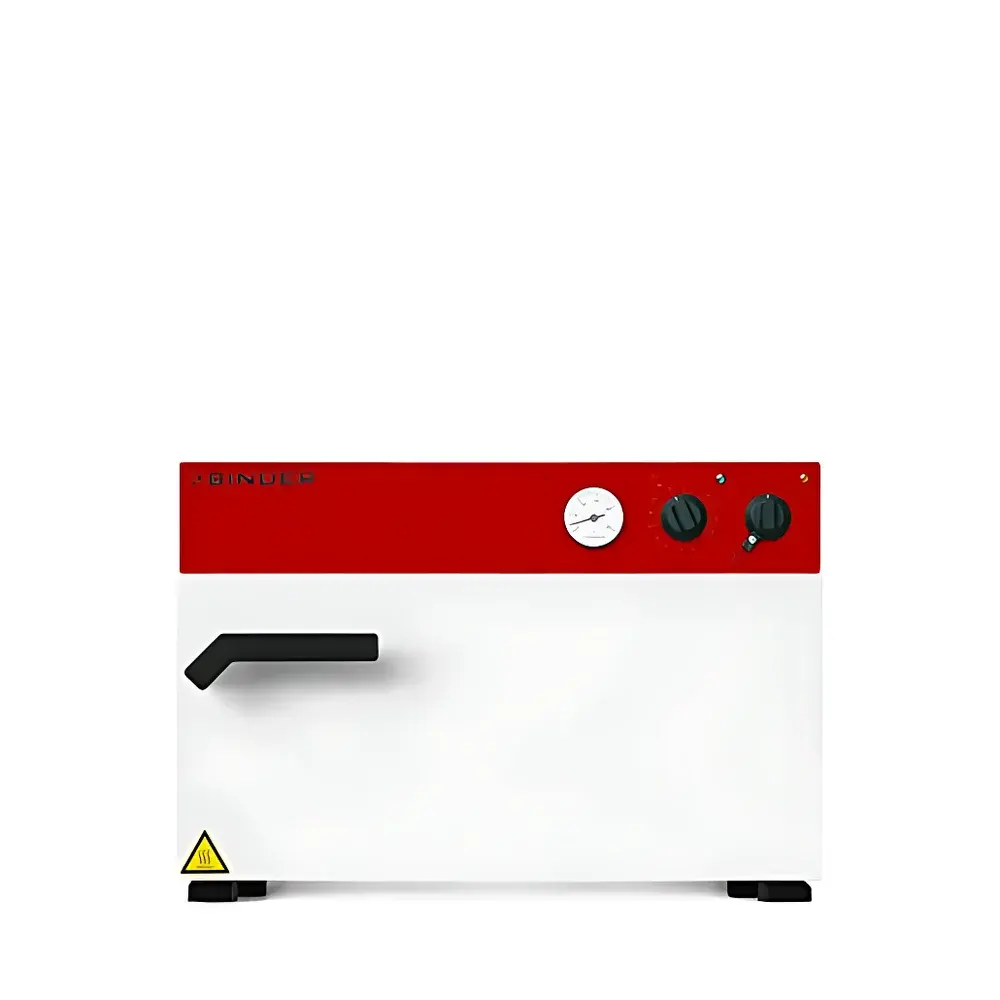
BINDER E28 Classic.Line Drying Oven
| Brand | BINDER |
|---|---|
| Origin | Germany |
| Model | E28 |
| Instrument Type | Standard Drying Oven |
| Temperature Range | 60 °C to 230 °C |
| Temperature Uniformity | ±0.5 °C (at 150 °C, steady state) |
| External Dimensions (W×H×D) | 580 × 405 × 425 mm |
| Internal Chamber Dimensions (W×H×D) | 400 × 280 × 250 mm |
| Internal Volume | 28 L |
| Net Weight (empty) | 22 kg |
| Max. Load Capacity | 25 kg |
| Max. Load per Shelf | 10 kg |
| Heating Method | Forced Air (Natural Convection with Fan-Assisted Preheating via APT.line™) |
| Recovery Time after 30-sec Door Opening (at 150 °C) | ≤19 min |
| Heating Time to 150 °C | ≤36 min |
| Rated Power | 0.8 kW (120 V / 230 V) |
| Shelves Supplied | 2 chrome-plated adjustable shelves |
| Timer Range | 0–120 min |
| Safety Device | Temperature Safety Controller Class 1 (DIN 12880) |
| Exhaust Valve | Adjustable mechanical damper |
Overview
The BINDER E28 Classic.Line Drying Oven is a precision-engineered, entry-level forced-air drying and heating system designed for reproducible thermal processing in academic, clinical, and industrial laboratory environments. Built in Tuttlingen, Germany, the E28 adheres to stringent DIN EN 61010-1 safety standards and leverages BINDER’s proprietary APT.line™ preheating chamber technology—a thermally insulated jacket surrounding the main chamber that maintains uniform air temperature distribution across the entire 28 L internal volume. Unlike conventional natural-convection ovens, the E28 uses gentle fan-assisted air circulation within a thermally decoupled chamber architecture to minimize thermal gradients, ensuring consistent drying kinetics and residue-free heat treatment of samples regardless of load configuration or shelf placement. Its operational envelope—60 °C to 230 °C—is optimized for moisture removal, polymer curing, glassware sterilization (non-critical), gravimetric analysis preparation, and pre-conditioning of pharmaceutical excipients under non-GMP research settings.
Key Features
- APT.line™ preheating chamber ensures temperature uniformity of ±0.5 °C at 150 °C (measured per DIN 12880), independent of sample mass or spatial arrangement
- Robust double-walled stainless steel inner chamber with seamless welding and rounded corners for easy cleaning and contamination control
- Adjustable mechanical exhaust valve enables fine-tuned vapor evacuation during moisture-sensitive drying protocols
- Class 1 temperature safety controller (DIN 12880 compliant) provides independent overtemperature protection with manual reset
- Dual-range mechanical thermostat with precise 1 °C resolution and integrated 0–120 minute mechanical timer
- Two height-adjustable, chrome-plated wire shelves (max. 10 kg each); optional third/fourth shelf available as accessory
- Energy-efficient insulation (min. 60 mm mineral wool) reduces standby heat loss and supports sustainable lab operations
Sample Compatibility & Compliance
The E28 accommodates standard laboratory ware including Petri dishes, weighing boats, beakers (up to 500 mL), glass desiccators, and aluminum sample pans. It is routinely deployed in ISO/IEC 17025-accredited testing labs for sample conditioning prior to elemental analysis (e.g., ASTM D240, ISO 1171), residual solvent determination, and moisture content validation (AOAC 950.46). While not certified for sterile processing or FDA 21 CFR Part 11-compliant data integrity, its mechanical controls and traceable thermal performance support GLP-aligned documentation when paired with external calibrated data loggers (e.g., compliant with ISO 17025 clause 6.4.10). The device carries CE marking, complies with EMC Directive 2014/30/EU, and meets RoHS 2011/65/EU material restrictions.
Software & Data Management
The E28 operates exclusively via analog controls—no embedded microprocessor, no digital interface, and no native data export capability. This design prioritizes operational simplicity, long-term reliability, and immunity to firmware obsolescence or cybersecurity vulnerabilities. Users record process parameters manually or integrate third-party USB/Bluetooth temperature loggers (e.g., Testo 176 T4) placed inside the chamber for time-stamped thermal profiling. All calibration and maintenance records—including periodic verification of temperature uniformity and recovery time—must be retained per institutional GLP or internal quality management requirements. No software license, cloud service, or driver installation is required or supported.
Applications
- Drying biological tissues, filter papers, and chromatography media prior to gravimetric quantification
- Curing epoxy resins, powder coatings, and ceramic precursors in materials science workflows
- Conditioning reference standards and volumetric glassware per USP drying specifications
- Accelerated stability testing of veterinary drug formulations (non-clinical phase)
- Pre-heating metal components before tensile testing or coating adhesion assessment
- Moisture equilibration of hygroscopic reagents (e.g., anhydrous salts, silica gels) in analytical chemistry prep
FAQ
Is the E28 suitable for sterilization of surgical instruments?
No. The E28 is not validated for microbiological sterilization; it lacks the temperature uniformity certification (EN 285), steam generation, or vacuum capability required for medical device sterilization.
Can I upgrade the E28 with a digital controller or data logging port?
No. The Classic.Line series features fixed analog electronics; no retrofit kits or OEM digital modules are offered by BINDER for this model.
What is the recommended recalibration interval for routine use?
BINDER recommends annual verification of temperature uniformity and recovery time using NIST-traceable probes, aligned with ISO/IEC 17025 clause 6.4.11 for equipment monitoring.
Does the E28 meet UL or CSA safety standards for North American laboratories?
Yes—the 120 V version is listed to UL 61010-1 and CAN/CSA C22.2 No. 61010-1, with full certification documentation available upon request from authorized distributors.
How does APT.line™ differ from standard forced convection?
APT.line™ isolates the heating circuit in a peripheral jacket, preheating incoming air before it enters the working chamber—reducing cold air ingress during door openings and minimizing thermal shock to sensitive samples.



