
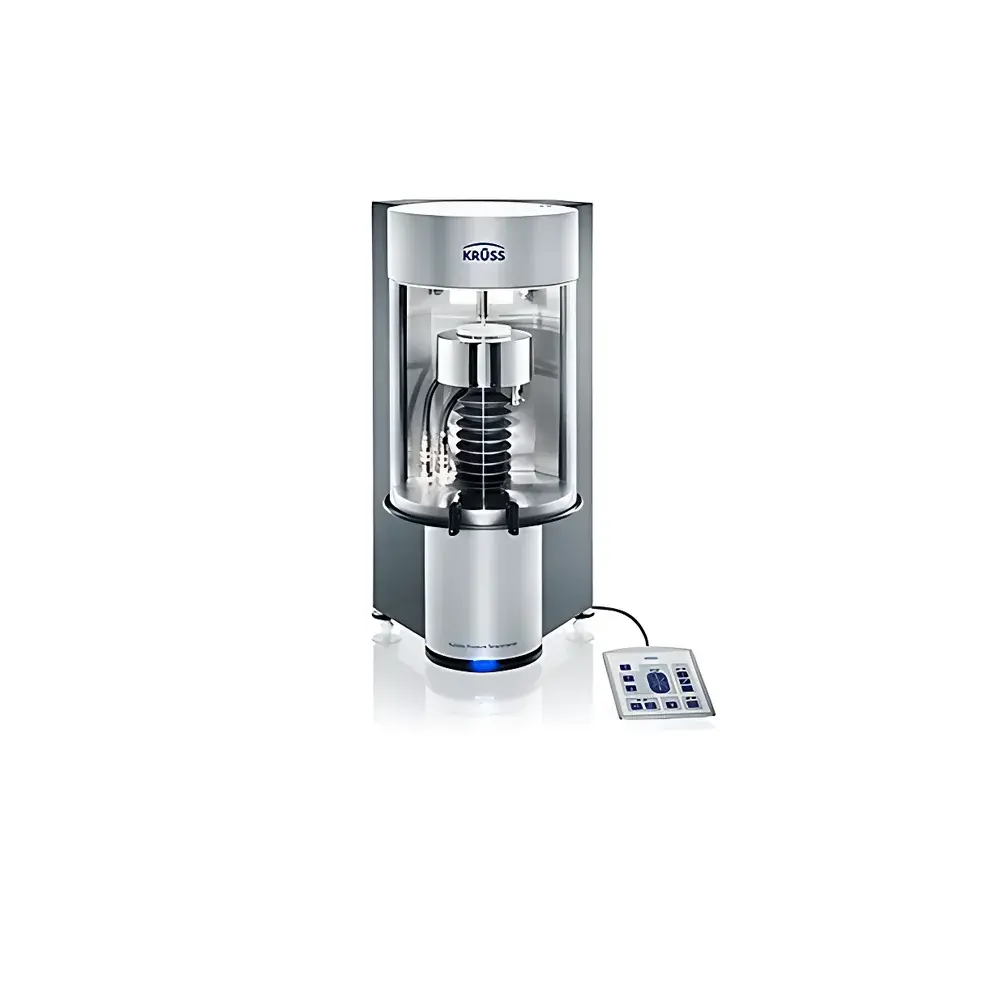
Krüss BP100 Bubble Pressure Tensiometer
| Brand | Krüss |
|---|---|
| Origin | Germany |
| Model | BP100 |
| Maximum Pressure | 3000 Pa |
| Measurement Frequency | 20 kHz |
| Sample Stage Travel Distance | >110 mm |
| Stage Speed Range | 0.1–500 mm/min |
| Temperature Control Range | −10 to +130 °C |
| Dynamic Surface Tension Range | 15–100 mN/m |
| Resolution | 0.01 mN/m |
| Surface Age Range | 5–200,000 ms |
| Compliance | ASTM D1331, ISO 6889, DIN 53914 |
Overview
The Krüss BP100 Bubble Pressure Tensiometer is a high-precision, laboratory-grade instrument engineered for the quantitative analysis of dynamic surface tension as a function of surface age. Based on the well-established bubble pressure method—governed by the Young–Laplace equation—the BP100 measures the maximum pressure required to expel an air bubble through a capillary immersed in a liquid phase. This principle enables direct, contactless determination of interfacial stress at precisely defined surface ages, ranging from milliseconds to over 200 seconds. Unlike static tensiometers, the BP100 captures kinetic adsorption behavior of surfactants under non-equilibrium conditions, making it indispensable for R&D and process optimization in applications where surface evolution occurs at high rates: inkjet printing, coil coating, electroplating bath monitoring, detergent formulation, and high-speed wetting processes. Its integrated temperature control (−10 to +130 °C) and real-time pressure acquisition at 20 kHz ensure thermodynamic reproducibility and temporal resolution essential for modeling surfactant diffusion and adsorption kinetics.
Key Features
- High-speed pressure transduction with 20 kHz sampling rate, enabling sub-millisecond resolution in surface age definition
- Motorized precision stage with >110 mm vertical travel and programmable speed (0.1–500 mm/min) for consistent bubble formation dynamics
- Active Peltier-based temperature control system with ±0.1 °C stability across −10 to +130 °C, verified by integrated platinum resistance thermometer (PT100)
- Dynamic surface tension measurement range: 15–100 mN/m, with resolution of 0.01 mN/m and repeatability ≤±0.2 mN/m (n ≥ 5, standard aqueous SDS solutions)
- Automated calculation of surfactant transport parameters: adsorption coefficient (β), diffusion coefficient (D), and characteristic relaxation time (τ)
- Support for disposable capillaries (optional) to eliminate cross-contamination in viscous, curing, or particulate-laden systems (e.g., UV-curable inks, electrodeposition baths, pigment dispersions)
Sample Compatibility & Compliance
The BP100 accommodates aqueous and organic surfactant solutions, microemulsions, polymer melts, and low-to-medium viscosity formulations (up to ~500 mPa·s). It complies with internationally recognized standards for surface tension measurement, including ASTM D1331 (bubble pressure method for surface tension of surfactant solutions), ISO 6889 (determination of surface tension by maximum bubble pressure), and DIN 53914 (surface-active agents — determination of surface tension). All measurements adhere to GLP-aligned data integrity protocols: full audit trail, user authentication, electronic signatures, and timestamped raw data export—fully compatible with FDA 21 CFR Part 11 requirements when deployed with validated LabDesk software configuration.
Software & Data Management
LabDesk software serves as the unified control and analysis platform for the BP100. It provides preconfigured test templates for standardized methods (e.g., constant-age measurement, time-sweep mode, temperature ramping), reducing operator-dependent variability. Each measurement generates an auto-generated report containing primary pressure curves, derived surface tension vs. surface age plots, fitted kinetic models (e.g., exponential decay, Ward–Tordai), and statistical summaries. Data are stored in a relational SQLite database supporting cross-instrument comparison (e.g., BP100 + K100 tensiometer + DSA100 contact angle system). Export options include CSV, PDF, and XML formats compliant with LIMS integration. Optional LabDesk Enterprise module enables centralized license management, remote diagnostics, and role-based access control for multi-user labs operating under ISO/IEC 17025 or GMP environments.
Applications
- Surfactant screening and structure–property relationship studies during molecular design
- Optimization of spray coating, dip-coating, and roll-to-roll printing processes via dynamic wettability mapping
- Real-time monitoring of surfactant depletion in alkaline cleaning baths and acidic electroplating electrolytes
- Quantification of adsorption kinetics in pharmaceutical emulsions and agrochemical adjuvant systems
- Validation of computational fluid dynamics (CFD) boundary conditions requiring time-resolved interfacial stress input
- Calibration transfer to field-deployable instruments (e.g., BPT Mobile) using traceable master curves generated under controlled lab conditions
FAQ
What physical principle does the BP100 rely on for surface tension measurement?
It applies the maximum bubble pressure method, derived from the Young–Laplace equation, where surface tension σ is calculated from the peak pressure ΔPmax observed during bubble formation at a defined capillary radius r: σ = r·ΔPmax/2.
Can the BP100 measure equilibrium surface tension?
Yes—by extrapolating dynamic data to infinite surface age using the Hua & Rosen method, or by conducting extended constant-age measurements (>10⁵ ms) to approach thermodynamic equilibrium.
Is temperature control mandatory for accurate dynamic measurements?
While ambient measurements are possible, precise thermal regulation is critical for kinetic studies, as surfactant diffusion and adsorption rates exhibit strong Arrhenius dependence; the BP100’s integrated Peltier system ensures traceable, uniform thermal conditions.
How does the BP100 support regulatory compliance in QC laboratories?
Through LabDesk’s 21 CFR Part 11-compliant workflow—including electronic signatures, audit trails, data immutability, and version-controlled method files—enabling use in FDA-regulated environments for release testing of surfactant-containing products.
What sample volume is required per measurement?
Typically 10–20 mL, depending on capillary immersion depth and bath geometry; disposable capillaries reduce carryover risk without compromising measurement fidelity.



