
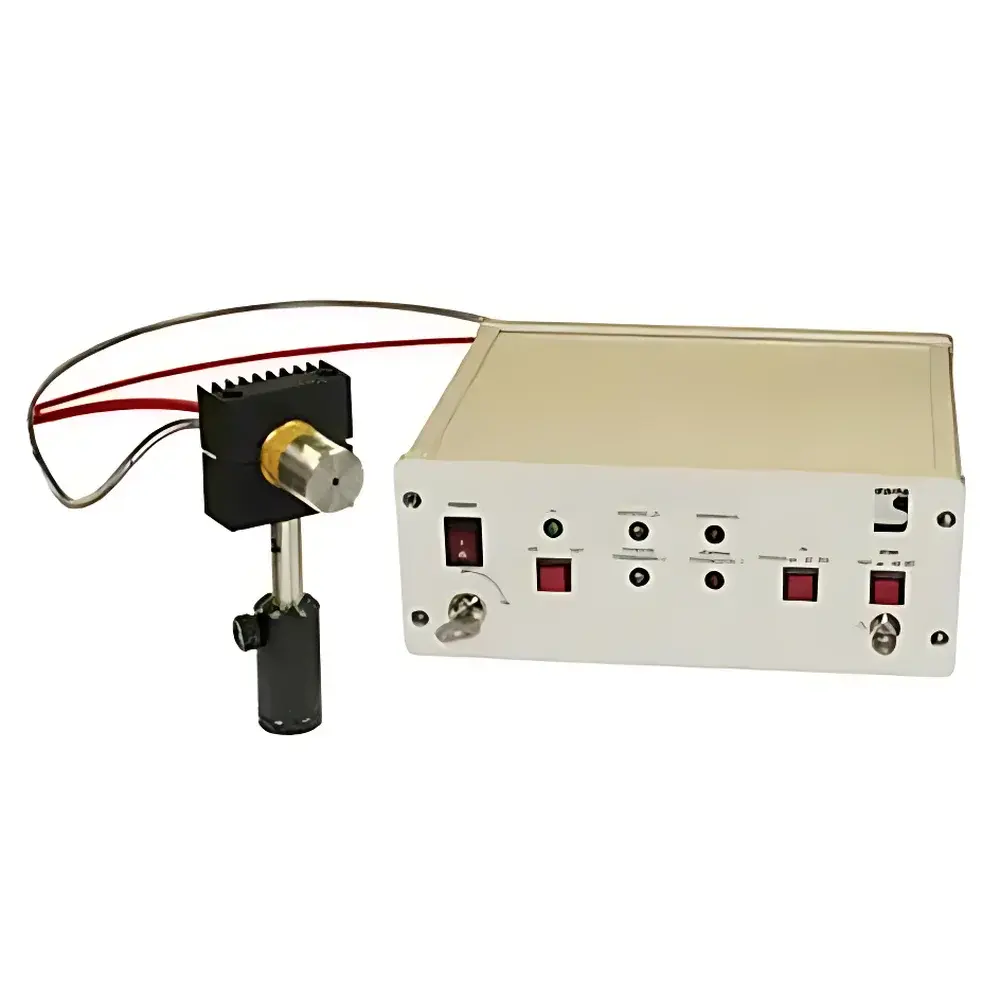

STANDA STA-01 Series Diode-Pumped Nd:YAG Single-Frequency Q-Switched Picosecond Laser
| Brand | STANDA |
|---|---|
| Model | STA-01-x |
| Wavelength | 1064 nm (optional 1062.5 nm) |
| Average Power | 65–200 mW |
| Pulse Energy | 6.5–200 µJ |
| Pulse Width | 0.5–0.8 ns |
| Repetition Rate | 10–70 kHz |
| Beam Quality (M²) | ≤1.2 |
| Spectral Output | Single Longitudinal Mode (SLM) |
| Polarization Ratio | >100:1 |
| Pulse Spectral Width | <5 pm |
| Beam Waist Diameter | 25–400 µm |
| Pulse Energy Stability | <0.4% (RMS, 5–10 min warm-up, ΔT ≤ ±3°C) |
| Power Stability (6 h) | <±1.5% |
| Input Voltage | 100–240 VAC |
| Operating Temperature | 15–40 °C |
| Interfaces | USB, External Trigger |
| Laser Head Dimensions | Ø25 × 44.5 mm |
| Warranty | 12 months or 5000 operating hours |
Overview
The STANDA STA-01 Series is a compact, diode-pumped solid-state (DPSS) Nd:YAG laser engineered for high-precision applications requiring stable, single-frequency, nanosecond-duration pulses with picosecond-equivalent temporal coherence. Though classified as a nanosecond Q-switched source (pulse width 0.5–0.8 ns), its sub-5 pm spectral bandwidth, diffraction-limited beam quality (M² ≤ 1.2), and single longitudinal mode (SLM) emission enable performance characteristics critical to ultrafast seeding, nonlinear frequency conversion, and high-resolution interferometric metrology. The laser operates at the fundamental 1064 nm wavelength—optionally tunable to 1062.5 nm—with average output powers ranging from 65 mW to 200 mW and pulse energies up to 200 µJ. Its monolithic, air-cooled design integrates the laser head and dedicated power supply module—including LD driver, fiber-coupled pump diode, and internal pulse generator—ensuring robustness and minimal alignment sensitivity. Unlike conventional Q-switched lasers, the STA-01 delivers exceptional amplitude stability (<0.4% RMS pulse energy fluctuation after thermal stabilization) and long-term power repeatability (<±1.5% over 6 hours), making it suitable for integration into OEM instrumentation and regulated laboratory environments.
Key Features
- Single longitudinal mode (SLM) output with spectral linewidth <5 pm — enabling high-fidelity interference and narrowband nonlinear conversion
- TEM₀₀ spatial profile with M² ≤ 1.2 and polarization extinction ratio >100:1 — optimized for coupling into single-mode fibers and nonlinear crystals
- Adjustable repetition rate from single-shot to 70 kHz — programmable via USB or external TTL trigger
- Integrated thermal management and active stabilization circuitry — achieves <±3°C ambient drift tolerance during operation
- Compact laser head (Ø25 × 44.5 mm) with standardized mechanical and electrical interfaces — designed for seamless integration into optical tables, vacuum chambers, or custom enclosures
- OEM-ready architecture — STANDA supports wavelength customization (e.g., harmonic generation-ready fundamental), pulse energy scaling, and interface protocol adaptation under NDA
Sample Compatibility & Compliance
The STA-01 is compatible with standard nonlinear optical components used in harmonic generation (e.g., type-II KTP, periodically poled LiNbO₃) and ultrafast amplification seeding. Its near-transform-limited pulse structure ensures high conversion efficiency in optical parametric oscillators (OPOs) and second-harmonic generation (SHG) setups. While not an FDA-cleared medical device, the laser complies with IEC 60825-1:2014 Class 4 laser safety requirements when operated within specified enclosure and interlock configurations. Its electrical design meets CE/UKCA standards for EMC (EN 55011) and low-voltage directive (2014/35/EU). For GLP/GMP-aligned installations, full traceability of serial-numbered units, calibration certificates (upon request), and audit-ready firmware logs (via USB interface) support regulatory documentation workflows.
Software & Data Management
Control is implemented through STANDA’s cross-platform USB communication protocol, supporting Windows, Linux, and macOS. The included software suite provides real-time monitoring of pulse energy, repetition rate, and internal temperature; enables remote configuration of trigger mode (internal/external), burst sequencing, and soft-start ramping; and exports timestamped measurement logs in CSV format. All firmware updates preserve backward compatibility and include cryptographic signature verification. For automated test systems, a documented SCPI-like command set allows integration with LabVIEW, Python (PyVISA), MATLAB, and PLC-based controllers. Audit trails — including parameter changes, session start/end timestamps, and error codes — are retained in non-volatile memory and exportable for 21 CFR Part 11-compliant environments when deployed with validated host software.
Applications
- Pump source for optical parametric oscillators (OPOs) and amplifiers using PPLN or KTP crystals
- Seed laser for chirped-pulse amplification (CPA) systems requiring SLM, narrow-linewidth, and high temporal contrast
- Coherent light source for white-light interferometry and absolute distance metrology
- Excitation source in time-resolved fluorescence microscopy and two-photon excitation microscopy (TPEF)
- Probe beam in pump-probe spectroscopy and transient absorption experiments
- Calibration reference in high-speed photodetector response characterization
- Source for stimulated Raman scattering (SRS) and coherent anti-Stokes Raman scattering (CARS) microscopy
FAQ
Is the STA-01 truly picosecond-class despite its nanosecond pulse width specification?
Yes — while the temporal FWHM is 0.5–0.8 ns, its <5 pm spectral bandwidth corresponds to a Fourier-transform-limited pulse duration of ~0.6 ps, qualifying it as a quasi-picosecond source for coherence-sensitive applications such as interferometry and nonlinear optics.
Can the laser be synchronized to an external clock with jitter below 100 ps?
Yes — the external trigger input accepts TTL-compatible signals with <50 ps RMS jitter propagation from input edge to optical pulse leading edge, verified under controlled thermal conditions.
Does STANDA provide factory calibration data for pulse energy and spectral purity?
Yes — each unit ships with a certificate of conformance listing measured M², polarization ratio, spectral FWHM, pulse energy linearity, and long-term stability metrics per ISO 11554 and ISO 13694 protocols.
What is the expected lifetime of the pump diode under continuous operation?
Rated for >10,000 hours at nominal drive current; warranty covers 5000 hours or 12 months, whichever occurs first, under specified thermal and power cycling conditions.
Are harmonic generation modules (e.g., 532 nm SHG) available as integrated options?
Yes — STANDA offers factory-integrated, temperature-stabilized SHG modules with >45% conversion efficiency and collimated output, configurable per model variant upon order.





