
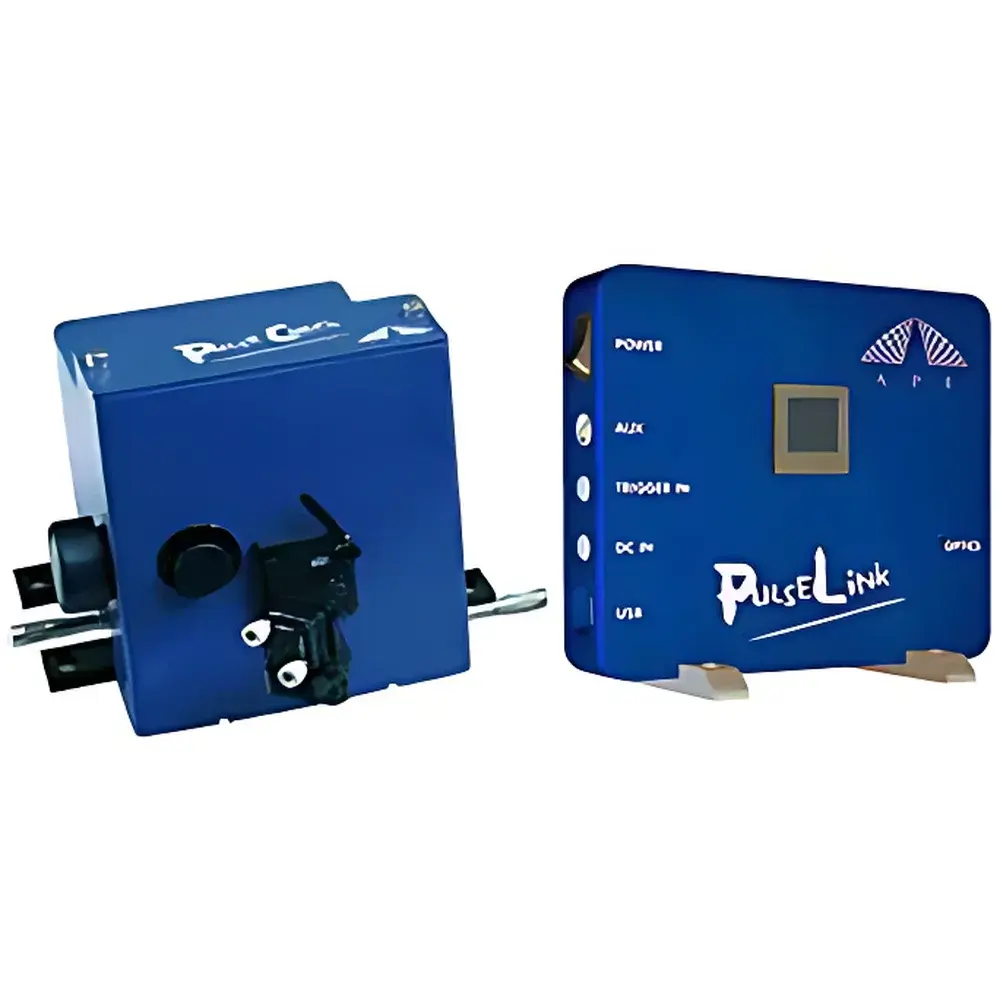

German APE PulseCheck USB Autocorrelator
| Brand | APE |
|---|---|
| Origin | Germany |
| Model | PulseCheck USB |
| Type | Scanning Autocorrelator for Ultrashort Laser Pulse Characterization |
| Wavelength Coverage | 200 nm – 2400 nm (configurable via optical modules) |
| Pulse Duration Range | 20 fs – 35 ps (dependent on module) |
| Scan Mechanism | Precision Linear Translation Stage with Real-Time Position Feedback |
| Detection Options | Photomultiplier Tube (PMT) and Photodiode (PD) |
| Interface | USB 2.0 with pulseLink Controller |
| Compliance | CE-marked, RoHS-compliant, Designed for GLP-Compatible Lab Environments |
| Software | Windows-based pulseView with TCP/IP support, Data Export (ASCII, CSV, HDF5), Trigger Synchronization (10 Hz – 50 kHz), FDA 21 CFR Part 11–Ready Audit Trail Optional |
Overview
The German APE PulseCheck USB Autocorrelator is a precision scanning interferometric autocorrelator engineered for the accurate temporal characterization of ultrashort laser pulses in research and industrial laser laboratories. Based on second-harmonic generation (SHG) in nonlinear optical crystals, it operates on the principle of intensity autocorrelation—where a split laser pulse is variably delayed and recombined to generate a nonlinear signal proportional to the square of the electric field envelope. This enables direct measurement of pulse duration (FWHM) without phase retrieval, delivering high reproducibility (< 0.5 fs typical accuracy) across femtosecond to picosecond regimes. Unlike single-shot or spectrally resolved techniques, the PulseCheck USB employs a mechanically scanned delay line with real-time position encoding, ensuring linear time calibration traceable to interferometric standards. Its modular architecture supports interchangeable optical heads (VIS, NIR, IR, MIR), enabling coverage from 200 nm to 20 µm—making it suitable for Ti:sapphire oscillators, Yb-fiber amplifiers, OPA systems, and quantum cascade lasers.
Key Features
- Modular optical head design: Swappable SHG crystals and detectors allow seamless wavelength range extension—from UV (260 nm) to mid-IR (20 µm) without hardware replacement.
- Real-time linearized scanning: Integrated capacitive position sensor ensures scan linearity better than ±1% of full-scale range, eliminating interpolation errors common in stepper-motor-based correlators.
- Dual detection paths: High-sensitivity PMT (10⁻⁴ W² threshold) for low-energy oscillators; robust photodiode (1 W² saturation limit) for high-power amplifier outputs up to 10 µJ/pulse.
- USB-integrated pulseLink controller: Fully programmable via USB 2.0; supports external triggering (TTL-compatible, 10 Hz–50 kHz), adjustable gate width (>50 ns), and 50 Ω / 1 kΩ impedance matching.
- Automated alignment assistance: Software-guided crystal angle tuning and gain optimization reduce setup time and operator dependency.
- FROG-ready expansion: Optional Frequency-Resolved Optical Gating (FROG) module converts the system into a phase-sensitive diagnostic tool, enabling full electric-field reconstruction (E(t), φ(t)) under appropriate beam conditioning.
Sample Compatibility & Compliance
The PulseCheck USB accommodates free-space Gaussian beams with diameters of 3 mm (aperture-closed) or 6 mm (aperture-open), accepting linear polarization (vertical polarization available via optional rotator). It is compatible with oscillator repetition rates ≥250 kHz (PMT mode) and amplifier systems down to 10 Hz (PD mode), supporting both CW-seeded and cavity-dumped sources. Input power limits are defined per configuration: ≤1 W average for high-repetition-rate oscillators (~70 MHz), ≤10 µJ per pulse for kHz-amplified systems. All optical modules comply with ISO 11146-1 for beam parameter measurement and are CE-certified per EN 61326-1 (EMC) and EN 61010-1 (safety). The system architecture supports audit-trail logging and electronic signature workflows required under FDA 21 CFR Part 11 when configured with validated pulseView software.
Software & Data Management
Control and analysis are performed using pulseView—a native Windows application with TCP/IP server capability for remote instrument orchestration in automated test benches. The software provides real-time autocorrelation trace acquisition, FWHM calculation (Gaussian, sech², or user-defined fitting), and automatic background subtraction. All raw and processed datasets export to ASCII, CSV, or HDF5 formats for post-processing in MATLAB, Python (NumPy/SciPy), or Igor Pro. Built-in scripting (via COM interface) enables integration into LabVIEW or Python-based control frameworks. Optional validation packages include IQ/OQ documentation templates aligned with ISO/IEC 17025 and GMP Annex 11 requirements.
Applications
- Ultrafast laser development: Pulse duration verification during oscillator cavity optimization and amplifier compression tuning.
- Nonlinear optics labs: Temporal diagnostics for OPA, DFG, and HHG source characterization.
- Industrial laser processing R&D: Monitoring pulse stability in ultrafast micromachining and glass welding systems.
- Academic photonics education: Hands-on training in time-domain metrology, nonlinear frequency conversion, and laser pulse physics.
- Mid-IR spectroscopy: Temporal gating of broadband MIR pulses from Fe:ZnSe or Cr:ZnS lasers (with PulseCheck USB MIR head).
FAQ
What is the minimum measurable pulse duration with the standard PulseCheck USB configuration?
With the VIS1 optical module and PMT detection, the system resolves pulses as short as 50 fs (20 fs achievable with the optional short-pulse kit at 800 nm).
Can the PulseCheck USB measure pulses outside the visible and near-IR ranges?
Yes—through interchangeable optical modules covering UV (260 nm), extended NIR (up to 2400 nm), and mid-IR (2–20 µm) spectral bands.
Is external triggering supported for low-repetition-rate amplified laser systems?
Yes—the USB interface accepts TTL-compatible trigger signals from 10 Hz to 50 kHz, with adjustable input impedance (50 Ω or 1 kΩ) and pulse width tolerance (>50 ns).
Does the system provide wavelength information from autocorrelation data?
Indirectly: Interferometric autocorrelation fringes permit estimation of central wavelength via fringe periodicity, though precise λ determination requires concurrent spectrometer calibration.
Is FROG functionality built-in or an add-on option?
FROG is an optional hardware and software upgrade—requiring a dedicated FROG module, motorized delay stage, and pulseView FROG license for phase-resolved reconstruction.





