
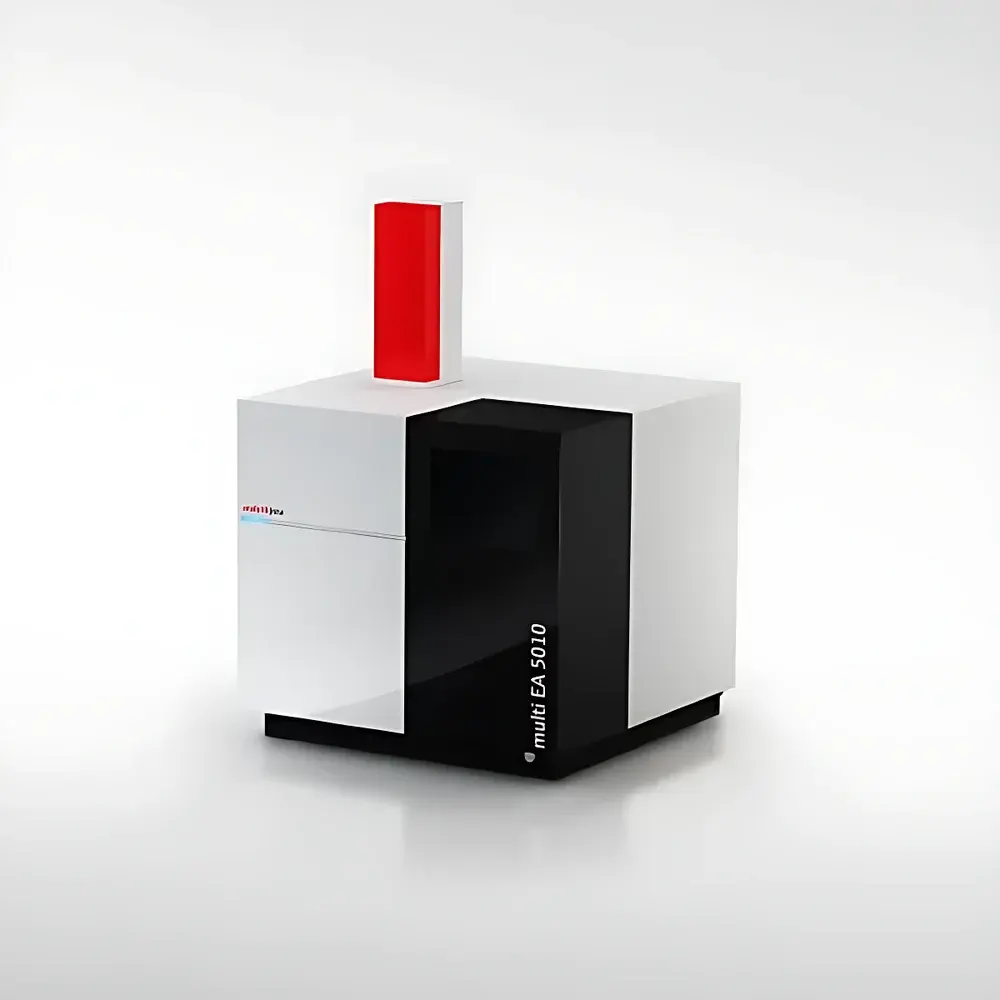
Analytik Jena multi EA 5010 Single Nitrogen or Single Sulfur Elemental Analyzer
| Brand | Analytik Jena |
|---|---|
| Origin | Germany |
| Model | multi EA 5010 |
| Detection Principle | Chemiluminescence (N) / UV Fluorescence (S) with MPO High-Nitrogen Interference Compensation |
| LOD (N) | 10 ppb |
| LOD (S) | 5 ppb |
| Linear Range (S) | up to 10,000 mg/kg |
| Analysis Time | 2–5 min per sample |
| Compliance | ASTM D5453, D7183, ISO 20846, ISO 29189, GB/T 17040, GB/T 17674, USP <233>, EPA Method 1664A (adapted), GLP/GMP-ready |
| Automation | Fully automated calibration, parameter optimization, and continuous unattended operation |
| Footprint | < 0.3 m² |
Overview
The Analytik Jena multi EA 5010 is a dedicated single-element elemental analyzer engineered for high-precision, high-throughput quantification of nitrogen (N) or sulfur (S) in liquid, solid, and gaseous samples. Designed for routine quality control and regulatory compliance in petroleum refining, lubricant manufacturing, biofuel development, and environmental monitoring laboratories, the instrument employs two distinct detection modalities: chemiluminescence detection (CLD) for nitrogen analysis and ultraviolet fluorescence detection (UVFD) for sulfur analysis. The UVFD variant—specifically the multi EA 5010 S MPO—is equipped with Analytik Jena’s proprietary Multi-Parameter Optimization (MPO) module, which actively suppresses nitrogen oxide (NOx) interference during sulfur measurement. This eliminates analytical bias in high-nitrogen matrices such as diesel fuel treated with 2-ethylhexyl nitrate (2-EHN), where conventional UVFD systems suffer from signal quenching or overestimation. The system operates on high-temperature combustion (1100 °C) followed by selective gas-phase detection, ensuring stoichiometric conversion of organic and inorganic N/S species into NO and SO2, respectively.
Key Features
- Modular, space-efficient architecture occupying less than 0.3 m²—ideal for constrained laboratory environments
- HiPerSens detection technology delivering sub-ppb detection limits (N: 10 ppb; S: 5 ppb) and extended linear dynamic range (up to 10,000 mg/kg for S)
- Patented MPO module for real-time NOx suppression in sulfur analysis—no catalysts, correction factors, or secondary trapping/release steps required
- Automated method selection, calibration curve assignment (up to five independent curves), and parameter optimization via embedded firmware
- Robust combustion furnace with ceramic-lined quartz reactor and programmable temperature ramping for optimal sample oxidation
- Touchscreen HMI with preloaded method libraries compliant with ASTM D5453 (S), D7183 (N), ISO 20846 (gasoline S), ISO 29189 (diesel S), and Chinese national standards GB/T 17040 and GB/T 17674
- Fully validated for 24/7 unattended operation with remote access capability under role-based authentication
Sample Compatibility & Compliance
The multi EA 5010 accepts a broad spectrum of sample types—including light and heavy hydrocarbons, biodiesel blends, lubricating oils, crude oil fractions, polymers, coal, and environmental water extracts—without dilution or derivatization. Its combustion interface accommodates both liquid autosampler vials (0.5–100 µL injection volume) and solid sample boats (up to 500 mg). All operational parameters—including oxygen flow rate, combustion temperature, and detector gain—are continuously monitored and auto-adjusted to maintain measurement integrity across matrix variations. The system supports full audit trail generation and electronic signature functionality aligned with FDA 21 CFR Part 11 requirements. It is routinely deployed in laboratories operating under GLP and GMP frameworks, with validation documentation supporting IQ/OQ/PQ protocols and traceability to NIST-traceable CRM materials.
Software & Data Management
Control and data acquisition are managed through EA Control Software—a Windows-based platform featuring intuitive workflow navigation, customizable report templates, and integrated statistical tools (RSD calculation, calibration diagnostics, outlier detection). Raw chromatograms, peak integration logs, and system diagnostic snapshots are stored in encrypted, timestamped binary files with SHA-256 checksum verification. Data export options include CSV, PDF, and XML formats compatible with LIMS integration. The software maintains full version history, user action logging, and configurable retention policies to meet ISO/IEC 17025 documentation requirements. Remote desktop access is enabled via TLS-secured SSH tunneling, permitting authorized users to monitor run status, review results, and initiate maintenance routines without physical presence.
Applications
- Regulatory sulfur testing in transportation fuels (ULSD, jet fuel, marine distillates) per ASTM D5453 and EN ISO 20846
- Nitrogen speciation in refinery feedstocks and catalyst poisons using ASTM D7183
- Quality assurance of biofuels (FAME, HVO) for S/N impurity profiling prior to blending
- Environmental analysis of wastewater, soil extracts, and sediment digests for total recoverable S/N
- R&D support for additive formulation—e.g., evaluating nitrogen-containing cetane improvers without compromising sulfur accuracy
- Pharmaceutical excipient screening per USP for residual sulfur compounds in APIs
FAQ
What detection technologies does the multi EA 5010 employ for nitrogen and sulfur?
The multi EA 5010 N uses chemiluminescence detection (CLD); the multi EA 5010 S and S MPO variants use ultraviolet fluorescence detection (UVFD) with optional MPO interference compensation.
Can the instrument analyze both nitrogen and sulfur in a single run?
No—this is a dedicated single-element platform. Dual-element analysis requires separate N and S configurations or sequential instrument runs.
Is method validation required when using preloaded standard methods?
Yes. While ASTM, ISO, and GB methods are preconfigured, laboratory-specific system suitability testing (SST), intermediate precision assessment, and matrix-matched calibration remain mandatory per ISO/IEC 17025.
How does the MPO module eliminate nitrogen interference in sulfur analysis?
MPO dynamically adjusts UVFD detector parameters and introduces a secondary reaction zone that thermally decomposes NOx before SO2 detection—eliminating quenching without consumables or hardware modifications.
What sample introduction options are supported?
Liquid autosampling (via 10-position tray), solid sample boat loading (manual or optional robotic handler), and gas sampling via calibrated loop injection.





