
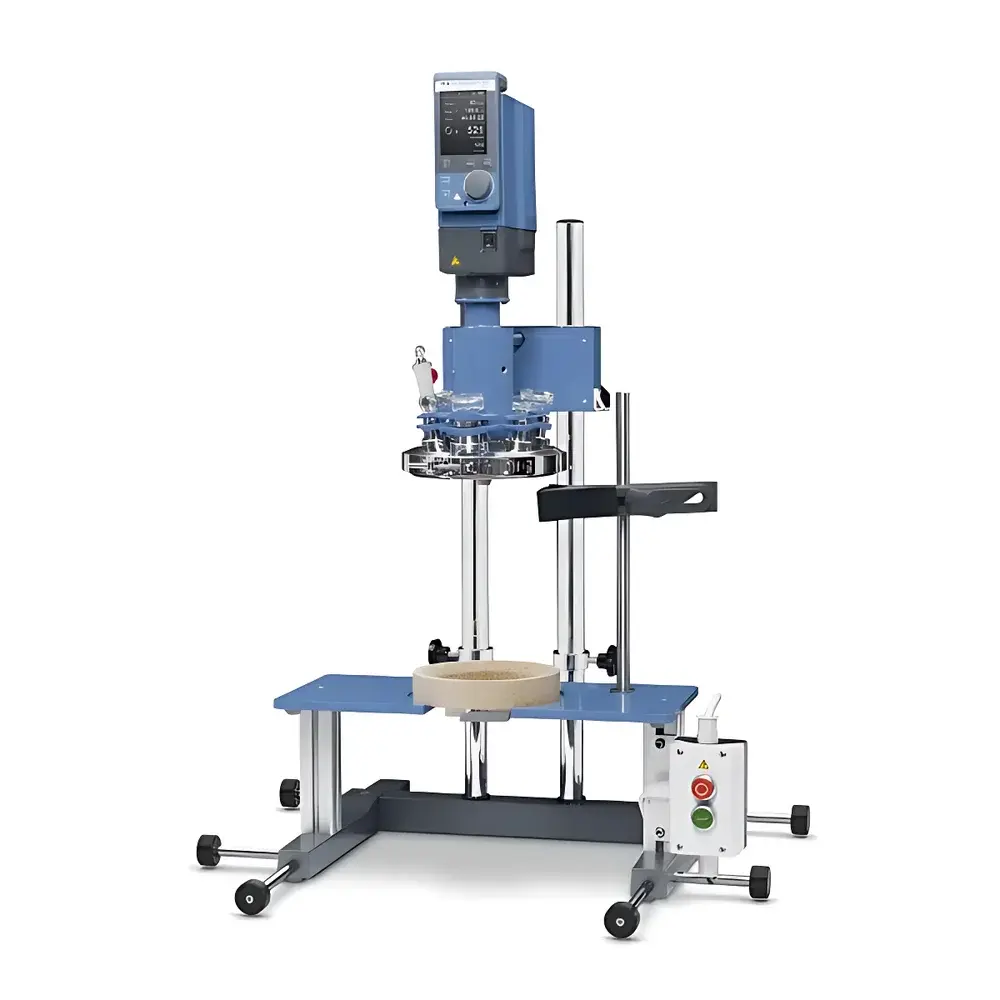
IKA LR-2.ST the Allrounder Modular Laboratory Reactor System
| Brand | IKA |
|---|---|
| Origin | Germany |
| Model | LR-2.ST the Allrounder |
| Usable Volume | 500–2000 mL |
| Temperature Range | Ambient to 230 °C |
| Vacuum Capability | Down to 25 mbar |
| Max. Viscosity | 100,000 mPa·s |
| Speed Range | 8–290 rpm |
| Lifting Stroke | 390 mm |
| Wetted Materials | Borosilicate Glass (DIN ISO 3585), FFPM, PTFE, Stainless Steel 1.4571 |
| Reactor Opening | 3 × NS 29/32, 2 × NS 14/23 |
| Max. Stirring Torque | 200 N·cm |
| Dimensions (W×H×D) | 460 × 1240 × 430 mm |
| Weight | 25 kg |
| Ambient Operating Conditions | 5–40 °C, ≤80% RH |
| Control | Microprocessor-based speed regulation with load-compensated stability |
Overview
The IKA LR-2.ST the Allrounder is a modular, vacuum-capable laboratory reactor system engineered for reproducible synthesis, reaction monitoring, and high-viscosity mixing under controlled thermal and atmospheric conditions. Built upon IKA’s EUROSTAR 200 control stirrer platform, it integrates mechanical robustness with precise process control—enabling consistent torque delivery up to 200 N·cm across variable load profiles. Its core architecture supports jacketed temperature control (via external circulator), vacuum operation down to 25 mbar, and inert atmosphere purging through standardized NS ground-glass joints. The system operates on the principle of mechanically driven impeller-based mixing within a sealed, chemically resistant vessel—optimized for batch-scale chemical development, polymerization trials, catalytic screening, and solvent-free homogenization where thermal stability, sealing integrity, and torque fidelity are critical.
Key Features
- Modular design with interchangeable reactor vessels (500–2000 mL) and configurable lid ports accommodating ULTRA-TURRAX® dispersers, Pt100 temperature probes, reflux condensers, addition funnels, and gas inlet/outlet lines
- Borosilicate glass (DIN ISO 3585) vessel body combined with perfluoroelastomer (FFPM) gaskets—resistant to aggressive solvents, strong acids/bases, and sustained exposure up to 230 °C
- Microprocessor-controlled stirring drive with real-time torque feedback and automatic speed compensation—maintaining set rpm even during viscosity spikes or solid suspension events
- Motorized lifting column with 390 mm vertical travel, enabling safe vessel access, probe insertion, and cleaning without manual repositioning
- Integrated safety interlock system: automatic motor shutdown upon lid removal or vacuum loss; overtemperature and overload protection embedded in controller firmware
- WiCo wireless controller option—certified for Class I, Division 2 environments—permits fully remote operation inside fume hoods while preserving full parameter logging and setpoint adjustment
Sample Compatibility & Compliance
The LR-2.ST accommodates diverse sample matrices including viscous organometallic slurries, thermosetting resin prepolymers, nanoparticle dispersions, and heterogeneous catalytic suspensions. All wetted components comply with USP Class VI and FDA 21 CFR §177.2600 for repeated-use laboratory contact surfaces. FFPM seals meet ASTM D1418 classification for fluorocarbon elastomers and demonstrate validated resistance to halogenated solvents (e.g., chloroform, DCM), concentrated HNO₃/H₂SO₄, and supercritical CO₂. The system supports GLP-compliant workflows via optional audit-trail-enabled software integration (IKA Labworldsoft v5.0), satisfying traceability requirements outlined in ISO/IEC 17025:2017 Annex A.2 and EU GMP Annex 11 for electronic records.
Software & Data Management
When paired with IKA Labworldsoft, the LR-2.ST enables synchronized acquisition of torque, speed, temperature, and time-stamped event markers (e.g., “addition started”, “vacuum reached”). Data export adheres to ASTM E2500-13 standards for raw instrument output, supporting CSV, PDF, and XML formats compatible with LIMS and ELN platforms. The software enforces role-based user access, electronic signatures per 21 CFR Part 11 Subpart B, and immutable data archiving with SHA-256 hash verification. Real-time torque trend visualization allows empirical determination of gel point onset, crosslinking kinetics, or phase inversion thresholds—critical for QbD-driven process development.
Applications
- Optimization of exothermic Grignard or lithiation reactions under nitrogen/vacuum with inline temperature ramping and torque-derived reaction progress tracking
- High-shear dispersion of carbon nanotubes in epoxy matrices—leveraging ULTRA-TURRAX® coupling to the reactor lid for scalable nanocomposite formulation
- Continuous viscosity profiling during polycondensation of PET precursors, correlating torque decay with molecular weight build-up (via Mark–Houwink calibration)
- Crystallization studies under reduced pressure, combining controlled cooling rates with agitation to modulate polymorph selectivity and particle size distribution
- Multi-step telescoped synthesis—where sequential reagent addition, solvent swaps, and distillative workup occur within a single, sealed reactor configuration
FAQ
Can the LR-2.ST operate under inert atmosphere with continuous gas flow?
Yes—the standard lid includes dedicated NS 29/32 ports for inert gas inlet and outlet, supporting dynamic purging or static blanketing protocols.
Is the system compatible with external temperature controllers for jacketed reactors?
Yes—integrated PT100 sensor input and analog 0–10 V output enable bidirectional communication with Julabo, Huber, or Lauda circulation chillers/heaters.
What is the maximum allowable working pressure for non-vacuum applications?
The base configuration is rated for ambient pressure only; optional pressure-rated lids (up to 6 bar g) are available separately under model designation LR-2.PRESS.
Does torque measurement meet ISO 2555:2019 requirements for rotational viscometry?
While not a dedicated viscometer, its calibrated torque sensor (±1.5% FS) and stable shear rate control permit relative viscosity comparisons compliant with ISO 2555 Annex B for quality control trending.
How is firmware updated and validated for regulatory use?
Updates are distributed via IKA’s secure portal with version-signed binaries; validation packages—including IQ/OQ templates and test scripts—are provided for GxP environments.



