
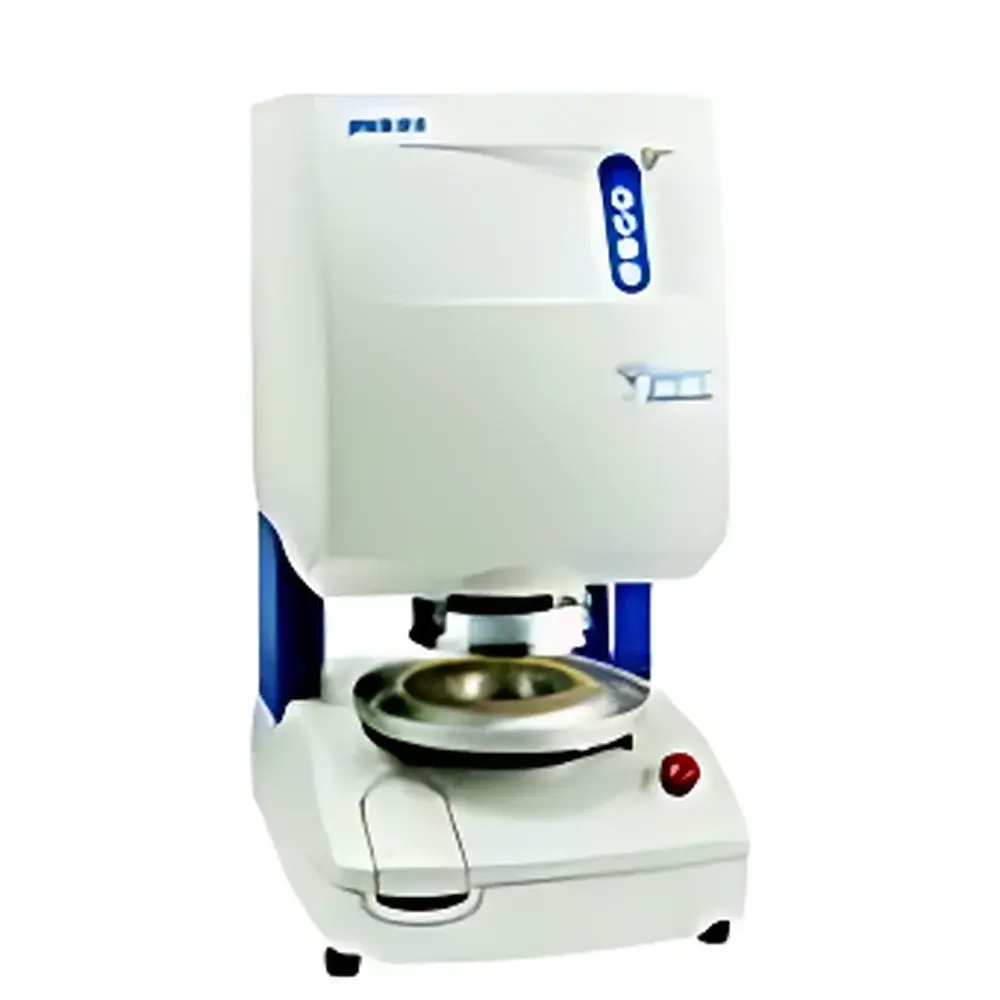
Brookfield PFT Powder Flow Tester
| Brand | Brookfield |
|---|---|
| Origin | USA |
| Manufacturer Type | Authorized Distributor |
| Origin Category | Imported |
| Model | PFT |
| Pricing | Available Upon Request |
| Axial Load Capacity | 7 kg |
| Load Accuracy | ±0.6% FSR |
| Plunger Speed | 0.1–5 mm/s |
| Displacement Accuracy | ±0.3 mm |
| Torque Range | ±7.0 N·m |
| Torque Accuracy | ±1.2% FSR |
| Hopper Rotation Speed | 1–5 RPH |
| Temperature Sensing Range | −20 °C to 120 °C |
| Humidity Sensing Range | 10–95% RH (±5% accuracy) |
| Test Modes | Flow Function, Time-Consolidated Flow Function, Wall Friction, Bulk Density |
| Flow Function Submodes | Demo (8 min), Standard (38 min), User-Defined Time Consolidation |
| Shear Algorithm Outputs | Peak Shear Stress, Steady-State Yield Locus, Stick-Slip Identification |
| Output Parameters | Flow Function Index (FF), Arching Diameter (Index), Rathole Diameter, Hopper Half-Angle, Gravity Chute Angle (Wall Friction Angle), Bulk Density Curve |
Overview
The Brookfield PFT Powder Flow Tester is an engineered solution for quantitative, shear-based characterization of bulk solid flow behavior under controlled consolidation and shear conditions. Operating on the principles of uniaxial confined shear testing—aligned with ASTM D6128 and ISO 4400 standards—the PFT applies a vertically imposed normal stress while simultaneously rotating a cylindrical hopper base to induce shear at the powder–wall interface. This architecture enables direct measurement of yield loci, critical for hopper design, silo discharge analysis, and process scale-up. Unlike empirical methods such as angle-of-repose or compressibility index, the PFT delivers physics-based metrics grounded in Jenike’s silo theory, supporting reliable prediction of arching, ratholing, and mass-flow transition thresholds in industrial powder handling systems.
Key Features
- Integrated axial loading system with 7 kg maximum capacity and high-resolution load cell (±0.6% FSR accuracy) for precise normal stress application during shear.
- Programmable plunger displacement velocity (0.1–5 mm/s) and hopper rotation speed (1–5 RPH), enabling dynamic control over consolidation rate and shear history.
- Real-time, on-screen progress tracking—including elapsed time, remaining duration, and active test step—optimized for operator efficiency in QC and R&D environments.
- Dual environmental sensing: embedded temperature probe (−20 °C to 120 °C) and capacitive humidity sensor (10–95% RH, ±5% accuracy) for ambient condition logging and data contextualization.
- Advanced shear algorithm processing that identifies peak shear stress, steady-state yield values, and stick-slip transitions—critical for detecting intermittent flow instabilities in cohesive or moisture-sensitive powders.
- Modular test protocol library supporting standardized and user-defined workflows, including time-consolidated flow function tests for aging-sensitive formulations.
Sample Compatibility & Compliance
The PFT accommodates dry, free-flowing to highly cohesive powders across pharmaceutical, chemical, food, battery materials, and additive manufacturing sectors. Sample volumes range from 50 mL to 500 mL, compatible with standard stainless-steel shear cells per ASTM D6128 Annex A2. All mechanical and electrical subsystems comply with CE marking requirements (EMC Directive 2014/30/EU, Low Voltage Directive 2014/35/EU). Data acquisition supports audit-ready traceability in GLP- and GMP-regulated environments; raw torque/displacement/time streams are timestamped and exportable in CSV format for external validation against 21 CFR Part 11-compliant LIMS or ELN platforms.
Software & Data Management
The PFT operates via Brookfield’s proprietary FlowPro software (Windows-based), which provides intuitive test setup, real-time graphical feedback, and automated post-processing. Each test generates a complete dataset—including shear stress vs. normal stress curves, flow function plots (FF), and derived geometric parameters (e.g., hopper half-angle, rathole diameter). Export options include CSV, PDF reports, and XML metadata compliant with ISA-88/ISA-95 data exchange conventions. Software logs all user actions, parameter changes, and calibration events with date/time stamps—enabling full procedural traceability required for FDA inspection readiness and internal quality audits.
Applications
- Formulation development: Quantifying how excipient ratios, particle size distribution, or surface treatments affect flow function index (FF) and critical hopper angles.
- Raw material qualification: Screening incoming API or granules against pre-established FF thresholds to ensure consistent discharge performance in high-speed capsule fillers or tablet presses.
- Silo and feeder design: Generating yield locus data for use in Jenike wedge analysis and DEM simulation boundary condition definition.
- Stability assessment: Conducting time-consolidated flow tests to evaluate storage-induced caking or moisture migration effects over hours or days.
- Process troubleshooting: Diagnosing flow interruptions in pneumatic conveying lines or rotary valves by correlating wall friction angle with liner material selection.
FAQ
What standards does the PFT comply with?
The PFT implements test methodologies aligned with ASTM D6128 (Standard Test Method for Determining the Flow Properties of Powders Using the Shear Cell), ISO 4400 (Powder Metallurgy—Determination of Flow Rate of Metal Powders), and supports data reporting formats used in USP & Ph. Eur. guidelines for pharmaceutical powder characterization.
Can the PFT be integrated into a laboratory automation network?
Yes—FlowPro software supports OPC UA connectivity and offers COM/ActiveX interfaces for integration with MES, SCADA, or custom LabVIEW applications. Full command-line scripting enables scheduled unattended operation and batch test sequencing.
Is calibration traceable to NIST standards?
Load cell and displacement transducers are factory-calibrated using NIST-traceable reference standards; calibration certificates are provided with each instrument and may be renewed annually through Brookfield-certified service centers.
How does the PFT differ from a traditional shear cell like the Jenike shear tester?
While both rely on the same fundamental theory, the PFT automates loading, rotation, and data capture with closed-loop digital control—eliminating manual torque reading errors and reducing test time from ~2 hours to under 40 minutes per flow function without sacrificing metrological rigor.
Does the system support variable temperature or humidity-controlled testing?
The PFT includes environmental sensors for ambient monitoring, but does not feature active climate control. For regulated thermal/humidity testing, it may be operated inside externally controlled environmental chambers with feedthrough-compatible cabling (optional accessory kit available).



