
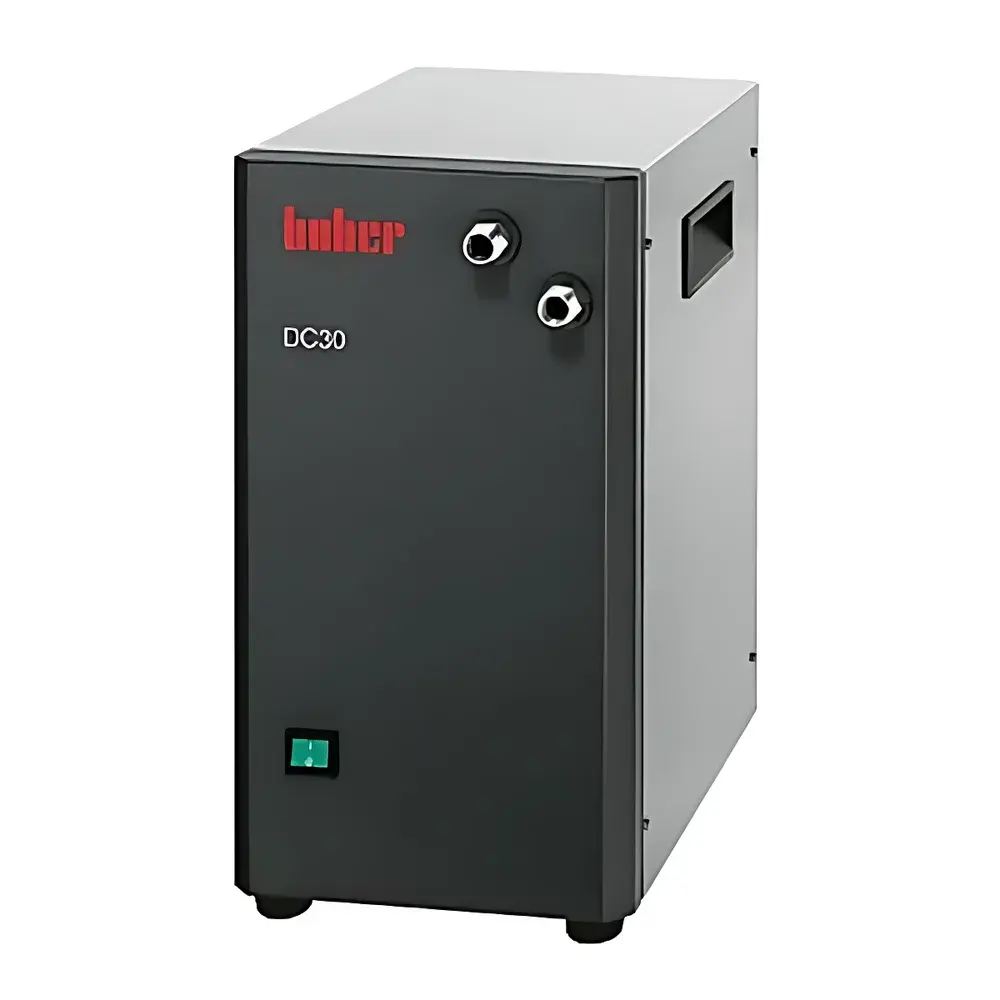
Huber DC® Continuous Inline Chiller
| Brand | Huber |
|---|---|
| Origin | Germany |
| Model | DC® |
| Temperature Range | –30 °C to +50 °C |
| Refrigeration Capacity | 2.0–4.7 kW (at –20 °C) |
| Dimensions (W×D×H) | 190×250×360 mm (DC30) / 250×310×415 mm (DC31) / 280×340×465 mm (DC32) |
| Refrigerant | R-410A |
| Power Supply | 230 V, 50/60 Hz |
| IP Rating | IP20 |
| Weight | 22–48 kg (model-dependent) |
Overview
The Huber DC® Continuous Inline Chiller is an engineered solution for precise, stable, and energy-efficient thermal management in demanding laboratory and pilot-scale applications. Designed explicitly for integration into closed-loop temperature control systems, the DC® operates on a vapor-compression refrigeration cycle with high-efficiency scroll compressors and optimized heat exchanger geometry. Unlike batch or static cooling units, the DC® delivers continuous, dynamic heat removal from circulating heat transfer fluids—typically water-glycol or silicone oil—enabling sustained operation across extended duty cycles. Its core function is to serve as an external cold source in conjunction with Huber’s Presto, Ministat, or Unistat series of heating/cooling circulators, where it absorbs excess thermal load from the return line, thereby extending the operational temperature range and improving system stability at low setpoints. This architecture supports applications requiring sub-ambient temperatures with high thermal inertia, such as reaction calorimetry, material testing under controlled thermal stress, and long-duration chromatography column conditioning.
Key Features
- Modular inline design optimized for seamless integration into existing circulation loops—no process interruption required during installation.
- Three scalable models (DC30, DC31, DC32) offering refrigeration capacities from 2.0 kW to 4.7 kW at –20 °C, enabling selection based on system flow rate, fluid type, and delta-T requirements.
- High-precision electronic expansion valve (EEV) control ensures stable evaporator superheat and consistent cooling output across variable load conditions.
- Robust stainless-steel fluid circuitry compatible with common heat transfer media including 30% aqueous glycol, Therminol VP-1, and Dow Corning PM-200 silicone oil.
- Integrated PID-controlled bypass valve maintains constant flow resistance and protects against cavitation during low-flow or transient thermal events.
- Front-panel digital interface with real-time display of inlet/outlet fluid temperatures, compressor discharge pressure, and system status flags—including refrigerant charge monitoring via pressure-temperature correlation.
Sample Compatibility & Compliance
The DC® chiller does not contact samples directly; rather, it regulates the temperature of the heat transfer fluid circulating through external jackets, coils, or reactors. As such, compatibility is determined by the chemical stability of the selected fluid within the specified operating range (–30 °C to +50 °C) and its miscibility with system wetted materials (316L stainless steel, EPDM, FKM). The unit complies with IEC 61000-6-2 (EMC immunity) and IEC 61000-6-4 (EMC emissions), meets CE marking requirements under the EU Machinery Directive 2006/42/EC and Low Voltage Directive 2014/35/EU, and conforms to EN 60335-1 for safety of electrical appliances. When deployed in regulated environments—such as pharmaceutical QC labs or GLP-compliant material characterization suites—the DC® supports audit-ready operation when paired with Huber’s optional ProfiNet or EtherCAT interfaces and integrated data logging compliant with FDA 21 CFR Part 11 requirements (user authentication, electronic signatures, and immutable audit trails).
Software & Data Management
The DC® operates autonomously but is fully interoperable with Huber’s SmartControl software suite via RS485 (Modbus RTU) or Ethernet (TCP/IP). SmartControl enables centralized configuration of setpoint profiles, alarm thresholds (e.g., high discharge pressure, low flow detection), and scheduled maintenance alerts (compressor runtime, filter replacement intervals). All operational parameters—including fluid inlet/outlet ΔT, cumulative refrigeration kWh, and compressor cycle count—are timestamped and exportable in CSV format. For facilities implementing LIMS or MES integration, the chiller supports OPC UA server functionality, allowing bidirectional data exchange with enterprise-level platforms without proprietary middleware. Firmware updates are performed securely over HTTPS, with version rollback capability and SHA-256 signature verification.
Applications
- Extended-range temperature control for reaction calorimeters (e.g., ChemiSens, Setaram), maintaining ±0.02 °C stability during exothermic polymerization studies.
- Cooling support for HPLC/UHPLC column ovens operating below ambient, preventing retention time drift during gradient elution.
- Thermal preconditioning of composite specimens prior to tensile or DMA testing per ASTM D638 and ISO 527 standards.
- Stabilization of laser cavity coolant in spectroscopy setups requiring <±0.1 °C thermal drift over 72-hour acquisition windows.
- Heat sink for vacuum jacketed transfer lines in cryogenic sample handling systems, minimizing condensation-induced contamination.
FAQ
Can the DC® operate independently without a Huber circulator?
Yes—it can function as a standalone chiller with user-supplied pump and reservoir, though its control logic and safety interlocks are optimized for closed-loop integration.
Is refrigerant recharging possible in the field?
No—refrigerant circuits are hermetically sealed and certified for life; any suspected leak requires return to an authorized Huber service center.
What flow rate range is supported?
Minimum: 1.2 L/min (to ensure laminar flow and avoid sensor error); maximum: 12 L/min (dependent on model and pressure drop across external loop).
Does the DC® support remote start/stop via dry contact?
Yes—terminal block inputs accept 24 V DC or potential-free contacts for PLC-initiated operation and emergency shutdown.
How is condensate managed during low-temperature operation?
The DC® includes an internal condensate evaporation tray with passive heat recovery; no external drain connection is required under standard lab humidity conditions (<60% RH).



