
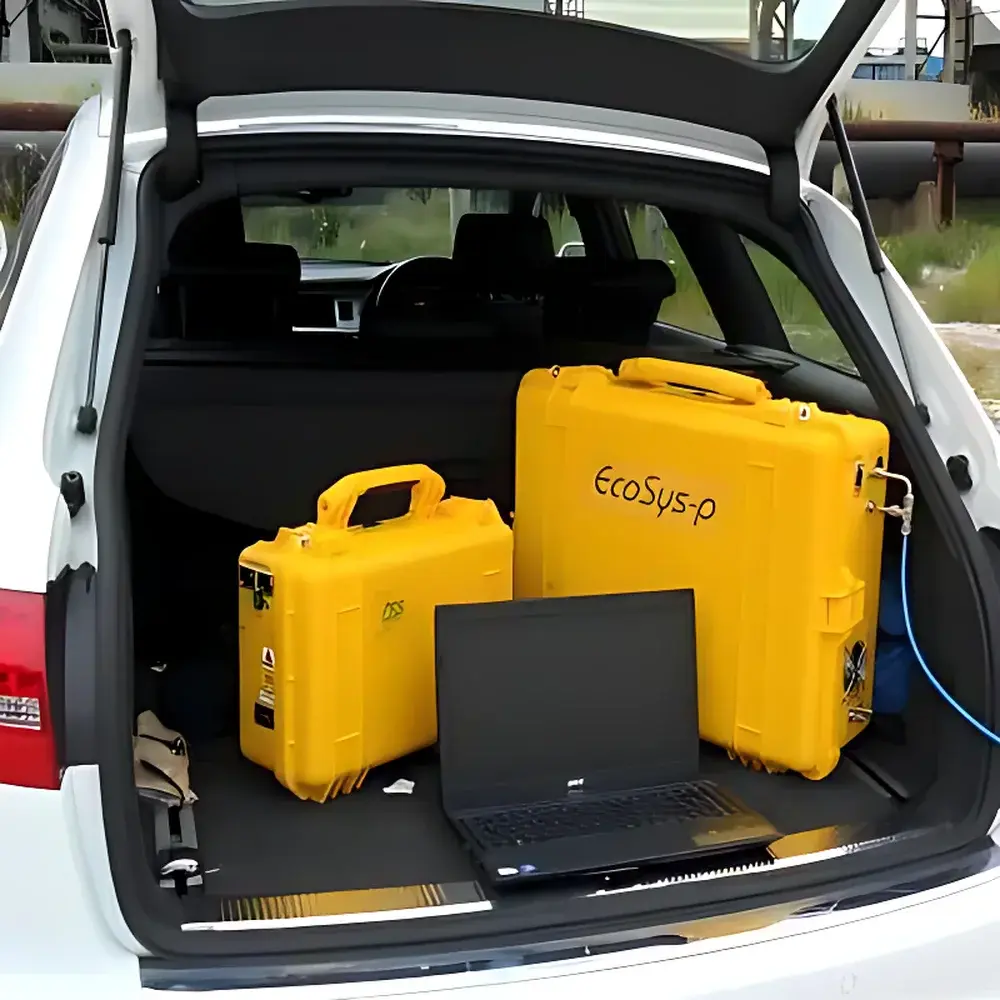
ESS Ecosys-P Portable Quadrupole Mass Spectrometer
| Brand | ESS |
|---|---|
| Origin | United Kingdom |
| Model | Ecosys-P |
| Power Supply | 100–240 V AC, 170 W |
| Battery | 24 V DC, 8 h continuous operation |
| I/O Ports | 4 analog outputs, 2 analog inputs, 2 digital inputs, 2 digital outputs |
| Detection Limit | sub-ppt (parts-per-quadrillion) for selected VOCs |
| Sample Introduction | Integrated thermal desorption unit with long-distance sampling capability |
| Operational Mode | Fully autonomous, unattended field deployment |
| Data Handling | Per-point data file generation, automated reporting, optional auto-calibration |
Overview
The ESS Ecosys-P Portable Quadrupole Mass Spectrometer is an integrated, field-deployable gas chromatography–mass spectrometry (GC-MS) system engineered for real-time, high-sensitivity detection and quantification of volatile organic compounds (VOCs) and ozone precursor species in ambient air, industrial emissions, and soil gas matrices. Built upon a robust quadrupole mass analyzer platform coupled with a microbore capillary GC column and thermally modulated sample introduction, the Ecosys-P operates on the principle of electron ionization (EI) followed by mass-to-charge (m/z) filtering under controlled vacuum conditions. Its compact architecture supports both direct ambient air analysis and pre-concentrated sampling via integrated thermal desorption—enabling reliable detection at sub-ppt (parts-per-quadrillion) levels for key target analytes including benzene, toluene, ethylbenzene, xylenes (BTEX), C2–C10 alkanes, alkenes, carbonyls, and halogenated organics. Designed for regulatory-grade environmental monitoring, the system meets functional requirements aligned with EPA Method TO-15, ASTM D6196, and ISO 16017-1 for trace-level VOC characterization.
Key Features
- Integrated thermal desorption module with programmable heating ramp (up to 350 °C) and cryo-focusing capability for enhanced sensitivity and compound retention
- Self-contained, battery-powered operation: 24 V DC lithium-ion pack supporting up to 8 hours of continuous unattended measurement
- Universal AC/DC power compatibility (100–240 V, 50/60 Hz) with internal voltage regulation and surge protection
- Dedicated I/O interface suite: four 4–20 mA analog outputs for external telemetry, two analog inputs for co-located sensor integration (e.g., temperature, humidity, pressure), and configurable digital I/O for remote trigger/control logic
- Onboard data autonomy: per-location timestamped binary data files (.raw), automatic metadata tagging (GPS coordinates, instrument status, calibration flags), and export-ready CSV/PDF report generation
- Optional wireless communication module supporting LTE-M and Wi-Fi 6 for secure cloud synchronization, remote diagnostics, and over-the-air firmware updates
Sample Compatibility & Compliance
The Ecosys-P accepts gaseous samples from ambient air, stack effluents, headspace vials, and soil vapor probes via standardized 1/8″ Swagelok or PTFE-lined tubing interfaces. It accommodates sorbent tubes (e.g., Tenax TA, Carbopack B/C) and can be interfaced with commercially available passive or active samplers. The system complies with ISO/IEC 17025:2017 general requirements for competence of testing and calibration laboratories. Its software architecture supports audit-trail functionality in accordance with FDA 21 CFR Part 11 for electronic records and signatures—enabling use in GLP and GMP-regulated environments where data integrity and operator accountability are mandated. Calibration protocols align with NIST-traceable standards and support multi-level bracketing with internal standard correction.
Software & Data Management
The Ecosys-P runs ESS Analytical Suite v4.x—a Windows-based, validated application providing method editor, real-time spectral visualization, library search (NIST MS Search 2.7g compatible), quantitative workflow automation, and QC charting (control charts, drift correction, recovery tracking). All raw spectral data are stored in vendor-neutral mzML format. Automated calibration routines include response factor verification, mass axis alignment, and detector gain optimization—all logged with full traceability. Data exports support LIMS integration via ASTM E1394-compliant ASCII formats and ODBC connectivity. Remote access is governed by TLS 1.3 encryption and role-based user permissions (administrator, analyst, viewer).
Applications
- Ambient air quality monitoring networks targeting ozone precursors (e.g., isoprene, terpenes, formaldehyde) and hazardous air pollutants (HAPs)
- Industrial fence-line monitoring for fugitive emissions compliance (e.g., refineries, chemical plants, landfills)
- Emergency response and hazmat incident characterization requiring rapid VOC identification and semi-quantitative screening
- Soil vapor intrusion assessments in brownfield redevelopment projects
- Method development and validation studies supporting regulatory submission packages (e.g., Tier 2 Risk Assessments, RCRA Corrective Action)
- Research applications in atmospheric chemistry, biogenic emission flux modeling, and urban pollution source apportionment
FAQ
What is the mass range and resolution specification of the quadrupole analyzer?
The Ecosys-P utilizes a ruggedized, low-voltage quadrupole with unit mass resolution (peak width at 10% valley, M/ΔM ≥ 1,000) across a nominal m/z range of 10–500.
Does the system support isotopic ratio measurements?
No—it is optimized for targeted and untargeted screening rather than high-precision isotope ratio analysis; for such applications, magnetic sector or Orbitrap-based platforms are recommended.
Can the thermal desorption module handle humid or particulate-laden samples?
Yes—the inlet path includes a heated particulate filter (0.5 µm sintered metal) and optional Nafion™ dryer integration to mitigate water vapor interference without analyte loss.
Is method transfer possible from laboratory GC-MS systems?
Yes—retention time indexing, spectral libraries, and quantitative methods developed on benchtop Agilent, Thermo, or Shimadzu GC-MS platforms can be ported with minor retention time adjustment.
What maintenance intervals are recommended for field deployment?
Ion source cleaning every 200 operating hours; quadrupole and detector bake-out every 1,000 hours; carrier gas filters replaced quarterly or after 500 sample injections—documented in the onboard maintenance log.






