
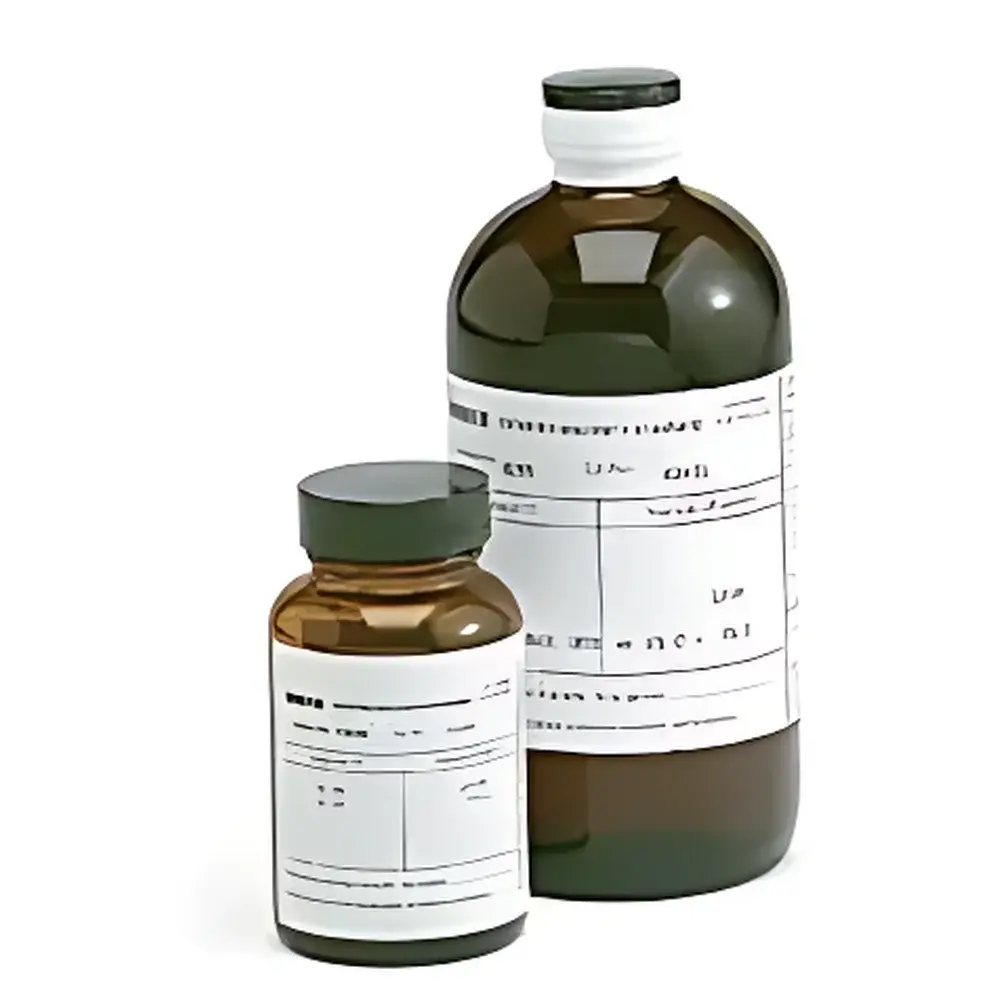
Brookfield Krebs Unit (KU) Viscosity Standard Oils
| Brand | Brookfield |
|---|---|
| Origin | USA |
| Model | Krebs Unit Viscosity Standard Oil |
| Nominal Viscosity Values | 61, 73, 87, 99, 106 KU at 25°C |
| Accuracy | ±1% of stated value |
| Packaging | 500 mL (1 pint) per bottle |
Overview
Brookfield Krebs Unit (KU) Viscosity Standard Oils are certified reference materials specifically formulated and validated for calibration and verification of Brookfield KU-series viscometers—widely used in architectural coatings, paint, and ink quality control laboratories. These oils operate on the principle of rotational viscometry under defined geometric and kinematic conditions: the KU viscometer employs a specially shaped paddle spindle rotating at 200 rpm in a fixed geometry cup, generating a shear rate profile centered above 500 s⁻¹. The resulting torque is converted into Krebs Units (KU), a proprietary scale calibrated against Newtonian oil standards traceable to the National Institute of Standards and Technology (NIST). Unlike generic viscosity standards, KU oils are engineered to replicate the rheological response of typical coating formulations under high-shear conditions, ensuring metrological continuity between instrument performance and industry-standard test methods such as ASTM D562 and ISO 2555.
Key Features
- Certified accuracy of ±1% of nominal KU value at 25°C, verified via primary calibration against NIST-traceable reference instruments
- Five discrete nominal values available: 61 KU, 73 KU, 87 KU, 99 KU, and 106 KU—covering the full operational range of KU viscometers used in QC labs
- Formulated from high-purity hydrocarbon blends (mineral oil and polybutene), ensuring chemical stability, low volatility, and long-term viscosity consistency
- Supplied in 500 mL amber glass bottles with tamper-evident seals to preserve integrity and minimize thermal/oxidative degradation
- Each bottle includes an individual Certificate of Calibration documenting batch-specific viscosity measurements, uncertainty budgets, temperature control records, and NIST traceability statements
- Validated for use exclusively with Brookfield KU-1, KU-2, KU-3, and compatible digital KU instruments—ensuring alignment with factory-set instrument algorithms
Sample Compatibility & Compliance
These standard oils are non-reactive with stainless steel, aluminum, and PTFE components common in KU viscometer assemblies. They exhibit negligible evaporation loss during standard 30-second measurement cycles and maintain thermal equilibrium rapidly at 25°C within laboratory-grade environmental chambers. All batches comply with ISO/IEC 17025:2017 requirements for certified reference material production and are manufactured under controlled cleanroom conditions to prevent particulate contamination. Documentation supports compliance with FDA 21 CFR Part 11 (when used with compliant data acquisition systems), GLP audit trails, and internal SOPs requiring documented instrument qualification (IQ/OQ/PQ). While not pharmaceutical-grade, their metrological rigor meets ASTM D562 Annex A1 requirements for reference fluid certification in paint viscosity testing.
Software & Data Management
When used with Brookfield’s optional KU software (e.g., Rheo3000 or ViscoQC 200), these standards enable automated calibration workflows that store calibration events with timestamps, operator IDs, ambient temperature/humidity logs, and deviation alerts. Audit trails include digital signatures and immutable records of all calibration parameters—including measured KU values, calculated % error, and pass/fail status relative to ±1% tolerance. Data exports conform to CSV and XML formats compatible with LIMS integration. All certificates are digitally signed and archived in accordance with ISO 17034:2016 for reference material producers, supporting full traceability from end-user lab back to NIST SRM protocols.
Applications
- Periodic verification and recalibration of KU viscometers prior to daily QC testing of architectural paints, latex emulsions, and industrial coatings
- Performance qualification of new or repaired instruments during installation and commissioning (IQ/OQ)
- Inter-laboratory method transfer studies where KU reproducibility must be demonstrated across multiple sites
- Root cause analysis when out-of-spec viscosity results occur—distinguishing instrument drift from formulation variation
- Training new technicians on proper KU measurement technique, including cup filling level, spindle immersion depth, and timing protocol adherence
- Supporting accreditation audits (e.g., A2LA, UKAS) by providing documented evidence of measurement traceability and uncertainty management
FAQ
What temperature must the standard oil be conditioned to before use?
All KU standard oils must be equilibrated to 25.0 ± 0.1°C in a thermostatically controlled water bath or environmental chamber for a minimum of 30 minutes prior to measurement.
Can these oils be reused after calibration?
Yes—provided they remain uncontaminated, sealed between uses, and stored at room temperature away from direct sunlight; however, Brookfield recommends discarding after 12 months from opening or if visible phase separation, cloudiness, or odor change occurs.
Is there a difference between KU and Krebs units?
No—“Krebs Unit” and “KU” are synonymous; both refer to the unit defined by ASTM D562 and generated exclusively by Brookfield’s KU-series geometry and 200 rpm rotation speed.
Do I need multiple standards for routine calibration?
At minimum, one standard near the midpoint of your typical test range (e.g., 87 KU for general-purpose coating QC) is required; two standards (e.g., 61 KU and 106 KU) are recommended for full-range verification per ASTM D562 Section 8.3.
Are these oils compatible with non-Brookfield KU viscometers?
Only if the instrument replicates Brookfield’s exact paddle geometry, cup dimensions, rotational speed (200 rpm), and torque conversion algorithm; deviations invalidate KU traceability and compromise compliance with ASTM D562.



