
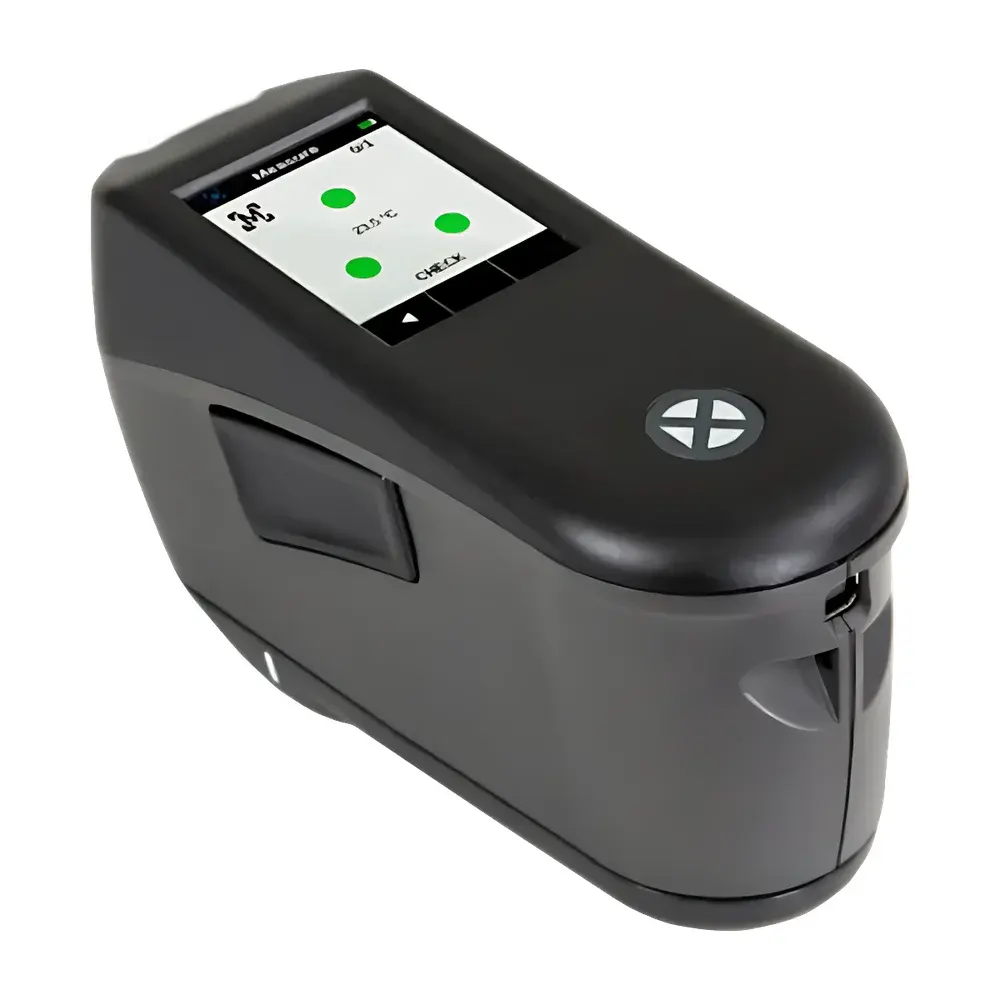
X-Rite MA-5 QC Multi-Angle Color Difference Meter
| Brand | X-Rite |
|---|---|
| Origin | USA |
| Model | MA-5 QC |
| Measurement Angles | 5 (r45as15, r45as25, r45as45, r45as75, r45as110) |
| Illuminant Options | D65, A, C, D50, F2, F7, F11, F12 |
| Observer Angle | 2° & 10° |
| Spectral Range | 400–700 nm |
| Spectral Interval | 10 nm |
| Aperture Size | Ø ≈ 12 mm |
| Measurement Time | 2.5 s |
| Repeatability (White Tile) | ≤ 0.02 ΔE* |
| Inter-instrument Agreement (BCRA Set) | 0.18 ΔE* avg |
| Display | 2.8″ QVGA TFT resistive touchscreen (240 × 320) |
| Operating Temp. | 10–40 °C |
| Storage Temp. | −20–50 °C |
| Relative Humidity | ≤ 85 % RH |
| Weight | 0.6 kg |
| Dimensions (L×W×H) | 180 × 70 × 95 mm |
| Light Source | White LED (10-year lifetime) |
| Battery | Rechargeable Li-ion (≥2000 cycles) |
| Connectivity | USB 2.0 |
| Software Mode | MA-94 Emulation |
| Data Storage | 1000 samples |
| Supported Languages | English, French, Italian, Spanish, German, Portuguese, Chinese, Japanese, Korean |
| Compliance | ISO 13655:2017, ASTM E308, CIE No. 15:2018, DIN 6175-2, ISO 12647-2 |
Overview
The X-Rite MA-5 QC Multi-Angle Color Difference Meter is an industrial-grade, handheld spectrophotometer engineered for high-precision color quality control in automotive, coatings, plastics, and metallic effect finish applications. It employs a fixed-geometry multi-angle reflectance measurement architecture—specifically the r45as (ring 45° illumination, asymmetric viewing) configuration at five discrete observation angles (15°, 25°, 45°, 75°, and 110°)—to quantify spatially varying goniochromatic behavior of effect pigments such as aluminum flakes, mica-based pearlescents, and interference pigments. Unlike conventional 0°/45° or d/8° instruments, the MA-5 QC captures angular-dependent color shift (flop), sparkle, and graininess with metrological rigor aligned with ISO 13655:2017 spectral measurement standards. Its optical design eliminates mechanical moving parts, ensuring long-term stability and minimizing drift across temperature gradients (10–40 °C operating range). The integrated white LED illuminant delivers stable, calibrated output over a 10-year service life and conforms to CIE illuminant definitions including D65, A, C, D50, and multiple fluorescent standards (F2, F7, F11, F12), enabling cross-process color evaluation under standardized lighting conditions.
Key Features
- Five-angle gonio-spectrophotometric measurement (r45as15, r45as25, r45as45, r45as75, r45as110) in a single 2.5-second acquisition cycle—no manual repositioning required.
- Compact, ergonomic form factor (180 × 70 × 95 mm; 0.6 kg) optimized for one-handed operation and extended use in production-line environments.
- High-repeatability optical path with ≤0.02 ΔE* short-term repeatability on white reference tile and 0.18 ΔE* average inter-instrument agreement across BCRA Series II tiles.
- Integrated auto-shutter mechanism prevents dust ingress and ensures consistent aperture geometry during idle periods.
- Real-time visual alignment aid via dual LED targeting system—ensures correct sample contact and measurement positioning without operator training dependency.
- Temperature preview function monitors ambient and instrument thermal state, flagging potential chromatic drift before measurement—critical for thermally sensitive substrates like thermoplastics or solvent-borne coatings.
- Dual observer support (2° and 10° CIE standard observers) and full compliance with CIE 15:2018 spectral computation models.
Sample Compatibility & Compliance
The MA-5 QC accommodates flat, curved, textured, and moderately flexible surfaces—including painted metal panels, injection-molded plastic parts, powder-coated extrusions, and laminated composites—within its 12 mm diameter measurement area. Its non-contact proximity sensing and spring-loaded measurement head maintain consistent pressure and distance control across variable surface topographies. All color difference calculations adhere to industry-standard metrics: ΔE* (CIELAB), ΔE₀₀ (CIEDE2000), ΔECMC (l:c = 2:1), ΔEDIN (DIN 6175-2), and ΔEAudi 2000Software & Data Management
The MA-5 QC operates natively in MA-94 emulation mode, ensuring backward compatibility with legacy X-Rite color management workflows. Data export is supported via USB 2.0 to Windows 7+ systems. Bundled Nucleos EXF QC software enables automated pass/fail evaluation against user-defined tolerances, statistical process control (SPC) charting, batch reporting, and spectral data archiving. The included USB memory stick contains licensed software variants—with or without hardware dongle authentication—and supports secure deployment in regulated manufacturing environments. All measurement metadata (timestamp, operator ID, instrument serial, illuminant/observer, angle-specific L*a*b*, temperature reading) is embedded in exported CSV and XML files. Firmware updates and language packs (English, German, French, Spanish, Italian, Portuguese, Japanese, Korean, Simplified Chinese) are delivered through the same interface. What calibration standards are included with the MA-5 QC?Applications
FAQ
A certified white ceramic calibration tile (BCRA Level III equivalent), traceable to NIST standards, is supplied as standard equipment. Optional secondary calibration kits—including black, gray, and metallic reference tiles—are available for enhanced angular validation.
Is the MA-5 QC suitable for measuring curved or textured surfaces?
Yes—the spring-loaded measurement head and 12 mm aperture provide reliable contact and consistent geometry on radii down to 25 mm and moderate surface textures (Ra ≤ 3.2 µm). For highly irregular geometries, optional fixturing accessories are recommended.
How does the MA-5 QC ensure measurement consistency across multiple instruments in a plant?
Inter-instrument agreement is validated against the BCRA Series II tile set, with a published average deviation of 0.18 ΔE*. Field recalibration using the included white tile every 21 days maintains this performance baseline across fleets.
Can measurement data be integrated into enterprise MES or LIMS platforms?
Yes—CSV and XML exports support direct ingestion into common manufacturing execution systems. With Nucleos EXF QC, users may configure custom API endpoints or scheduled database pushes via ODBC-compliant drivers.
What is the expected service life of the optical system?
The white LED illuminant is rated for 10 years of continuous operational use under normal laboratory or shop-floor conditions. Spectral stability is verified annually via factory recalibration services or accredited third-party labs.




