
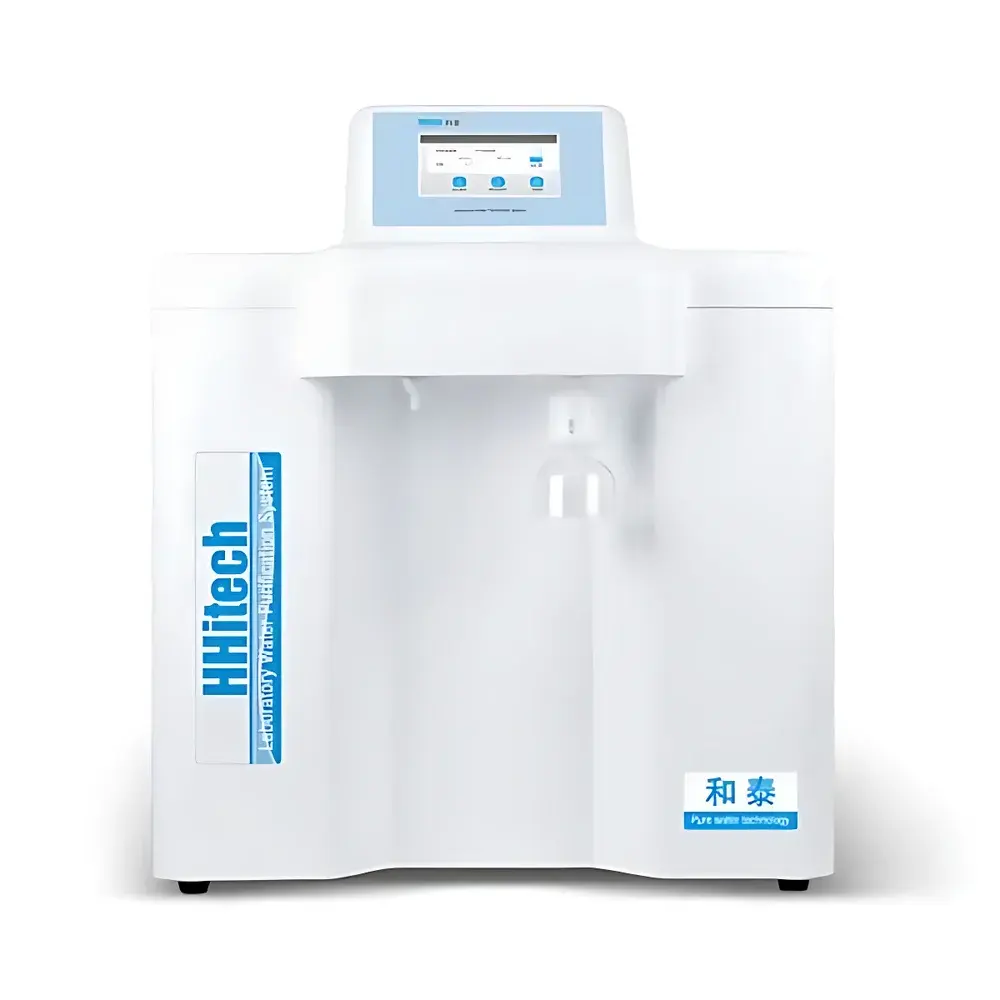
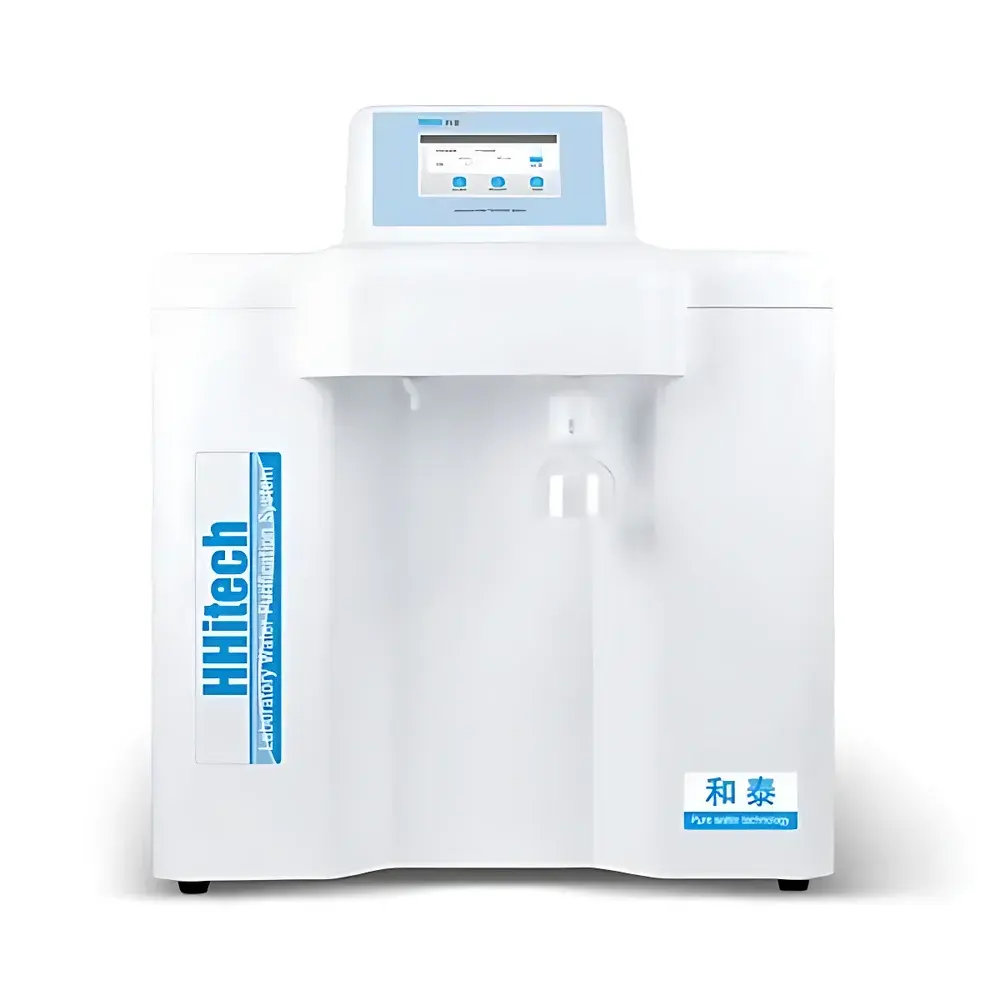
HHitech Master-R Dual-Stage Reverse Osmosis Ultra Pure Water System
| Brand | HHitech |
|---|---|
| Origin | Shanghai, China |
| Manufacturer Type | Authorized Distributor |
| Country of Origin | China |
| Model | Master-R |
| Price | Upon Request |
| Pure Water Output | 24 L/h |
| Ultra-Pure Water Output | Up to 2.0 L/min (with full reservoir) |
| RO Stage 1 Conductivity | ≈5% of feed water conductivity |
| RO Stage 2 Conductivity | 1–5 µS/cm (≤2% of feed water conductivity) |
| Organic Removal Rate (>200 Da) | >99% |
| Particle & Bacterial Rejection Rate | >99% |
| DI Resistivity | 16–18.2 MΩ·cm |
| Heavy Metals (DI) | <0.1 ppb |
| Bacteria (DI) | <0.01 CFU/mL |
| Particles (>0.1 µm, DI) | <1/mL |
| UP Resistivity | 18.2 MΩ·cm @ 25°C |
| Heavy Metals (UP) | <0.01 ppb |
| Bacteria (UP) | <0.01 CFU/mL |
| Particles (>0.1 µm, UP) | <1/mL |
| TOC (Standard) | <10 ppb |
| TOC (UV/UVF models) | <3 ppb |
| Endotoxins (UF/UVF) | <0.001 EU/mL |
| RNase (UF/UVF) | <1 pg/mL |
| DNase (UF/UVF) | <5 pg/mL |
| Feed Water | Municipal tap water, 5–45°C, 1.0–4.0 kgf/cm² |
| Dimensions (L×W×H) | 500×360×540 mm |
| Weight | ~28 kg |
| Electrical | 100–240 V, 50/60 Hz |
| Power Consumption | 120 W |
| Terminal filtration | (0.45 + 0.2) µm PES membrane |
Overview
The HHitech Master-R Dual-Stage Reverse Osmosis Ultra Pure Water System is an integrated laboratory water purification platform engineered for consistent production of Type I ultra-pure water (ASTM D1193-20) and Type III pure water (ISO 3696:1987) from municipal tap feed. It employs a sequential purification architecture: dual-stage reverse osmosis (RO) followed by electrodeionization (EDI) or mixed-bed ion exchange (DI), optional ultraviolet (UV) photooxidation at 185 nm and 254 nm, ultrafiltration (UF), and terminal 0.2 µm sterile filtration. This multi-barrier design ensures removal of dissolved ions, organic compounds (TOC), endotoxins, nucleases, particles, and microorganisms—meeting stringent requirements for molecular biology, cell culture, HPLC, LC-MS, and clinical diagnostics applications. The system operates under continuous monitoring of resistivity, TOC, temperature, pressure differentials, and flow rates, with all critical parameters logged for auditability and compliance with GLP/GMP frameworks.
Key Features
- Dual-stage RO configuration with Dow Filmtec™ composite membranes, delivering stable salt rejection (>99%) and extended membrane service life through programmable automatic anti-scaling flush cycles.
- Modular architecture enables independent servicing of pre-treatment (5 µm PP + KDF + coconut-shell activated carbon), RO, DI/EDI, UV, UF, and terminal filtration stages—minimizing downtime and simplifying preventive maintenance.
- NSF/ANSI 61-certified fluid path components—including tubing, quick-connect fittings, and housing materials—to suppress leachable TOC and ensure long-term chemical stability.
- Intelligent recirculation loop for ultra-pure water distribution, operating intermittently to maintain low bioburden (<0.01 CFU/mL) while reducing energy consumption and pump wear.
- Configurable disinfection protocols: user-initiated “loop circulation sterilization”, “point-of-use outlet sanitization”, “tank refill control”, and “manual drain”—all traceable in system logs.
- Two-tier password protection (factory + user levels) secures calibration, alarm thresholds, timer settings (including standby and auto-shutdown), and consumables tracking—supporting 21 CFR Part 11-compliant access control.
Sample Compatibility & Compliance
The Master-R accommodates variable feed water qualities typical of urban municipal supplies (5–45°C, 1.0–4.0 kgf/cm², turbidity <1 NTU). Its robust pre-treatment stage—featuring KDF-55 alloy media and acid-washed coconut-shell carbon—neutralizes chlorine, heavy metals, and scale-forming cations without sodium leakage. Final ultra-pure water meets or exceeds ASTM F795 (for cell culture), USP (water for pharmaceutical use), and ISO 13485 Annex A requirements for bioburden and endotoxin control. UF-equipped variants comply with IVF media preparation standards (e.g., ESHRE guidelines) due to verified removal of endotoxins (<0.001 EU/mL) and nucleases (RNase <1 pg/mL; DNase <5 pg/mL).
Software & Data Management
An embedded microprocessor records real-time operational data including resistivity (0.01–18.2 MΩ·cm), TOC (0.5–10 ppb), UV intensity, pressure drop across each module, and cumulative volume dispensed. Historical logs retain up to 12 months of event-driven entries: consumables usage (RO membrane, DI cartridges, UV lamp hours), alarm history (low pressure, high TOC, conductivity deviation), and manual intervention timestamps. Exportable CSV reports support internal QA audits and regulatory submissions. Optional Ethernet or RS232 connectivity enables integration into centralized lab infrastructure management systems.
Applications
- Molecular biology workflows requiring nuclease-free water: PCR, qRT-PCR, NGS library prep, CRISPR transfection.
- Sensitive analytical instrumentation: ICP-MS, GF-AAS, HPLC mobile phase preparation, and electrophoresis buffer formulation.
- Cell culture and regenerative medicine: stem cell expansion, organoid development, and embryo transfer media.
- Pharmaceutical QC testing: dissolution media, blank preparation for residual solvent analysis, and cleaning validation.
- Calibration standards preparation where trace metal contamination must remain below detection limits (e.g., EPA Method 200.8).
FAQ
What feed water quality is required for optimal Master-R performance?
Municipal tap water meeting WHO drinking water guidelines is sufficient; however, pretreatment capacity assumes turbidity <1 NTU, free chlorine <1 ppm, and iron <0.1 ppm. Higher contaminant loads necessitate customized pre-filtration.
Can the system be validated per IQ/OQ/PQ protocols?
Yes—the modular design, digital parameter logging, and password-protected configuration allow formal qualification against ISO/IEC 17025 and GAMP 5 principles. Validation templates and calibration certificates are available upon request.
How often must consumables be replaced?
RO membranes: 2–3 years (dependent on feed water hardness); KDF/carbon pre-filters: 12 months; UV lamps: 9,000 hours; UF membranes: 18–24 months; terminal filters: 6 months or after 1,000 L, whichever occurs first.
Is remote monitoring supported?
Standard models include local display and data export via USB; optional Ethernet or Wi-Fi modules enable SNMP-based network integration and third-party SCADA compatibility.
Does the system meet FDA 21 CFR Part 11 requirements?
Full electronic record and signature functionality—including audit trail, role-based access, and immutable log archiving—is available with the optional Compliance Package firmware upgrade.



