
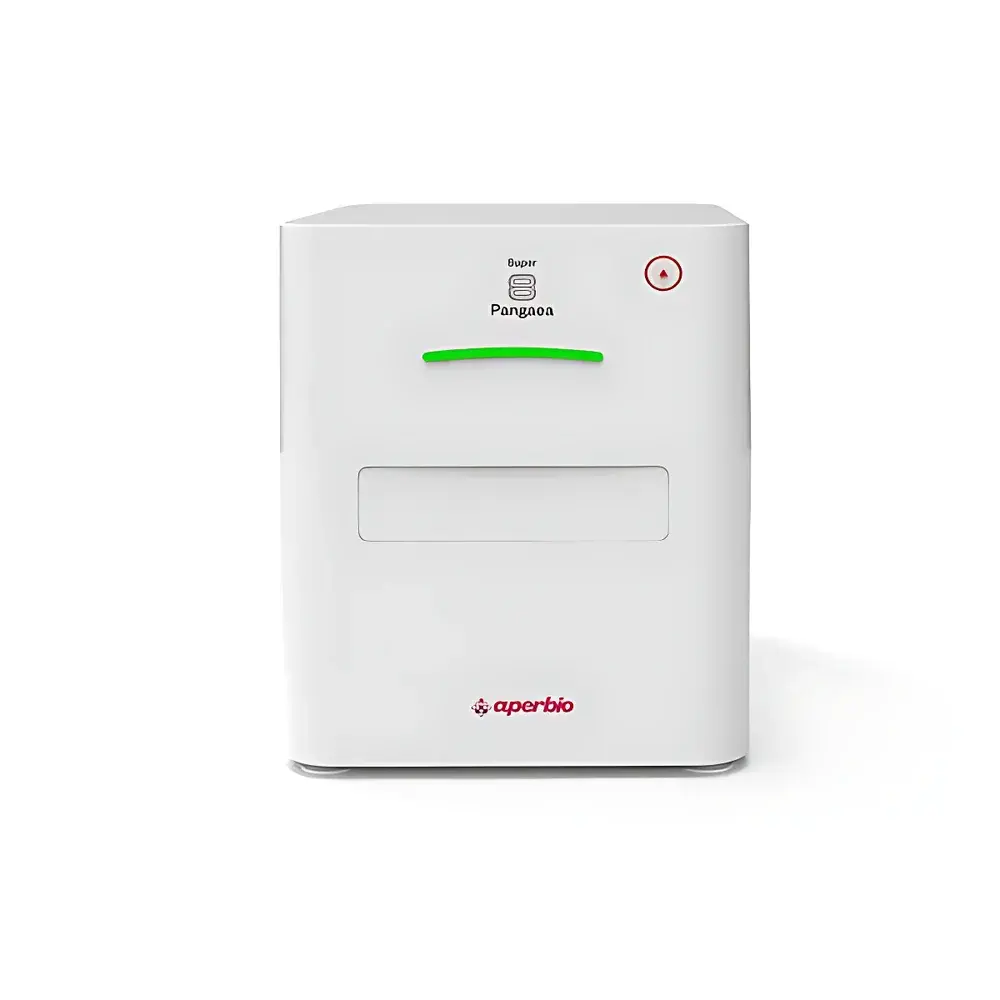
Aperbio Pangaea Super 8 Portable Ultra-Fast Real-Time Fluorescent Quantitative PCR System
| Brand | Aperbio |
|---|---|
| Origin | Jiangsu, China |
| Manufacturer Type | Original Equipment Manufacturer (OEM) |
| Instrument Category | Domestic |
| Model | Pangaea Super 8 Portable |
| Instrument Type | Real-Time Fluorescent Quantitative PCR System |
| Sample Throughput | 8 samples |
| Heating Rate | 12 °C/s |
| Temperature Accuracy | ±0.1 °C |
| Inter-Well Temperature Uniformity | ±0.15 °C |
| Detection Channels | 4 (FAM/VIC/ROX/Cy5) |
| Reaction Volume | 10–50 µL |
| Optical Detection System | Waveguide-Coupled CMOS Imaging System |
| Dimensions (L×W×H) | 280 × 200 × 230 mm |
| Sample Loading | Motorized Auto-Loading Tray |
| Operating System | Windows 10 (optimized for Microsoft Surface Go) |
| Multi-Unit Networking | ≥4 units via Ethernet (Wi-Fi adapter optional) |
| Connectivity | RJ45 Ethernet port |
Overview
The Aperbio Pangaea Super 8 Portable Ultra-Fast Real-Time Fluorescent Quantitative PCR System is an engineered molecular diagnostics platform designed for point-of-need nucleic acid amplification and quantification. Based on real-time fluorescence detection of sequence-specific amplicons during thermal cycling, the system implements a high-fidelity two-step or three-step PCR protocol with integrated optical monitoring across four independent excitation/emission channels (FAM, VIC, ROX, Cy5). Its core architecture leverages rapid Peltier-based thermal control—achieving heating rates up to 12 °C/s—and precision microfluidic chamber design to deliver quantitative results in ≤20 minutes from sample loading. The system operates without routine calibration or service intervention, making it suitable for deployment in field laboratories, mobile testing units, border health checkpoints, veterinary clinics, and decentralized clinical settings where infrastructure, power stability, or technical staffing may be constrained.
Key Features
- Ultra-rapid thermal cycling: 12 °C/s heating rate enables full qPCR runs—including denaturation, annealing, extension, and fluorescence acquisition—in under 20 minutes.
- Portable form factor: Compact footprint (280 × 200 × 230 mm) and integrated motorized auto-loading tray support single-handed operation and transport between locations without recalibration.
- Four-channel multiplex detection: Simultaneous quantification of up to four targets per reaction using standardized fluorophore sets (FAM/VIC/ROX/Cy5), compatible with common probe chemistries including hydrolysis (TaqMan) and hybridization probes.
- Waveguide-coupled CMOS optical system: Delivers high signal-to-noise ratio detection with minimal photobleaching and no moving optical components—ensuring long-term stability and reproducibility across field deployments.
- Networked scalability: Supports synchronized operation of ≥4 units via standard Ethernet; centralized data aggregation and remote status monitoring are enabled through native TCP/IP communication protocols.
- Embedded Windows 10 runtime: Preconfigured for Microsoft Surface Go-class devices; supports local data storage, export in CSV/Excel formats, and integration with LIMS via ODBC-compliant database drivers.
Sample Compatibility & Compliance
The Pangaea Super 8 accommodates standard 0.2 mL thin-wall PCR tubes and 8-well strips (reaction volume: 10–50 µL), with compatibility verified for commercial master mixes, lyophilized reagents, and ISO 13485-certified diagnostic kits. Thermal performance meets ASTM E2927-22 requirements for temperature uniformity (±0.15 °C inter-well) and accuracy (±0.1 °C at setpoint), supporting method validation under CLIA, CAP, and ISO 15189 frameworks. While not FDA 510(k)-cleared as an IVD device, the platform complies with general-purpose laboratory instrument standards (IEC 61010-1) and supports audit-ready data management when used in GLP/GMP-aligned workflows.
Software & Data Management
The bundled Aperbio QPCR Control Suite provides intuitive workflow navigation in English and Chinese UI modes, with preloaded assay templates for SARS-CoV-2, influenza A/B, RSV, and common bacterial pathogens. All raw fluorescence curves, Ct values, efficiency calculations, and melt curve derivatives are stored with timestamped metadata (user ID, instrument serial, run parameters). Software enforces role-based access control, automatic backup to network drives, and configurable audit trails compliant with FDA 21 CFR Part 11 requirements when deployed with validated Windows domain authentication and encrypted storage.
Applications
- Rapid pathogen identification in outbreak response scenarios (e.g., foodborne illness investigations, zoonotic spillover events)
- On-site antimicrobial resistance gene screening in livestock and aquaculture operations
- Field-deployable environmental DNA (eDNA) monitoring for invasive species detection
- Quality control of biomanufactured plasmids and viral vectors in GMP pilot facilities
- Teaching labs requiring robust, low-maintenance qPCR instrumentation for undergraduate molecular biology curricula
FAQ
Does the Pangaea Super 8 require regular optical recalibration after relocation?
No. The waveguide-CMOS optical path is factory-aligned and mechanically stabilized; no user-performed recalibration is required following transport or repositioning.
Can the system perform absolute quantification using external standards?
Yes. The software supports standard curve generation from serial dilutions, with automatic interpolation of unknown concentrations based on linear regression (R² ≥ 0.995) and slope-derived amplification efficiency.
Is the instrument compatible with third-party qPCR master mixes?
Yes. It has been validated with commercially available hot-start Taq polymerases, reverse transcriptase blends, and intercalating dye formulations—provided they fall within the specified excitation/emission bandwidths of the four detection channels.
What cybersecurity measures are implemented for networked operation?
Units operate on isolated subnets by default; firmware updates are cryptographically signed, and all remote connections require TLS 1.2+ authentication. No cloud telemetry or outbound data transmission occurs without explicit administrator consent.
How is thermal uniformity verified during manufacturing?
Each unit undergoes NIST-traceable thermal mapping using calibrated micro-thermocouples across all eight wells at multiple setpoints (45–95 °C); final certification requires ≤±0.15 °C deviation across the block.






