
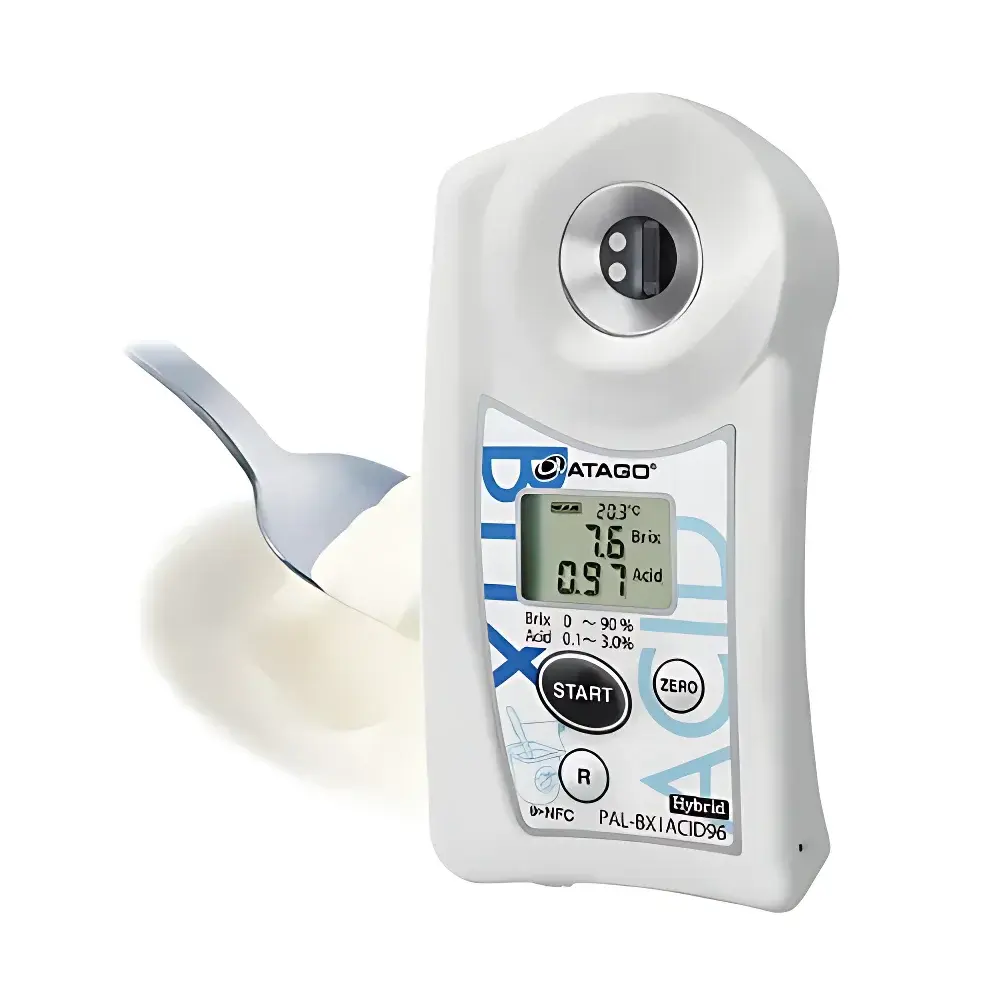
ATAGO PAL-BX/ACID 96 Portable Digital Refractometer for Yogurt Brix and Total Acidity Measurement
| Brand | ATAGO |
|---|---|
| Origin | Japan |
| Model | PAL-BX/ACID 96 |
| Product Type | Handheld Refractometer |
| Display | Digital LCD |
| Temperature Compensation Range | 10–40 °C |
| Brix Range | 0.0–90.0 % |
| Acid Range (as lactic acid) | 0.10–3.00 % |
| Brix Accuracy | ±0.2 % |
| Acid Accuracy | ±0.10 % (0.10–1.00 %), ±10 % relative (1.01–8.80 %) |
| Brix Resolution | 0.1 % |
| Acid Resolution | 0.01 % (0.00–9.99 %), 0.1 % (≥10.0 %) |
| Sugar-Acid Ratio Resolution | 0.01 (0–9.99), 0.1 (10.0–99.9), 1 (≥100) |
| Operating Temp. | 10–40 °C |
| Power | 2 × AAA alkaline batteries |
| IP Rating | IP65 |
| Dimensions | 5.5 × 3.1 × 10.9 cm |
| Weight | 100 g (instrument only) |
Overview
The ATAGO PAL-BX/ACID 96 is a compact, handheld digital refractometer engineered for simultaneous, rapid quantification of soluble solids (Brix) and total acidity—expressed as lactic acid concentration—in fermented dairy products, particularly yogurt and cultured milk beverages. Unlike conventional titrimetric methods requiring reagents, glassware, and trained personnel, this instrument leverages the optical principle of critical angle refraction: light passing through a sample–prism interface undergoes angular deviation proportional to the sample’s refractive index, which correlates linearly with solute concentration under controlled temperature conditions. Integrated automatic temperature compensation (ATC) across 10–40 °C ensures measurement stability without external thermostating. The device does not perform direct pH or titratable acidity (TA) measurement; instead, it reports acidity as a calibrated conversion from refractive index shift induced by lactic acid accumulation during fermentation—a validated empirical correlation widely adopted in dairy quality control per ISO 2173 (milk and milk products — determination of soluble solids content — refractometric method) and aligned with internal QC protocols used by ISO/IEC 17025-accredited laboratories.
Key Features
- Single-instrument dual-parameter measurement: Brix (0.0–90.0 %) and total acidity (0.10–3.00 % as lactic acid) with dedicated calibration curves optimized for yogurt matrices.
- Digital LCD display with intuitive key operation: ‘R’ button triggers instantaneous sugar–acid ratio calculation—critical for sensory profiling and process consistency assessment.
- Robust industrial design: IP65-rated enclosure resists dust ingress and low-pressure water jets, suitable for humid production environments and clean-in-place (CIP) adjacent workstations.
- No external power supply required: Operates on two standard AAA alkaline batteries with typical service life exceeding 10,000 measurements.
- High reproducibility: ±0.2 % Brix and ±0.10 % acidity accuracy (at low-range concentrations) supports routine monitoring within GMP-aligned dairy QA workflows.
- Minimal sample volume: Requires only 0.3 mL per measurement; no centrifugation, filtration, or chemical reagents needed.
Sample Compatibility & Compliance
The PAL-BX/ACID 96 is validated for homogeneous, non-particulate liquid dairy samples including plain and fruit-blended yogurts, kefir, buttermilk, and acidified milk drinks. Viscous or pulpy formulations must be homogenized prior to analysis to avoid prism surface residue and refractive index heterogeneity. It is not intended for use with whey protein isolates, powdered reconstitutes, or samples containing suspended solids >5 µm without pre-filtration (e.g., 0.45 µm PVDF membrane). While not FDA 21 CFR Part 11 compliant out-of-the-box (lacking audit trail, electronic signature, and user access controls), its measurement output satisfies documentation requirements for HACCP prerequisite programs and internal QC records when paired with controlled SOPs (e.g., ISO 22000 Annex SL clause 8.5.2). Calibration verification using NIST-traceable sucrose and lactic acid standards is recommended before each shift.
Software & Data Management
This stand-alone instrument does not feature Bluetooth, USB, or PC connectivity. All data remain on-device with no onboard memory or export capability. Users record results manually into paper-based logbooks or LIMS-integrated spreadsheets. For traceability, operators are advised to annotate measurement time, ambient temperature, sample ID, and instrument serial number alongside each reading. Optional accessories include the ATAGO RS-232 interface cable (sold separately) and compatible data logging software (PAL-DataLink v3.0), enabling CSV export and basic trend visualization—though such configurations require validation per laboratory-specific data integrity policies (ALCOA+ principles).
Applications
- Real-time fermentation endpoint detection in yogurt starter culture batches.
- In-process verification of post-fermentation acidification and refrigerated storage stability.
- Raw material acceptance testing of incoming milk for baseline acidity screening.
- Shelf-life studies correlating Brix–acidity ratios with organoleptic degradation markers.
- Supplier qualification audits where rapid field verification of declared acidity specifications is required.
- Educational laboratories demonstrating colligative property relationships in food colloids.
FAQ
Does the PAL-BX/ACID 96 measure pH or titratable acidity (TA)?
No. It estimates total lactic acid concentration via refractive index correlation—not electrochemical or volumetric methods. Results align with AOAC 947.03–derived TA equivalents only within the validated yogurt matrix range.
Can I measure flavored or probiotic yogurts?
Yes—if thoroughly mixed to ensure homogeneity and free of fruit pulp or stabilizer aggregates. High-viscosity samples may require brief centrifugation (3,000 rpm, 2 min) prior to sampling.
Is calibration traceable to national standards?
ATAGO provides factory calibration certificates referencing JCSS (Japan Calibration Service System); users should perform daily verification using certified 10.00 % Brix and 1.00 % lactic acid reference solutions.
What maintenance is required?
Wipe prism surface with lens tissue and distilled water after each use; avoid alcohol or abrasive cleaners. Store in protective case with desiccant at 10–30 °C ambient.
Does it comply with ISO/IEC 17025 requirements?
The instrument itself is not accredited, but its use within a validated method (e.g., internally developed SOP based on ISO 2173) satisfies measurement uncertainty and traceability clauses when supported by documented calibration, environmental monitoring, and operator training records.






