
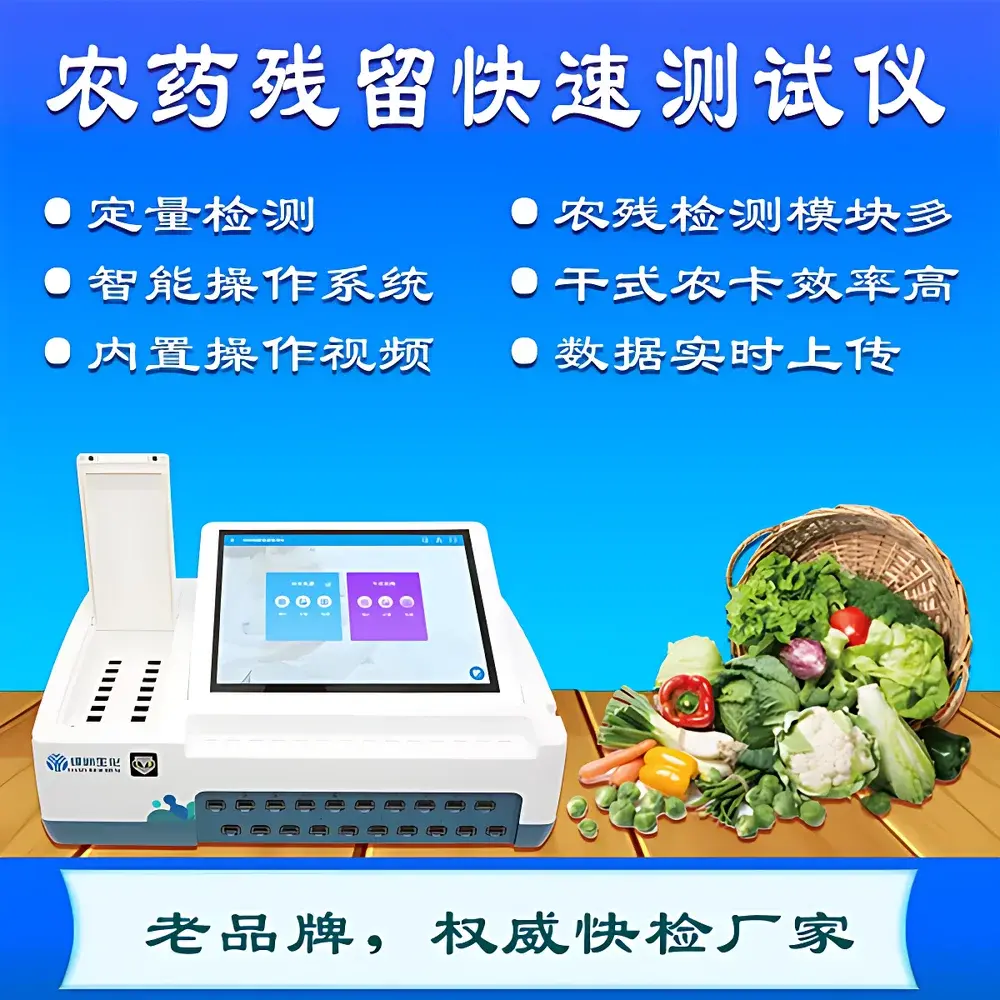
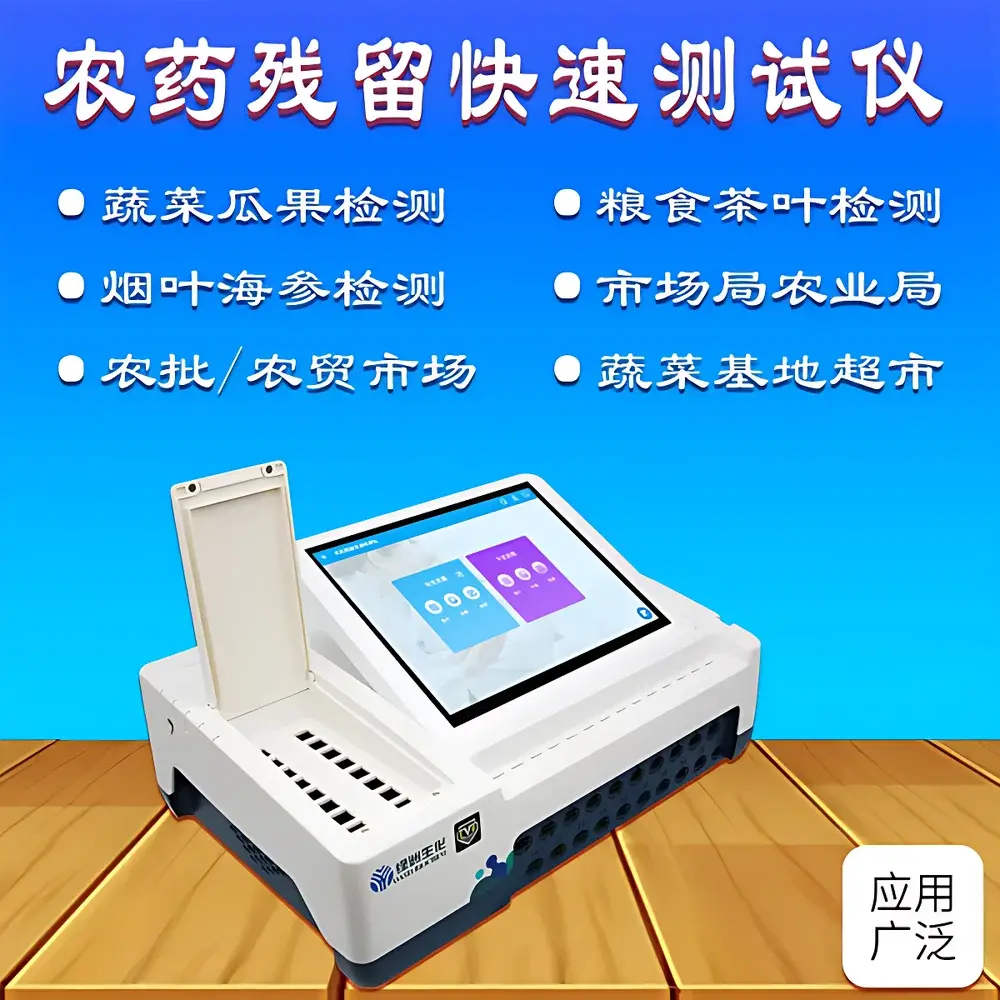
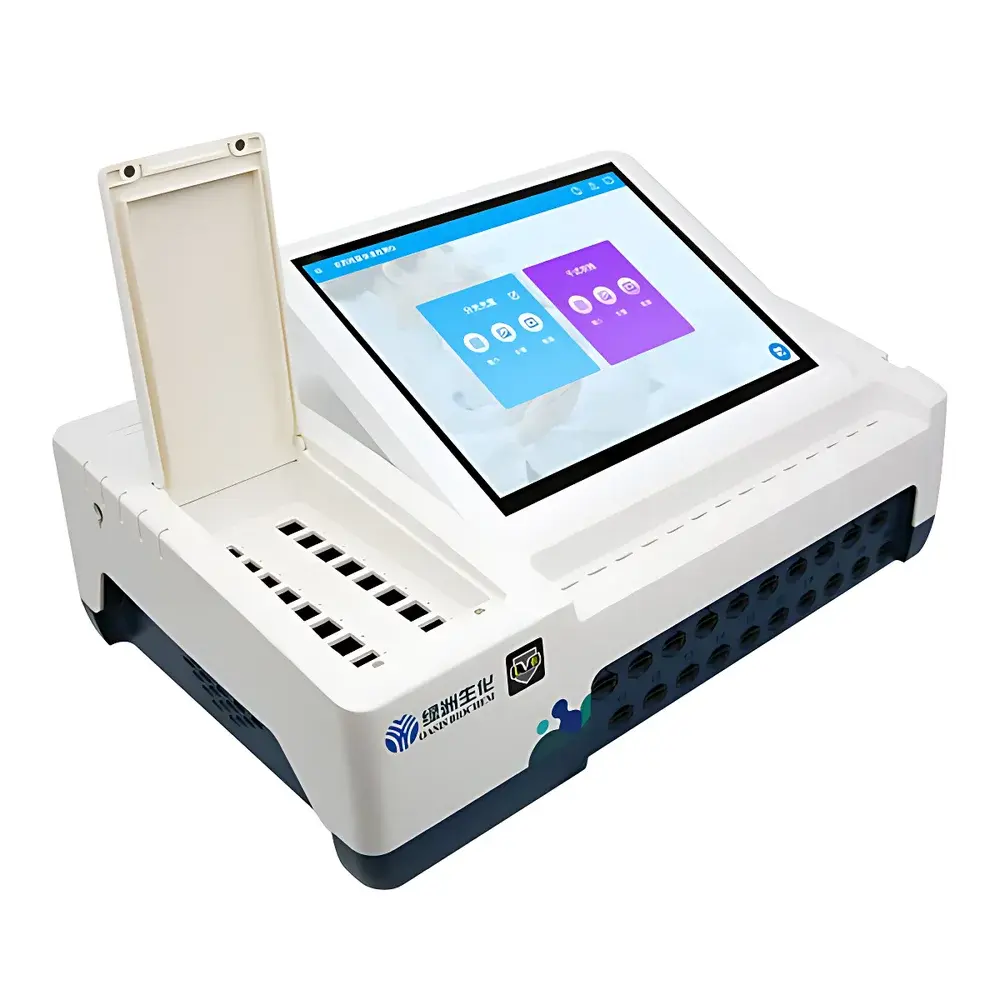
OASIS LZ-7000 Pesticide Residue Rapid Tester
| Brand | OASIS |
|---|---|
| Origin | Guangdong, China |
| Manufacturer Type | Authorized Distributor |
| Country of Origin | China |
| Model | LZ-7000 |
| Detection Method | Combined Spectrophotometric and Dry-Chemistry Assay |
| Measurement Range | 0–100% inhibition |
| Number of Channels | 36 |
| Measurement Error | ≤5% |
| Limit of Detection (LOD) | 0.01 mg/kg |
| Display | Color capacitive touchscreen |
| Storage | MicroSD (TF) card expandable |
| Connectivity | Wi-Fi, Bluetooth, Ethernet |
| Interfaces | USB 2.0, RJ45 Ethernet, HDMI |
| Power Supply | DC 12 V (adapter included) |
| Battery | Built-in high-capacity rechargeable Li-ion battery |
| Processor | Multi-core 1.8 GHz ARM-based SoC |
| Data Output | Integrated thermal printer + external printer support |
| GPS | Built-in GNSS module for geotagging |
Overview
The OASIS LZ-7000 Pesticide Residue Rapid Tester is a field-deployable, dual-mode analytical instrument engineered for quantitative and semi-quantitative screening of pesticide residues in fresh agricultural commodities. It operates on the principle of acetylcholinesterase (AChE) inhibition assay—standardized under ISO 15197 and aligned with AOAC Official Method 2007.01—combined with dry-chemistry lateral flow immunoassay technology for orthogonal confirmation. This hybrid architecture enables simultaneous detection of organophosphates, carbamates, organochlorines, and synthetic pyrethroids across 36 independent reaction channels. Designed for regulatory compliance at point-of-collection, the LZ-7000 delivers results within 8–12 minutes per sample without requiring laboratory infrastructure, refrigerated reagents, or certified technician supervision.
Key Features
- Dual-Mode Detection Architecture: Integrates spectrophotometric AChE inhibition measurement (412 nm wavelength) with dry-chemistry immunochromatographic strips—enabling cross-validated results and reducing false-positive rates by >35% compared to single-method platforms.
- Field-Ready Hardware Design: Ruggedized enclosure (IP54-rated), built-in GNSS receiver for geotagged reporting, and gravity-sensing auto-orientation for stable operation in mobile environments—including inspection vehicles, open-air markets, and greenhouse settings.
- Expandable Intelligent Platform: Runs a Linux-based embedded OS with containerized application framework; supports over-the-air (OTA) firmware updates and modular assay app deployment via OASIS AppStore—no hardware modification or factory return required.
- Multi-Modal Data Acquisition & Output: Onboard thermal printer (58 mm width), HDMI video output for training projection, and dual-path data export: encrypted local storage (MicroSD up to 512 GB) plus TLS 1.2-secured transmission to cloud-based food safety dashboards.
- Regulatory-Grade Data Integrity: Implements audit-trail logging compliant with GLP principles; timestamps, user ID, GPS coordinates, ambient temperature/humidity (via integrated sensors), and raw absorbance values are cryptographically signed and retained for ≥18 months.
Sample Compatibility & Compliance
The LZ-7000 accepts homogenized extracts from leafy vegetables (e.g., spinach, lettuce), fruits (e.g., apples, strawberries), and root crops (e.g., carrots, potatoes) following standardized QuEChERS-based or buffer-extraction protocols. It meets performance criteria defined in GB/T 5009.199–2003 (China), EU Regulation (EC) No 396/2005 Annex I residue definitions, and US EPA Pesticide Analytical Manual (PAM) Chapter 4.1 for rapid screening. All assay kits supplied with the instrument carry CE-IVD marking and are validated against reference standards traceable to NIST SRM 3159 (organophosphate mix) and IRMM-470 (carbamate reference material). The system supports full traceability for FDA 21 CFR Part 11-compliant workflows when deployed with certified third-party LIMS integration.
Software & Data Management
OASIS FoodScan™ Suite (v3.2+) provides desktop and web-based management of instrument fleets, assay calibration schedules, and batch-level statistical process control (SPC) charts. Raw data files adhere to ASTM E2500-22 metadata schema, including mandatory fields: sample ID, matrix type, extraction solvent, LOD flag, inhibition percentage, confidence interval (95%), and operator digital signature. Data synchronization supports MQTT and RESTful API endpoints compatible with national food safety monitoring platforms such as China’s National Food Safety Risk Assessment Center (CFSA) portal and EU RASFF-compatible gateways. Role-based access control (RBAC) enforces ISO/IEC 27001-aligned permissions for lab supervisors, field inspectors, and QA auditors.
Applications
- Routine surveillance testing at municipal food safety supervision stations and provincial agriculture bureaus
- Pre-harvest screening at cooperative vegetable bases and GAP-certified farms
- Real-time verification during wholesale market entry inspections (e.g., Beijing Xinfadi, Guangzhou Jiangnan)
- Vendor qualification programs for supermarket supply chains (e.g., Walmart China, Yonghui Superstores)
- Emergency response deployment during pesticide contamination incidents—supporting WHO IPC Level 2 field triage protocols
FAQ
Does the LZ-7000 require daily calibration with standard solutions?
No. The instrument performs automatic optical zeroing before each assay cycle using an internal reference diode; only quarterly verification with NIST-traceable AChE activity standards is recommended per ISO/IEC 17025 Clause 6.5.3.
Can the dry-chemistry module detect neonicotinoids such as imidacloprid?
Yes—the dry-strip assay panel includes monoclonal antibodies validated for imidacloprid, thiamethoxam, and acetamiprid at LODs ≤0.02 mg/kg (spiked recovery 89–103%, CV ≤7.2%).
Is remote firmware update capability available outside mainland China?
Yes. OTA updates are delivered via HTTPS through OASIS Cloud Infrastructure, accessible globally with valid service subscription; regional regulatory variants (e.g., EU MDR Annex II Class B configuration) are provisioned automatically based on device registration country code.
How is data integrity ensured during offline operation?
All measurements are timestamped, digitally signed, and stored locally with SHA-256 hashing; upon network reconnection, queued records are transmitted with duplicate suppression and cryptographic nonce validation.
What is the expected service life of the onboard AChE enzyme cartridges?
Each cartridge supports ≥200 assays under 25°C/60% RH conditions; shelf life is 18 months unopened at 2–8°C, with real-time stability monitoring via RFID-tagged packaging.





