
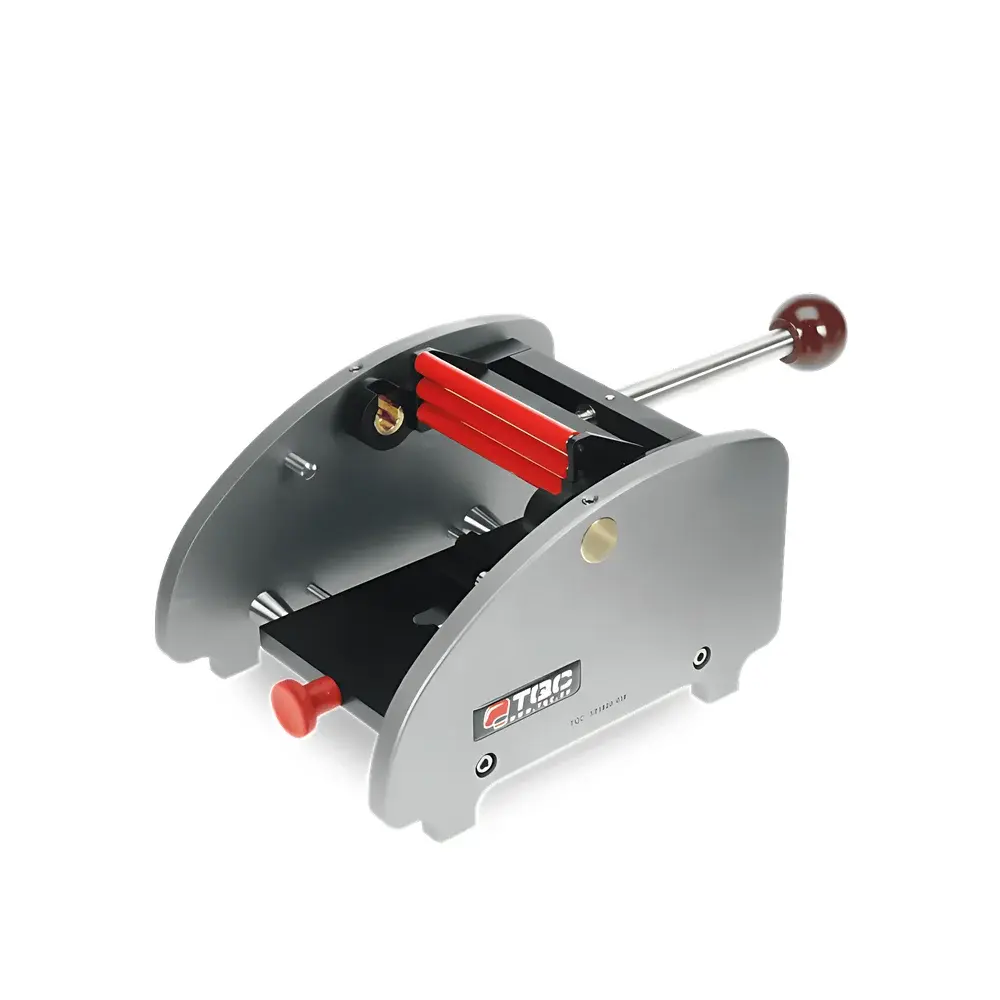
TQC Sheen SP1820/SP1822 Cylindrical Mandrel Bend Tester
| Brand | TQC Sheen |
|---|---|
| Origin | Netherlands |
| Model | SP1820 (Metric) / SP1822 (Imperial) |
| Dimensions (Unit) | 140 × 170 × 340 mm |
| Weight (Unit) | 4150 g |
| Max Panel Size | 150 × 100 mm |
| Max Panel Thickness | 1 mm |
| Mandrel Set Count | 14 (SP1820) / 7 (SP1822) |
| Mandrel Diameters | 2–32 mm (SP1820) / 1/8–1 in (SP1822) |
| Base Frame Dimensions | 100 × 130 × 160 mm |
| Load Arm Mass (with mandrel) | 2900 g (SP1820) / 1740 g (SP1822) |
Overview
The TQC Sheen SP1820 and SP1822 Cylindrical Mandrel Bend Testers are precision-engineered mechanical instruments designed to evaluate the flexibility, adhesion, and elongation characteristics of organic coatings applied to rigid metallic substrates. Based on the fundamental principle of controlled plastic deformation—where a coated test panel is bent around a fixed-diameter cylindrical mandrel—the device subjects the coating to quantifiable tensile strain at the outer surface and compressive stress at the inner surface. The onset of cracking, flaking, or delamination after bending serves as a qualitative and semi-quantitative indicator of coating integrity under mechanical stress. This method is standardized under ISO 1519, ASTM D522 (Method A), GOST 6806, and referenced in industry-specific specifications including Qualicoat, QIB, and GSB. Unlike dynamic or servo-controlled testers, this manual lever-operated system delivers repeatable, operator-independent results when used in accordance with GLP-aligned laboratory procedures.
Key Features
- Two interchangeable configuration sets: SP1820 (metric, 14 mandrels: 2, 3, 4, 5, 6, 8, 10, 12, 13, 16, 19, 20, 25, 32 mm) and SP1822 (imperial, 7 mandrels: 1/8, 1/4, 3/8, 1/2, 5/8, 3/4, 1 inch)
- Anodized aluminum frame and stainless-steel mandrels ensure long-term dimensional stability, corrosion resistance, and consistent surface finish critical for reliable interfacial stress transfer
- Ergonomic clamping mechanism with positive alignment stops guarantees precise positioning of panels (max 150 × 100 mm, thickness ≤1 mm) relative to the mandrel axis
- Optimized lever geometry provides mechanical advantage for smooth, low-friction bending without jerking or overshoot—minimizing operator-induced variability
- Modular base design supports both benchtop operation and wall-mount installation; footprint optimized for ISO-standard laboratory workspaces
- Compliant load arm mass (2900 g for SP1820; 1740 g for SP1822) ensures consistent bending force across all mandrel sizes per ASTM D522 requirements
Sample Compatibility & Compliance
The tester accommodates flat, rigid substrates—including cold-rolled steel, aluminum, and stainless-steel panels—coated with liquid paints, powder coatings, lacquers, and industrial primers. Panels must be free of warping, edge burrs, or pre-existing defects that could influence crack initiation. Maximum specimen dimensions are strictly limited to 150 mm × 100 mm × 1 mm to maintain uniform strain distribution during bending. Both SP1820 and SP1822 configurations meet the geometric tolerances specified in ISO 1519:2021 (Clause 5.2) for mandrel diameter deviation (±0.05 mm for diameters ≤10 mm; ±0.1 mm for >10 mm) and surface roughness (Ra ≤0.8 µm). The instrument is routinely employed in quality control environments operating under ISO/IEC 17025, IATF 16949, and AS9100 frameworks, where documented traceability to national metrology institutes (e.g., NMi, VSL) is maintained for mandrel calibration.
Software & Data Management
As a manually operated mechanical tester, the SP1820/SP1822 does not incorporate embedded electronics or digital output. However, it is fully compatible with laboratory information management systems (LIMS) and electronic lab notebooks (ELN) via structured manual entry protocols. Test records—including mandrel ID, panel substrate type, coating formulation batch number, observed failure mode (e.g., “edge cracking at 4 mm mandrel”, “intercoat delamination at 1/4 in”), and pass/fail designation per specification—can be logged in accordance with 21 CFR Part 11-compliant audit trails when using validated ELN platforms. Calibration certificates for individual mandrels (traceable to NIST or EURAMET standards) are supplied with each set and must be retained for regulatory audits.
Applications
This instrument is deployed across sectors requiring rigorous assessment of coating durability under flexural stress: aerospace component finishing (e.g., fuselage skins, wing leading edges), automotive OEM and refinish coatings (bumpers, trim, chassis parts), beverage can exteriors (aluminum litho printing), marine hull and deck coatings, military vehicle camouflage systems, and architectural metal cladding. In R&D laboratories, it supports formulation optimization—e.g., evaluating plasticizer efficacy in PVC-based coil coatings or crosslink density effects in epoxy-polyester hybrids. Educational institutions use it for teaching polymer mechanics principles, including strain-to-failure correlation and Hooke’s law limitations in viscoelastic thin films.
FAQ
What international standards does this tester support?
ISO 1519, ASTM D522 (Method A), GOST 6806, Qualicoat Technical Specification Section 3.3.2, and QIB Standard 12-2020.
Can the same mandrel set be used for both steel and aluminum panels?
Yes—substrate material does not affect mandrel selection; bending criteria are defined solely by coating system performance, not substrate modulus.
Is recalibration required between tests?
No—mechanical mandrels do not drift; however, periodic verification of mandrel diameter tolerance (annually or per internal QA schedule) is recommended.
How is failure defined during visual inspection?
Failure includes any visible cracking, flaking, peeling, or loss of adhesion extending beyond the immediate bend region, assessed under 2× magnification per ISO 1519 Annex B.
Does the instrument require electrical power or compressed air?
No—it operates entirely manually via mechanical leverage; no utilities or consumables are needed.



