
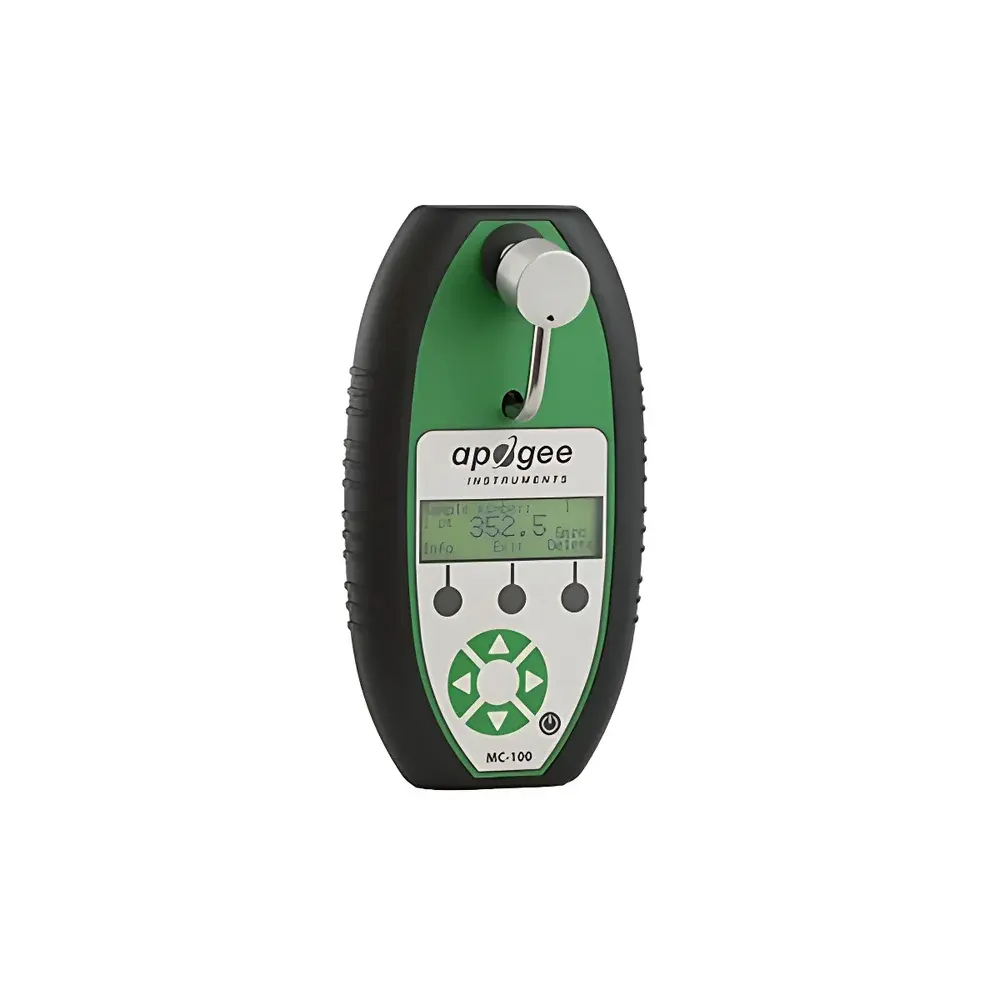
Apogee MC-100 Chlorophyll Meter
| Brand | Apogee |
|---|---|
| Origin | USA |
| Model | MC-100 |
| Measurement Principle | Dual-wavelength (653 nm & 931 nm) transmittance ratio |
| Display Units | μmol/m² (default), CCI, SPAD |
| Measurement Area | 63.6 mm² (9.0 mm diameter), 19.6 mm² (with optional shade hood for leaves <5 mm wide) |
| Resolution | ±10 μmol/m² (typical plants), 0.1 CCI |
| Linearity | ±1% |
| Repeatability | ±1% |
| Measurement Time | <3 s |
| Data Storage | 8 MB (up to 160,000 measurements |
| Interface | Mini-B USB, RS-232 (GPS-compatible) |
| Display | 50 mm × 15 mm graphical LCD, 8-button navigation |
| Operating Temperature | 0–50 °C |
| Power | 9 V alkaline battery |
| Auto-shutdown | After 4 min of inactivity or no data download |
| Dimensions | 152 × 82 × 25 mm |
| Weight | 210 g |
Overview
The Apogee MC-100 Chlorophyll Meter is a field-deployable, non-destructive optical instrument engineered for rapid quantification of chlorophyll content in intact plant leaves. It operates on the principle of dual-wavelength transmittance spectroscopy—measuring the ratio of light transmission at 653 nm (absorbed strongly by chlorophyll a and b) and 931 nm (a reference wavelength minimally affected by pigment absorption but sensitive to leaf structure and thickness). This ratio serves as the basis for calculating both the Chlorophyll Content Index (CCI) and, via embedded calibration curves, absolute chlorophyll concentration expressed in micromoles per square meter (μmol/m²). Unlike empirical SPAD meters that report arbitrary units, the MC-100 integrates species-specific calibration coefficients for 22 widely studied plant taxa—including maize, soybean, wheat, rice, Arabidopsis, and common broadleaf and narrowleaf species—enabling direct conversion from CCI to physiologically meaningful chlorophyll surface density. Its design prioritizes field robustness, measurement reproducibility, and compatibility with ecological monitoring protocols requiring traceable, standardized leaf-level physiological metrics.
Key Features
- Direct output of chlorophyll concentration in μmol/m²—traceable to published extinction coefficients and validated against solvent-extraction HPLC reference methods
- Dual-wavelength optical architecture (653 nm LED source + 931 nm reference detector) with temperature-compensated photodiode circuitry ensuring stable performance across 0–50 °C ambient conditions
- Two interchangeable measurement apertures: standard 9.0 mm diameter (63.6 mm² area) and narrow-leaf mode using optional shade hood (5.0 mm diameter, 19.6 mm² area) for accurate assessment of grasses, sedges, and juvenile foliage
- High-capacity internal memory (8 MB flash) supporting up to 160,000 timestamped measurements; reduced capacity (94,000 entries) when synchronized with external GPS via RS-232 for georeferenced canopy surveys
- Integrated data interface with Mini-B USB (for PC transfer and firmware updates) and RS-232 serial port (compatible with NMEA 0183 GPS receivers for real-time spatial metadata tagging)
- Graphical LCD display (50 × 15 mm) with intuitive 8-button navigation enabling on-device data review, unit switching (μmol/m² / CCI / SPAD), and batch export control
Sample Compatibility & Compliance
The MC-100 is optimized for intact, flattened leaf tissue with minimal surface pubescence or wax deposition. It accommodates leaf thicknesses from 0.1 to 0.8 mm and has been validated across monocot and dicot species with varying mesophyll anatomy. Calibration models are derived from peer-reviewed literature (e.g., Gitelson & Merzlyak, 1994; Peng et al., 2013) and empirically refined using destructive extraction validation datasets. While not certified to ISO/IEC 17025 for metrological accreditation, the instrument adheres to principles outlined in ASTM E2917–22 (“Standard Practice for Determination of Chlorophyll Content in Plant Tissue”) and supports GLP-aligned data integrity through timestamped storage, user-defined sampling IDs, and audit-ready CSV export formats. No regulatory submission claims are made under FDA 21 CFR Part 11; however, its deterministic optical algorithm and non-volatile memory architecture support defensible data lineage in academic and agricultural research contexts.
Software & Data Management
Data retrieval is performed via Apogee’s proprietary MC-100 Utility software (Windows/macOS compatible), which enables batch download, spectral ratio visualization, unit conversion, and export to CSV or Excel with column headers including measurement ID, timestamp, latitude/longitude (if GPS-tagged), raw 653/931 ratio, CCI, SPAD-equivalent, and μmol/m². The software enforces read-only access to stored records—preventing post-acquisition modification—and logs all download events with system timestamp. Firmware updates preserve user-configured settings and do not reset calibration parameters. For integration into LIMS or custom Python/R workflows, the USB HID protocol exposes ASCII-formatted measurement strings compliant with RFC 7111 conventions, facilitating automated ingestion without proprietary drivers.
Applications
- Field phenotyping of chlorophyll dynamics during nitrogen stress trials, drought response studies, and senescence progression
- High-throughput screening of crop germplasm for photosynthetic efficiency traits in breeding programs
- Long-term ecological monitoring of forest understory species, invasive plant spread, and wetland vegetation health
- Validation of satellite-derived vegetation indices (e.g., NDVI, EVI) at plot scale through ground-truthing campaigns
- Teaching laboratories for plant physiology courses—demonstrating light absorption theory, Beer–Lambert law limitations, and non-destructive assay design
- Urban horticulture assessments evaluating fertilizer efficacy and irrigation scheduling impacts on ornamental species
FAQ
How does the MC-100 differ from SPAD-502-style meters?
The MC-100 reports absolute chlorophyll surface density (μmol/m²) based on species-specific transmittance calibrations, whereas SPAD meters output dimensionless relative indices requiring secondary regression to obtain quantitative estimates.
Can I add custom calibration curves for unstudied species?
No—the 22 built-in calibrations are fixed firmware parameters. Users must rely on the closest morphological analog or perform independent correlation studies using solvent extraction.
Is the instrument waterproof or dust-resistant?
It carries no IP rating; operation is intended for dry, shaded field conditions. Prolonged exposure to rain or high-humidity environments is not recommended.
Does temperature compensation affect accuracy across the full operating range?
Yes—both LED source intensity and photodiode responsivity are actively compensated across 0–50 °C via onboard thermistor feedback, maintaining linearity within ±1% as specified.
What GPS receivers are compatible with the RS-232 port?
Any NMEA 0183-compliant GPS device outputting GGA and RMC sentences at 4800 or 9600 baud; Apogee provides pinout documentation for common OEM modules (e.g., u-blox NEO-6M, Garmin GPS 18x).




