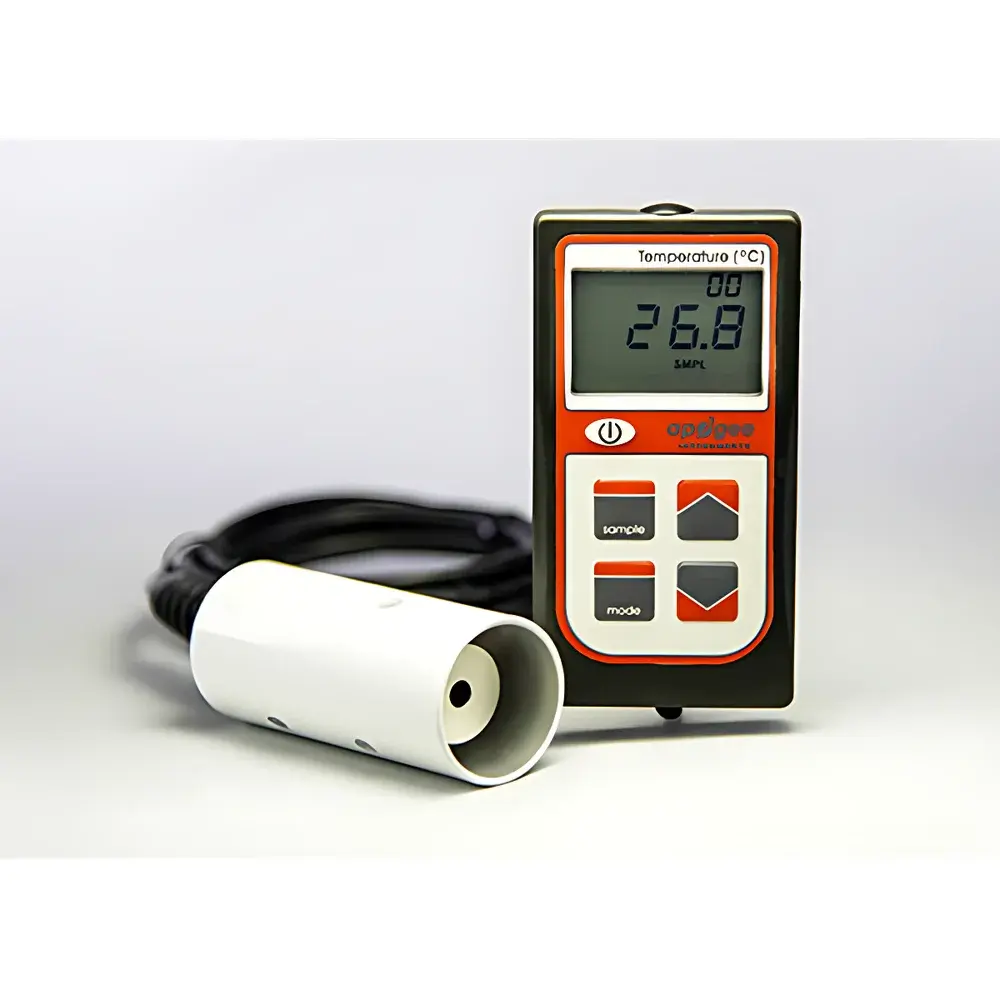
Apogee MI Series Handheld Infrared Radiometer
| Brand | Apogee |
|---|---|
| Origin | USA |
| Model | MI Series Handheld Infrared Radiometer |
| Field of View (FOV) | MI-210: 22° half-angle |
| MI-220 | 18° half-angle |
| MI-2H0 | 32° horizontal half-angle, 13° vertical half-angle |
| Spectral Range | 8–14 µm |
| Accuracy | ±0.3 °C (−30 to +65 °C, target–detector ΔT ≤ 20 °C) |
| Repeatability | ±0.1 °C |
| Stability | <2% per year |
| Response Time | 0.6 s |
| Operating Environment | 0–50 °C, 0–90% RH (non-condensing) |
| Instrument Dimensions | 126 × 70 × 24 mm |
| Sensor Dimensions | Ø23 × 60 mm |
| Weight | 270 g (with radiation shield) |
| Cable Length | 2 m |
| Warranty | 4 years |
Overview
The Apogee MI Series Handheld Infrared Radiometer is a precision field-deployable instrument engineered for non-contact surface temperature measurement across ecological, agricultural, and environmental monitoring applications. Based on calibrated broadband thermopile detection within the atmospheric infrared transmission window (8–14 µm), the system measures emitted longwave radiation from natural surfaces—including plant canopies, soil, snow, water bodies, and paved surfaces—and converts it to absolute temperature using Planck’s law and emissivity-corrected algorithms. Unlike contact thermometers or low-resolution thermal imagers, the MI Series delivers laboratory-grade radiometric accuracy in a portable, battery-operated platform. Its fast 0.6-second response time enables rapid scanning of heterogeneous surfaces, while its thermally stabilized sensor architecture minimizes drift under ambient fluctuations. Designed for outdoor deployment, the instrument operates reliably across the full range of terrestrial microclimates—from subfreezing alpine environments to humid subtropical field sites—without requiring active cooling or recalibration between measurements.
Key Features
- High-fidelity thermopile detector with factory calibration traceable to NIST standards
- Three interchangeable field-of-view configurations (MI-210: 22° half-angle; MI-220: 18° half-angle; MI-2H0: 32° H × 13° V half-angles) to match spatial sampling requirements for canopy, road, or soil studies
- Integrated radiation shield reduces convective and reflected-radiation errors, improving measurement robustness under variable wind speed and solar loading
- Modular design separates the optical sensor head from the display/data logger unit via a ruggedized 2-meter cable—enabling flexible positioning (e.g., mounting on tripods, booms, or UAV platforms)
- Onboard memory stores up to 99 manual samples (Sampling Mode) or continuous averaged logs (Logging Mode: 30-second acquisition, 30-minute averaging, daily mean computed from 48 intervals)
- Backlit LCD display provides real-time temperature readout, status indicators, and menu navigation without external power
- Four-year limited warranty reflecting long-term stability performance (<2% annual drift)
Sample Compatibility & Compliance
The MI Series is optimized for measuring natural and engineered surfaces with emissivities ≥0.92—such as green vegetation, moist soil, asphalt, concrete, snowpack, and freshwater. It is not intended for low-emissivity targets (e.g., polished metal, glass) without correction. All models comply with IEC 60584-1 (thermocouple reference tables), ASTM E1256-22 (infrared thermometry), and ISO 18434-1 (condition monitoring via infrared imaging). Data integrity meets GLP and GMP documentation requirements when used with ApogeeAMS software and AC-100 communication cable, supporting audit trails, user authentication, and timestamped metadata export (CSV/Excel). The instrument’s operating specifications conform to IP54 ingress protection for dust and splashing water resistance, and its electronics meet FCC Part 15 Class B and CE EMC Directive 2014/30/EU standards.
Software & Data Management
Data retrieval and configuration are managed exclusively through ApogeeAMS (Apogee Measurement Software), a Windows-based application certified for FDA 21 CFR Part 11 compliance when deployed in regulated environments. ApogeeAMS enables secure data download, batch processing of daily means, emissivity adjustment per measurement session, and synchronization with co-located weather station inputs (e.g., air temperature, humidity, solar irradiance) for energy balance modeling. Raw time-series files include embedded calibration coefficients, sensor serial number, UTC timestamps, and environmental condition flags. Export formats include UTF-8 CSV with header metadata, compatible with MATLAB, R, Python (pandas), and commercial statistical packages. No cloud connectivity or proprietary firmware updates are required—the device operates autonomously with no internet dependency.
Applications
- Plant physiology research: Canopy temperature differentials (CTD) for stomatal conductance estimation and drought stress phenotyping
- Transportation infrastructure monitoring: Pavement surface temperature mapping to predict icing onset and optimize de-icing protocols
- Landscape-scale energy balance studies: Partitioning net radiation into sensible and latent heat fluxes using surface–air temperature gradients
- Agricultural water management: Spatial assessment of crop water status across irrigation zones via thermal time-series analysis
- Cryosphere monitoring: Snow surface temperature trends correlated with melt onset and albedo feedback mechanisms
- Urban climate studies: Surface temperature heterogeneity across land-cover types (rooftops, sidewalks, parks) for heat island quantification
FAQ
What emissivity value is assumed in factory calibration?
The MI Series is calibrated at ε = 0.97, representative of most vegetated and natural surfaces. Users may apply site-specific emissivity corrections in ApogeeAMS during post-processing.
Can the instrument be used indoors or in controlled-environment chambers?
Yes—provided ambient temperature remains within 0–50 °C and relative humidity stays below 90% non-condensing. Avoid rapid thermal transients (>5 °C/min) near the sensor housing.
Is the radiation shield removable for compact storage?
The shield is permanently affixed to minimize alignment error and thermal lag; removal is not supported and voids warranty.
Does the device support external power or USB charging?
No—it operates solely on two AA alkaline batteries (included), providing ~100 hours of continuous use. USB or external DC input is not implemented.
How is sensor stability verified over the 4-year warranty period?
Apogee performs accelerated aging tests per MIL-STD-810G and issues a Certificate of Calibration with each unit, including initial offset and sensitivity values. Field recalibration is not required but recommended every 24 months for critical applications.