
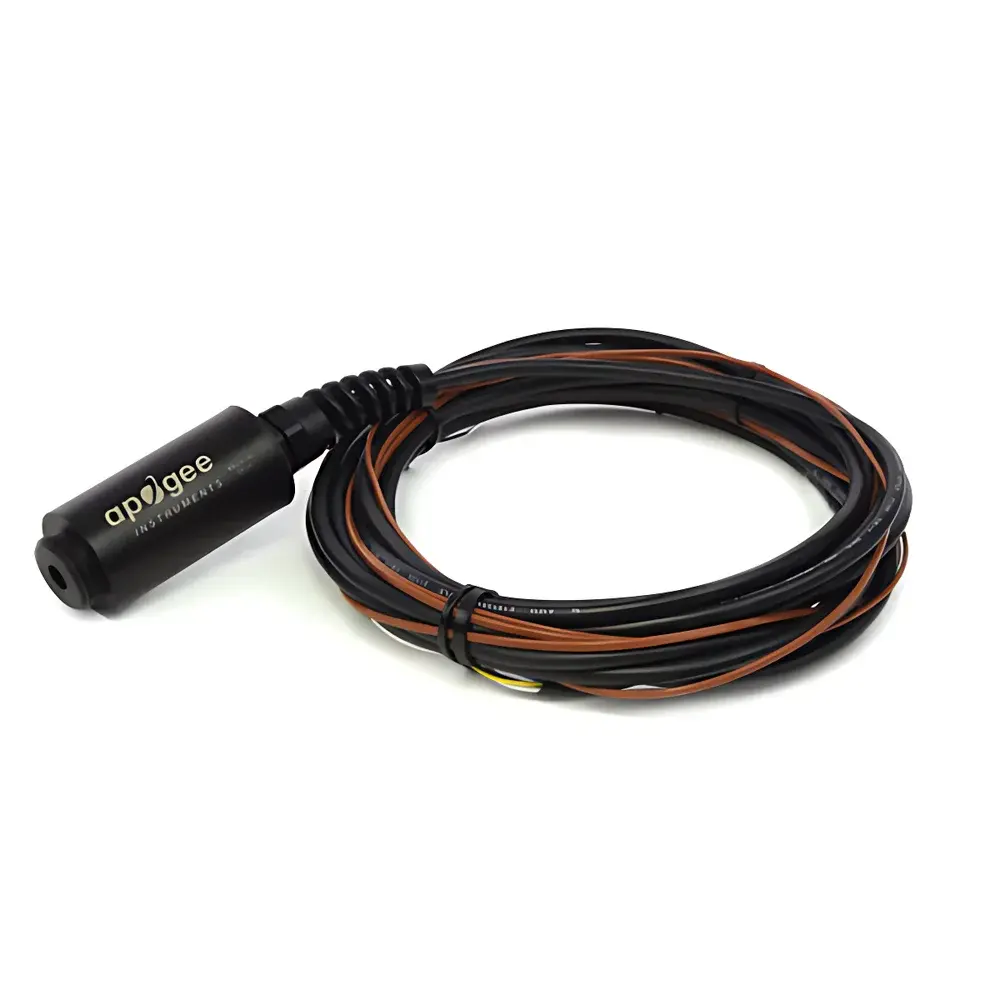
Apogee SO-220 Ambient Oxygen Sensor
| Brand | Apogee |
|---|---|
| Origin | USA |
| Model | SO-220 |
| Measurement Range | 0–100% O₂ |
| Accuracy (Stability) | ±0.05% O₂ (under stable ventilation) |
| Repeatability | ±0.001% O₂ (10 ppm) |
| Operating Temperature | −20 to +60 °C |
| Relative Humidity Range | 0–100% RH |
| Pressure Range | 60–140 kPa |
| Response Time (t₉₀) | 12 s |
| Output Signal | 12 mV at 20.95% O₂ |
| O₂ Consumption Rate | 2.2 µmol/day at 20.95% O₂, 23 °C |
| Interferent Resistance | CO₂, CO, NO, NO₂, H₂S, H₂, CH₄ — no interference |
| Power Supply | 12 V for heater, 2.5 V for thermistor activation |
| Cable | 5 m foil-shielded |
| Diffusion Cap (optional) | 3.5 cm L × 3.5 cm Ø, 125 vent holes |
| Flow-through Cap (optional) | 3.2 cm L × 3.2 cm Ø, 1/8″ conical adapter for tubing |
| Integrated Temperature Sensor | Thermocouple |
Overview
The Apogee SO-220 Ambient Oxygen Sensor is an electrochemical, current-mode galvanic cell sensor engineered for continuous, high-stability measurement of oxygen partial pressure in ambient air and controlled atmospheric environments. It operates on the principle of oxygen diffusion through a hydrophobic polytetrafluoroethylene (PTFE) membrane into an aqueous electrolyte, where molecular O₂ undergoes reduction at a gold cathode and oxidation at a lead anode. The resulting diffusion-limited current is linearly proportional to the partial pressure of oxygen—expressed in kPa—and can be mathematically converted to volumetric concentration (% O₂) or parts-per-million (ppm) using temperature- and pressure-compensated algorithms. Unlike optical or paramagnetic methods, the SO-220 requires no external excitation source or calibration gas, offering inherent long-term stability with minimal drift under consistent ventilation conditions. Its low oxygen consumption rate (2.2 µmol/day at 20.95% O₂, 23 °C) ensures negligible perturbation of sample composition during extended deployment—critical for closed-loop environmental chambers, incubators, and soil respiration studies.
Key Features
- Galvanic electrochemical cell with Pb anode and Au cathode, eliminating need for external polarization voltage
- Hydrophobic PTFE diffusion membrane providing robust moisture and particulate rejection while maintaining rapid O₂ permeability
- Integrated thermocouple for real-time temperature compensation—essential for accurate partial pressure-to-concentration conversion per ISO 8573-1 and ASTM D6245
- Factory-calibrated at 20.95% O₂ (3240 µmol/mol, 23 °C, 101.3 kPa); traceable to NIST-standard reference gases
- Low-power design: 12 V supply powers internal heater for condensation mitigation; 2.5 V activates thermistor circuitry
- Shielded 5 m foil-wrapped cable minimizes electromagnetic interference in industrial or laboratory settings
- Two interchangeable sampling interfaces: diffusion cap (125 micro-vents) for passive ambient monitoring; flow-through cap (1/8″ conical adapter) for active sampling lines per EPA Method TO-15 requirements
Sample Compatibility & Compliance
The SO-220 exhibits exceptional selectivity toward molecular oxygen in complex gas matrices. Validation testing confirms no measurable response to CO₂, CO, NO, NO₂, H₂S, H₂, or CH₄ at concentrations up to 10,000 ppm. Cross-sensitivity to NH₃, HCl, and benzene (C₆H₆) remains below 1%—well within acceptable limits for ambient air quality monitoring per ISO 16000-23 and EU Directive 2008/50/EC. The sensor complies with IEC 61238-1 for electrochemical gas sensors and meets mechanical robustness requirements of IP65 when installed with optional caps. Its operating pressure range (60–140 kPa) supports high-altitude deployments and pressurized enclosure applications without recalibration. All materials—including housing, membrane, and electrolyte—are RoHS-compliant and free of mercury or lead beyond the functional anode.
Software & Data Management
The SO-220 delivers a ratiometric analog output (12 mV at 20.95% O₂), compatible with standard data loggers (e.g., Campbell Scientific CR1000X, Onset HOBO U12) and PLC analog input modules (±100 mV range, 16-bit resolution recommended). When integrated into Apogee’s proprietary environmental monitoring platforms—or third-party systems compliant with Modbus RTU or SDI-12 protocols—the sensor supports automated temperature and barometric pressure compensation using embedded lookup tables aligned with NIST SP 800-140B traceable algorithms. Audit trails, calibration history, and sensor health diagnostics (e.g., baseline drift, membrane integrity flagging) are retained per FDA 21 CFR Part 11 requirements when deployed in GLP/GMP-regulated facilities such as pharmaceutical stability chambers or cleanroom HVAC validation.
Applications
- Ambient air quality monitoring networks (AQN) for regulatory compliance reporting under EPA NAAQS and EEA Air Quality Directive
- Controlled-environment agriculture (CEA) and vertical farming—real-time O₂ feedback for root-zone aeration optimization
- Soil respiration flux measurements via closed-chamber systems (ISO 5667-16)
- Incubator and bioreactor headspace O₂ control in life science research
- Fire suppression system verification (O₂ depletion detection in inert gas systems)
- Indoor air quality (IAQ) assessment in schools, hospitals, and office buildings per ASHRAE Standard 62.1
- Long-term ecological monitoring in remote field stations powered by solar-battery systems
FAQ
Does the SO-220 require periodic zero or span calibration?
No—this galvanic sensor is self-zeroing and does not require routine zero calibration. Span verification against certified 20.95% O₂ gas is recommended annually or after exposure to extreme contaminants.
Can the sensor operate continuously at 100% relative humidity?
Yes, provided the diffusion or flow-through cap is installed; the PTFE membrane prevents liquid water ingress, and the internal heater mitigates condensation under sustained high-RH conditions.
Is temperature compensation mandatory for accurate %O₂ output?
Yes—oxygen partial pressure varies with temperature and absolute pressure; accurate conversion to %O₂ requires simultaneous measurement of both parameters using the integrated thermocouple and an external barometer.
What is the expected service life under typical ambient conditions?
The sensor exhibits a minimum operational lifetime of 24 months when operated within its specified environmental envelope; electrolyte depletion is the primary aging mechanism, with gradual signal attenuation <0.5% per month after 18 months.
Can the SO-220 be used in explosive atmospheres?
No—it is not intrinsically safe or ATEX-certified; use only in non-hazardous locations per NEC Class I, Division 2 guidelines.
Related Products







