
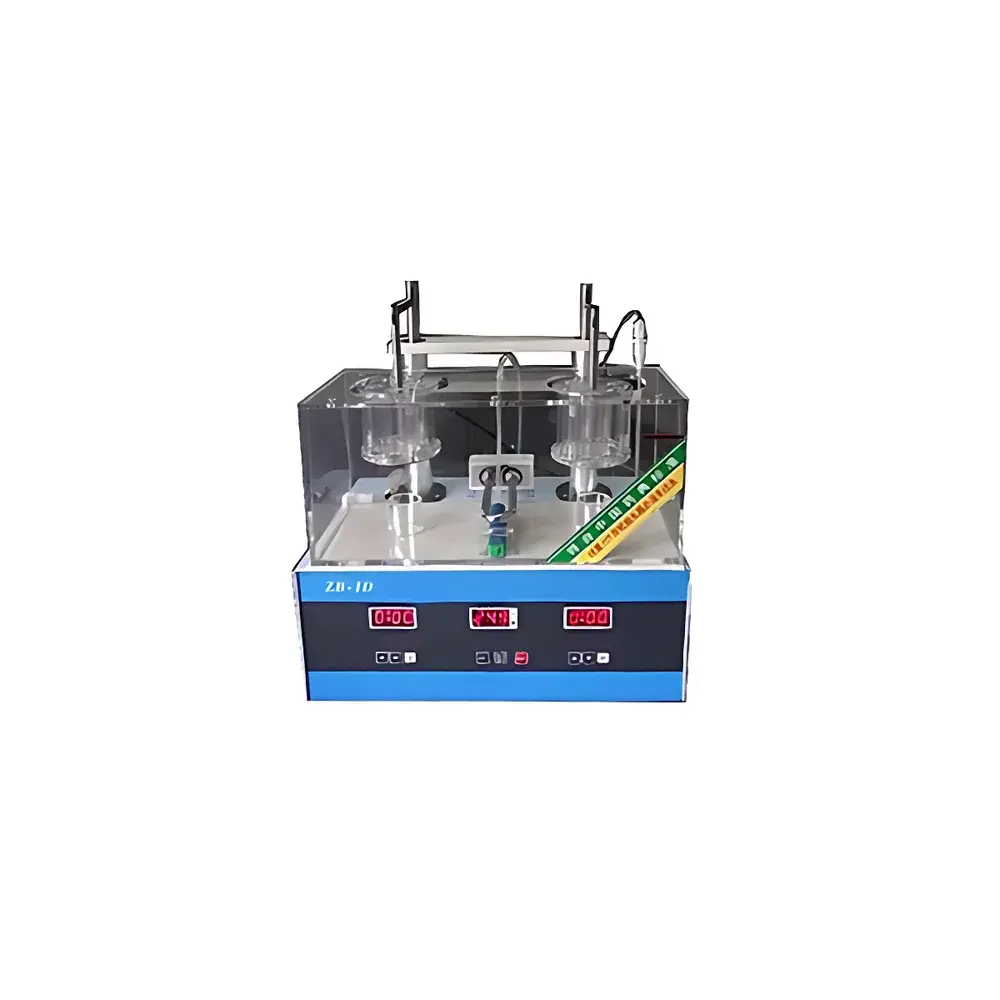
Josvok ZB-1D Intelligent Disintegration Tester
| Brand | Josvok |
|---|---|
| Origin | Tianjin, China |
| Model | ZB-1D |
| Temperature Range | 5.0 °C (or ambient) to 40.0 °C (0.1 °C resolution) |
| Temperature Accuracy | ±0.5 °C |
| Timing Range | 0–600 minutes (1-minute resolution) |
| Basket Stroke Frequency | 30–32 cycles/min |
| Basket Stroke Amplitude | 55 mm ±1 mm |
| Distance from Sieve to Beaker Bottom | 25 mm ±2 mm |
| Sieve Aperture Options | 2.0 mm and 0.425 mm |
Overview
The Josvok ZB-1D Intelligent Disintegration Tester is a precision-engineered pharmaceutical testing instrument designed to evaluate the disintegration behavior of solid oral dosage forms—including tablets, capsules, and pills—in accordance with pharmacopoeial standards. It operates on the principle of mechanical immersion cycling: test units are placed in mesh baskets suspended in heated dissolution medium (typically water or simulated gastric/intestinal fluid), and subjected to vertical reciprocating motion at controlled frequency and amplitude. The device monitors time-to-disintegration—the interval required for complete passage of the dosage form through the specified sieve—under rigorously maintained thermal and mechanical conditions. Its architecture complies with the fundamental operational requirements defined in the Chinese Pharmacopoeia (ChP) Volume IV, General Chapter 0921, as well as the United States Pharmacopeia (USP) <701> Disintegration and the British Pharmacopoeia (BP) Appendix XVII A. The ZB-1D is not a dissolution analyzer; it does not quantify active pharmaceutical ingredient (API) release kinetics, but rather verifies structural integrity failure under standardized physiological temperature and agitation conditions—a critical quality control checkpoint prior to stability and bioavailability studies.
Key Features
- Dual independent basket assemblies (left and right) enable parallel testing of two distinct sample sets under identical or individually configured parameters—enhancing laboratory throughput without cross-contamination risk.
- Intelligent temperature control system maintains bath temperature within ±0.5 °C of user-defined setpoint across the full 5.0–40.0 °C range, with real-time digital display resolving to 0.1 °C; default startup preset is 37.0 °C, aligned with human physiological temperature.
- Precise electromechanical drive delivers consistent vertical stroke motion at 30–32 cycles per minute, with stroke amplitude fixed at 55 mm ±1 mm—meeting USP/ChP mechanical tolerance specifications.
- Programmable timer supports duration settings from 1 minute to 600 minutes (10 hours), displayed in whole-minute increments; upon completion, baskets automatically rise and halt at the uppermost position for unobstructed access to baskets and beakers.
- Integrated overtemperature protection circuit triggers immediate power cutoff and audible alert if bath temperature exceeds safe operational limits—ensuring equipment longevity and operator safety.
- Interchangeable sieve plates with standardized apertures (2.0 mm and 0.425 mm) allow method flexibility for different dosage form categories (e.g., uncoated tablets vs. enteric-coated capsules) per ChP/USP guidance.
Sample Compatibility & Compliance
The ZB-1D accommodates standard USP/ChP-compliant glass beakers (1,000 mL capacity) and stainless-steel baskets fitted with either 2.0 mm or 0.425 mm woven-wire mesh—both traceably manufactured to ISO 9001-certified dimensional tolerances. It supports monolithic tablets (up to 30 mm diameter), hard and soft gelatin capsules, sugar-coated pills, and layered multiparticulates, provided samples meet pharmacopoeial size and weight constraints. All operational parameters—including temperature setpoint, timing duration, and basket positioning—are fully documentable and auditable, supporting GLP-compliant laboratory workflows. While the instrument itself does not generate electronic records compliant with FDA 21 CFR Part 11, its deterministic mechanical behavior and stable thermal profile make it suitable for use in GMP environments when paired with manual logbook entries or external validated data capture systems.
Software & Data Management
The ZB-1D operates via embedded microcontroller logic with no onboard software interface or data export capability. All parameter inputs (temperature, time) are executed through tactile membrane buttons and confirmed via LED-based numeric display. No firmware updates, network connectivity, or USB/data port functionality is integrated—reflecting its design intent as a dedicated, low-maintenance QC instrument. Users are expected to record test conditions and endpoint observations manually in bound laboratory notebooks or LIMS-integrated worksheets. This architecture minimizes validation burden during regulatory inspections, as no software verification (e.g., IQ/OQ/PQ for embedded code) is required. For laboratories requiring automated data capture, third-party digital timers with RS-232 output or industrial PLC interfaces may be externally synchronized with basket actuation signals using auxiliary contact closures (available upon request).
Applications
- Routine QC release testing of tablet batches against ChP/USP disintegration limits (e.g., ≤30 min for uncoated tablets, ≤60 min for enteric-coated products).
- Stability-indicating method development for modified-release formulations undergoing accelerated aging studies.
- Comparative evaluation of binder efficacy or granulation process changes during formulation optimization.
- Pre-validation screening of excipient compatibility prior to formal dissolution method development.
- Educational use in pharmaceutical sciences curricula for demonstrating physicochemical principles of dosage form erosion and wetting dynamics.
FAQ
Does the ZB-1D comply with USP <701> and ChP 0921?
Yes—its temperature control accuracy (±0.5 °C), stroke frequency (30–32 cpm), amplitude (55 mm), and sieve specifications align with the mechanical and environmental requirements stipulated in both standards.
Can I run two different test methods simultaneously?
Yes—the left and right baskets operate independently; each can be assigned unique temperature setpoints and timing durations, provided the shared water bath remains thermally homogeneous.
Is calibration certification included with shipment?
No factory-issued calibration certificate is supplied; users must perform initial temperature and timer verification using NIST-traceable reference standards per internal SOPs prior to first use.
What maintenance is required for long-term reliability?
Routine cleaning of baskets and beakers after each use; periodic inspection of drive linkage lubrication and basket suspension cables; annual verification of temperature sensor drift using calibrated thermistor probes.
Is the 0.425 mm sieve compliant with USP requirements for delayed-release dosage forms?
Yes—this aperture corresponds to USP Specification 21 for enteric-coated tablets tested in pH 6.8 phosphate buffer, as referenced in USP <701> Annex I.
Related Products






