
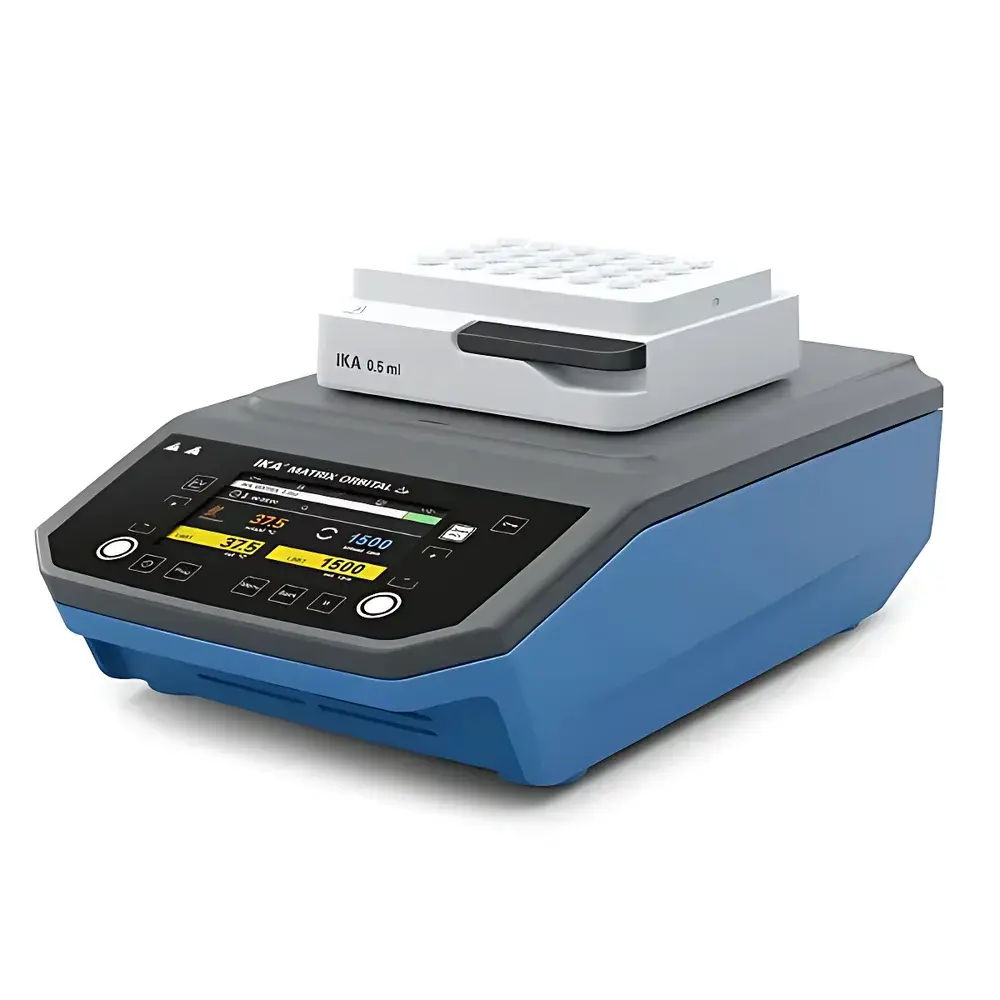
IKA MATRIX Delta Plus Thermo-Shaker for Microplates and Tubes
| Brand | IKA |
|---|---|
| Origin | Germany |
| Model | MATRIX Delta Plus |
| Max Load | 0.3 kg |
| Timer Range | 1 s – 6000 min |
| Operating Modes | Timed, Continuous, Programmable (incl. Ramp) |
| Temperature Range | −10 °C to 110 °C |
| Temp. Control Accuracy | ±0.5 °C |
| Temp. Uniformity | ±0.5 °C |
| Heating Rate | 5.5 °C/min |
| Cooling Rate | 2 °C/min (within 30 °C below ambient) |
| Heating Power | 100 W |
| Cooling Power | 72 W |
| Display | TFT touchscreen |
| Interfaces | RS232, USB |
| Enclosure Rating | IP21 |
| Dimensions (W×D×H) | 216 × 127 × 351 mm |
| Weight | 9.5 kg |
| Ambient Operating Conditions | 5–40 °C, ≤80% RH |
| Safety Cut-off | 145 °C |
| Power Supply | 100–240 V AC, 50/60 Hz |
| Max Input Power | 230 W |
| Fuse | 2× T4A 250V |
Overview
The IKA MATRIX Delta Plus Thermo-Shaker is a precision-engineered benchtop instrument designed for simultaneous temperature control and orbital mixing of microplates, PCR tubes, and small-volume vials in life science laboratories. It operates on the principle of Peltier-based thermoelectric heating and cooling combined with digitally controlled orbital shaking (typically 200–1500 rpm, depending on module configuration), enabling rapid, bidirectional thermal transitions while maintaining mechanical homogeneity across samples. Unlike conventional water-bath or air-circulation shakers, the MATRIX Delta Plus integrates a solid-state thermal module directly beneath the platform—eliminating condensation risks, minimizing thermal lag, and ensuring high reproducibility in kinetic assays, enzyme reactions, cell culture pre-incubations, and immunoassay preparation. Its compact footprint and modular architecture support seamless integration into automated workflows and regulated environments where traceability, stability, and protocol fidelity are critical.
Key Features
- Peltier-driven dual-mode temperature control: precise heating (−10 °C to 110 °C) and active cooling (down to 30 °C below ambient), with independent calibration and real-time feedback via integrated Pt100 sensor
- Programmable ramp profiles: user-defined linear temperature ramps (e.g., 37 °C → 4 °C over 15 min), synchronized with shaking speed and duration for complex multi-step protocols
- TFT touchscreen interface with intuitive menu navigation, multilingual support (EN/DE/FR/ES), and context-sensitive help—designed for operation under gloves and in ISO Class 5–7 cleanroom conditions
- Modular platform system: supports up to 10 interchangeable SmartModules (e.g., 96-well PCR plate, 0.2 mL tube rack, deep-well block), each auto-recognized via embedded RFID for parameter validation and audit trail generation
- Robust aluminum die-cast housing (IP21 rated) with reinforced mounting points, vibration-damped feet, and internal safety circuitry—including hardware-enforced overtemperature cutoff at 145 °C
- Dual communication interfaces (RS232 and USB) compliant with ASTM E2500-13 and FDA 21 CFR Part 11 requirements when paired with validated software—enabling remote monitoring, electronic signature capture, and GLP/GMP-compliant data archiving
Sample Compatibility & Compliance
The MATRIX Delta Plus accommodates standard ANSI/SLAS-format microplates (96-, 384-well), PCR strips, conical tubes (0.2–50 mL), and custom labware via certified third-party adapters. All contact surfaces are autoclavable or compatible with ethanol/isopropanol disinfection per EN 14476. The instrument meets DIN EN 61326-1 (EMC) and DIN EN 61010-1 (safety) standards. Its thermal performance is verified per ISO 13485:2016 Annex A.2 for medical device manufacturing environments and supports USP Analytical Instrument Qualification (AIQ) protocols—including Installation Qualification (IQ), Operational Qualification (OQ), and Performance Qualification (PQ) documentation templates provided by IKA upon request.
Software & Data Management
When connected to IKA LabWorldSoft™ v4.x or third-party LIMS platforms (via ASCII/SCPI command set), the MATRIX Delta Plus enables full lifecycle data management: timestamped temperature/shaking logs, user ID tagging, parameter change history, and exportable CSV reports with SHA-256 hash integrity verification. Audit trails comply with ALCOA+ principles (Attributable, Legible, Contemporaneous, Original, Accurate, Complete, Consistent, Enduring, Available). Firmware updates are digitally signed and delivered through IKA’s secure customer portal—ensuring version control and cybersecurity alignment with IEC 62443-3-3.
Applications
- Kinetic studies of protein-ligand binding and enzymatic activity requiring strict thermal ramping and mixing synchronization
- Pre-analytical sample conditioning for ELISA, qPCR, and lateral flow assays—minimizing adsorption loss and improving assay CVs
- Cryo-preservation workflows involving controlled-rate thawing and immediate post-thaw mixing
- High-throughput screening (HTS) plate incubation with staggered thermal profiles across rows/columns
- Stability testing of biopharmaceutical formulations under ICH Q5C stress conditions (e.g., 25 °C/60% RH simulated via controlled ambient offset)
- Cell suspension maintenance during transfection or staining protocols where shear sensitivity demands low-orbit amplitude and uniform thermal distribution
FAQ
Does the MATRIX Delta Plus support GLP-compliant electronic record keeping?
Yes—when used with LabWorldSoft™ and configured with electronic signatures, it generates 21 CFR Part 11–compliant audit trails, including operator authentication, parameter lockout, and immutable event logging.
Can the instrument operate unattended overnight?
Yes—its continuous-duty rating, redundant thermal fusing, and programmable end-of-run actions (e.g., cooldown + beep + status LED) enable safe overnight operation within specified ambient limits (5–40 °C, ≤80% RH).
Is module calibration traceable to national standards?
Each SmartModule includes factory calibration certificates traceable to PTB (Physikalisch-Technische Bundesanstalt) via accredited metrology labs; on-site recalibration services are available globally.
What is the maximum allowable load for non-standard labware?
The 0.3 kg limit applies to total mass—including adapter, plate/tube carrier, and contents. Exceeding this may compromise thermal uniformity and mechanical stability, voiding warranty and regulatory validation.
How does the Peltier cooling performance compare to compressor-based systems?
While not intended for sub-zero cryogenic applications, its 2 °C/min cooling rate (within 30 °C below ambient) provides superior responsiveness and condensation-free operation versus fan-cooled alternatives—ideal for rapid transition between assay steps without dew formation on optical plates.
Related Products




