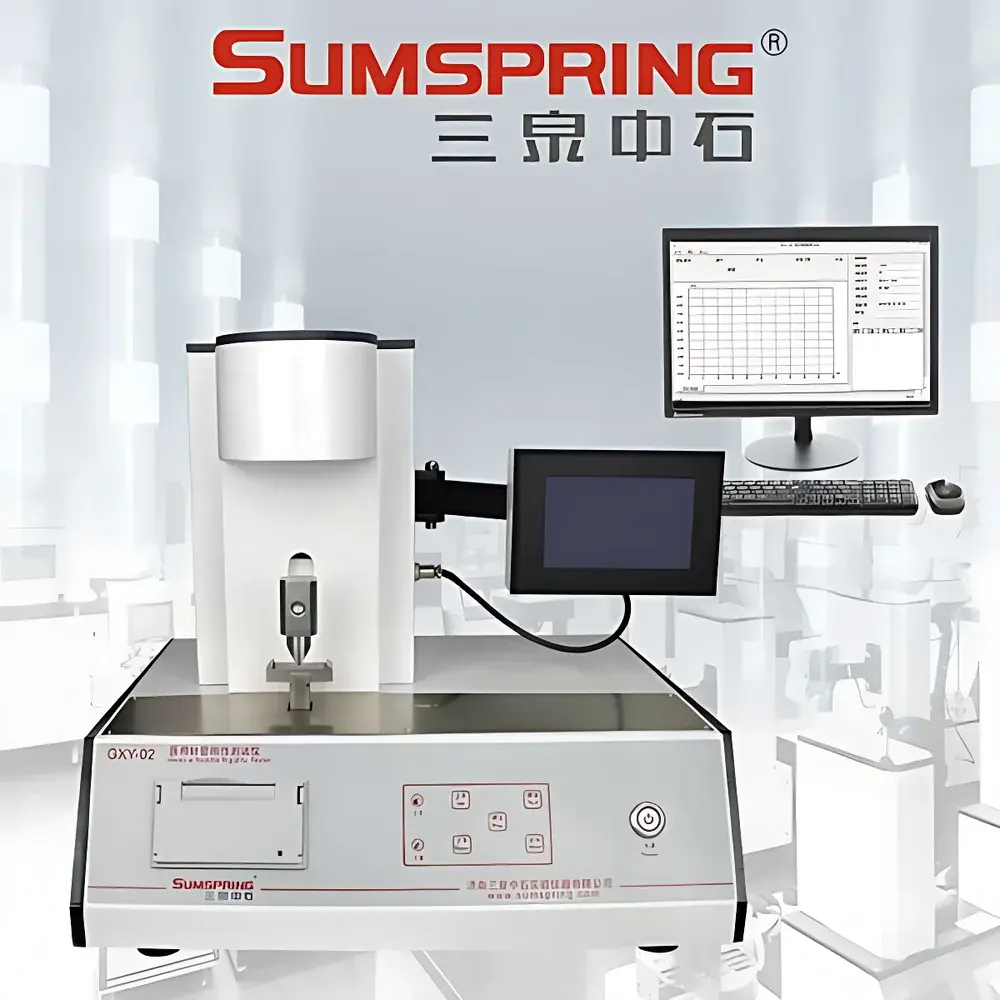
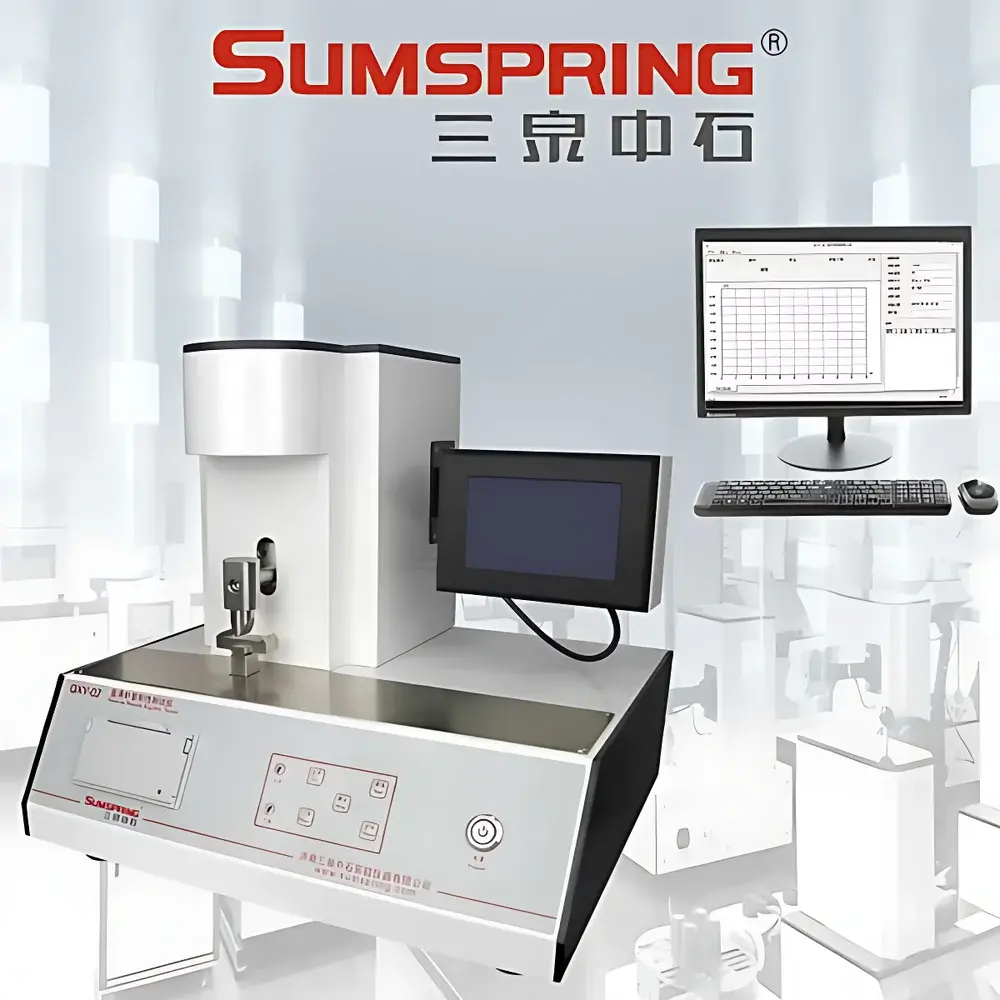
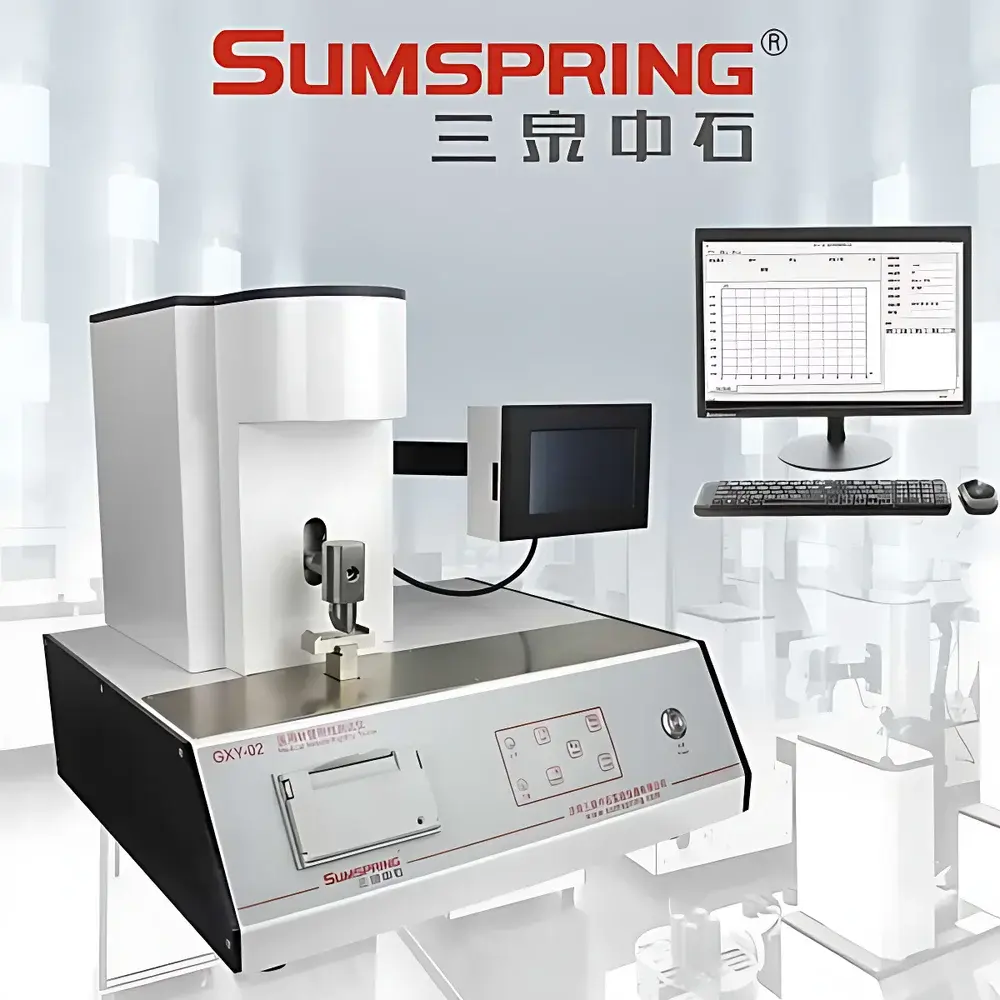
SumSpring GXY-02 Stainless Steel Needle Tube Rigidity Tester
| Brand | SumSpring |
|---|---|
| Origin | Shandong, China |
| Manufacturer Type | Manufacturer |
| Country of Origin | China |
| Model | GXY-02 |
| Force Sensor Range | 5.5–60 N (±0.1 N) |
| Deflection Measurement Range | 0–5 mm (±0.01 mm) |
| Support Span Adjustment | 0–55 mm (±0.5 mm) |
| Needle ID Compatibility | 0.3–3.4 mm (normal/thin/ultra-thin wall) |
| Loading Speed | 1 mm/min (±0.1 mm/min) |
| Displacement Resolution | 0.001 mm |
| Dimensions | 460 × 340 × 400 mm |
| Weight | 25 kg |
| Operating Temperature | 5–40 °C |
| Relative Humidity | 45–80% RH (non-condensing) |
| Power Supply | 220 V ± 10%, 50 Hz ± 2% |
Overview
The SumSpring GXY-02 Stainless Steel Needle Tube Rigidity Tester is a precision mechanical testing instrument engineered for the quantitative determination of flexural rigidity in rigid stainless steel hypodermic needle tubes used in medical devices. It operates on the principle of three-point bending under controlled static loading: a standardized force is applied vertically at the midpoint of a horizontally supported needle segment, and the resulting deflection (挠度) — i.e., the vertical displacement at the load point — is measured with high-resolution displacement transduction. This method directly evaluates structural stiffness per ISO 7886-1, GB 15811-2001, GB 18457-2015, and YBB00092004-2015, all of which mandate rigidity verification for needles intended for intradermal, subcutaneous, intramuscular, and intravenous administration. Rigidity is a critical mechanical safety parameter — insufficient stiffness may cause buckling or bending during insertion, compromising patient safety, dosing accuracy, and device functionality. The GXY-02 provides traceable, repeatable measurements essential for design validation, incoming material inspection, and regulatory compliance in Class II/III medical device manufacturing.
Key Features
- Compliant three-point bending configuration with adjustable support span (0–55 mm) to accommodate needle lengths per pharmacopoeial test specifications;
- Dual-sensor architecture: integrated 200 N load cell (±0.1 N accuracy) and high-resolution linear displacement sensor (0.001 mm resolution, ±0.01 mm full-scale accuracy);
- Programmable constant-rate loading (1 mm/min ±0.1 mm/min), aligned with standard test velocity requirements for mechanical integrity assessment;
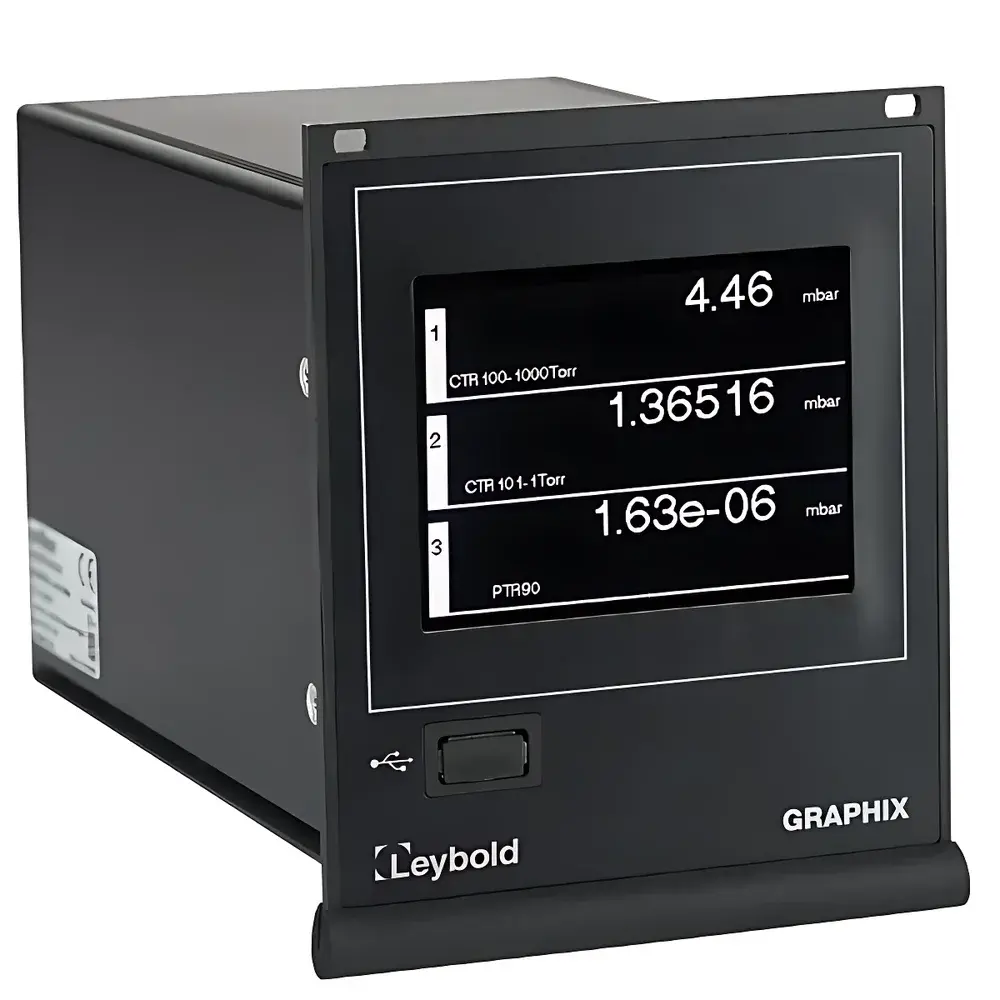
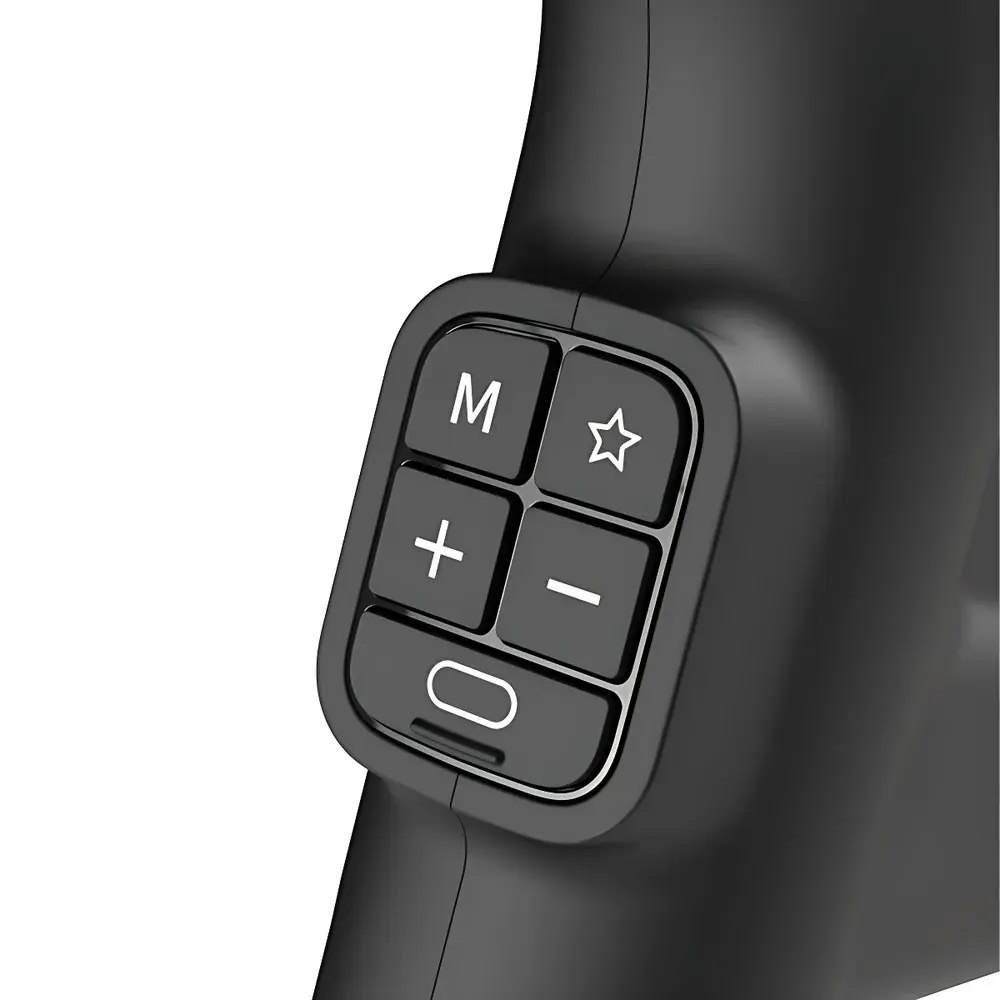
- Dual-mode human interface: responsive 7-inch capacitive touchscreen + tactile physical keypad for operation in gloved or sterile-prep environments;
- User-accessible role-based permissions system (administrator/operator modes), supporting audit-ready workflows per FDA 21 CFR Part 11 and GLP/GMP documentation standards;
- Onboard statistical processing: automatic calculation and display of maximum, minimum, and mean deflection values across up to 99 sequential tests;
- Robust aluminum alloy frame with anti-vibration base plate, ensuring mechanical stability during high-precision micro-displacement measurement.
Sample Compatibility & Compliance
The GXY-02 accommodates stainless steel needle tubes ranging from 0.3 mm to 3.4 mm outer diameter, including normal-wall, thin-wall, and ultra-thin-wall configurations specified in ISO 9626 and ASTM F2852. Its modular support fixtures enable rapid reconfiguration for needle lengths between 10 mm and 150 mm, covering common applications such as insulin syringes, pre-filled cartridges, IV catheters, epidural needles, and blood collection sets. All test procedures conform to mandatory clauses in GB 15811-2001 (sterile injection needles), GB 18457-2015 (stainless steel needle tubing for medical devices), and YBB00092004-2015 (pre-filled syringe needle standards). The instrument’s metrological traceability is maintained via factory calibration against NIST-traceable force and displacement standards, with optional annual recalibration services available.
Software & Data Management
Data acquisition and reporting are managed through embedded firmware compliant with IEC 62304 Class B software safety requirements. Test parameters (load setpoint, span distance, dwell time) are stored with timestamped metadata and user ID. Results export in CSV format via USB port for integration into LIMS or QMS platforms. Audit trail functionality records all parameter changes, test executions, and user logins — satisfying FDA 21 CFR Part 11 electronic record requirements when paired with validated network configuration. Optional PC-based software (SumSpring LabLink v3.2) enables advanced statistical process control (SPC), trend analysis, and automated report generation compliant with ISO 13485 clause 7.6.
Applications
- Quality control release testing of stainless steel needle tubes prior to assembly into syringes, infusion sets, or anesthesia kits;
- Design verification and comparative rigidity benchmarking across needle gauges (e.g., 25G vs. 30G) and wall thickness variants;
- Root cause analysis of needle deformation incidents during clinical use or packaging transport;
- Supplier qualification and incoming inspection of raw needle stock per ISO 13485 Clause 7.4.3;
- Regulatory submission support — generating test reports accepted by NMPA, FDA, and EU Notified Bodies for MDR Annex II technical documentation.
FAQ
What is the physical principle behind needle tube rigidity testing?
It follows the Euler–Bernoulli beam theory for small-deflection elastic bending: deflection δ = (F × L³) / (48 × E × I), where F is applied force, L is support span, E is Young’s modulus, and I is second moment of area — making measured δ an inverse indicator of inherent rigidity.
Does the GXY-02 meet international pharmacopoeial requirements?
Yes — its mechanical configuration, force application method, and dimensional tolerances align with USP <788>, Ph. Eur. 2.9.20, and JP 17 Appendix 5.2 for needle rigidity assessment.
Can test data be exported for external statistical analysis?
Yes — all raw and processed data export as ASCII CSV files via USB 2.0, preserving timestamps, operator IDs, and measurement uncertainty metadata.
Is calibration certification included with delivery?
Each unit ships with a factory calibration certificate traceable to CNAS-accredited standards; ISO/IEC 17025-compliant recalibration services are available upon request.