
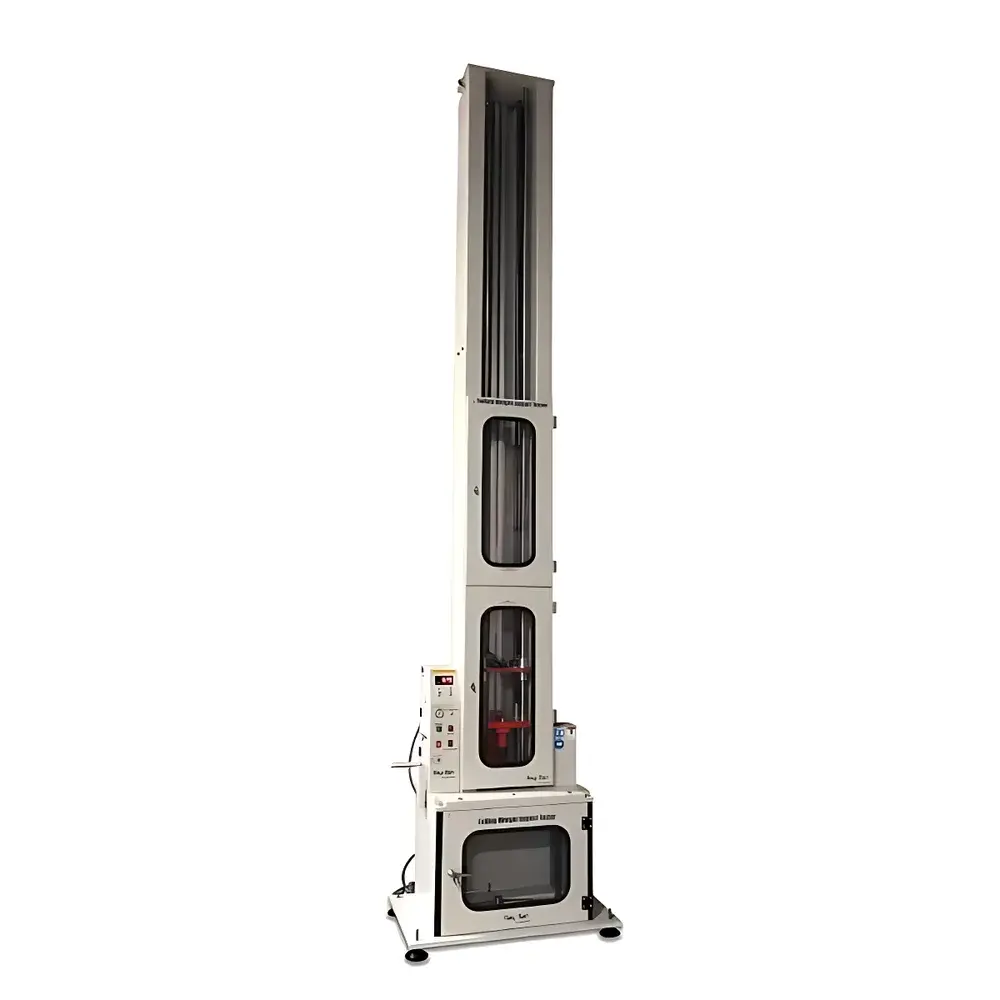
Ray-Ran FWT Instrumented Drop Weight Impact Tester
| Brand | Ray-Ran |
|---|---|
| Origin | United Kingdom |
| Model | FWT |
| Voltage | 110 V or 240 V AC |
| Display | Integrated touchscreen interface |
| Load Cell Options | 5 kN, 13 kN, 22 kN, 45 kN |
| Operating Pressure Range | 80–150 PSI (5.5–10.3 bar) |
| Drop Heights | 1 m, 2 m, 3.35 m |
| Maximum Impact Energy | 1100 J |
| Maximum Impact Velocity | 8.1 m/s |
| Drop Mass Range | 1–35 kg |
| Safety System | Full electrical interlock with cabinet door sensing |
| Release Mechanism | Solenoid-actuated bracket release |
| Return System | Pneumatic carrier return |
| Guidance | Dual vertical precision rails with low-friction bearings |
| Rebound Arrest | Standard anti-rebound mechanism |
| Height Measurement | Digital height readout |
| Sample Chamber Clearance | Up to Ø400 mm (customizable for larger diameters) |
| Fixture Options | Adjustable vertical support fixture |
Overview
The Ray-Ran FWT Instrumented Drop Weight Impact Tester is an engineered solution for standardized and customized impact resistance evaluation in accordance with ISO 6603, ISO 7765, ASTM D3763, ASTM D7136/D7136M, ISO 179, ISO 180, and related international material testing standards. It operates on the principle of gravitational potential energy conversion: a precisely controlled mass is elevated to a defined height and released under gravity to strike a specimen, while high-speed force-time data acquisition enables full characterization of dynamic response—including peak load, energy absorption, fracture initiation, and propagation behavior. Unlike non-instrumented systems, the FWT integrates calibrated load cells, real-time velocity monitoring, and synchronized digital height measurement to deliver traceable, repeatable, and physics-based impact metrics essential for R&D validation, quality assurance, and regulatory compliance.
Key Features
- Modular drop height configuration: standard options at 1 m (impact velocity ≈ 4.42 m/s), 2 m (≈ 6.26 m/s), and 3.35 m (≈ 8.1 m/s), supporting impact energies up to 1100 J depending on selected mass and height combinations.
- Pneumatically assisted carrier return system ensures consistent repositioning of the falling mass without operator intervention—critical for high-throughput testing environments.
- Dual vertical precision rail guidance with low-friction linear bearings guarantees orthogonal, vibration-damped descent, minimizing lateral deviation and kinetic energy loss during impact.
- Full electrical safety interlock architecture: operation is inhibited if the test chamber door is open or fixtures are unsecured; pneumatic clamping only engages when cabinet doors are fully closed and interlocked.
- Standard anti-rebound arrest mechanism prevents secondary contact between striker and specimen post-impact—preserving waveform integrity and enabling accurate energy partition analysis.
- Integrated touchscreen HMI provides intuitive setup of test parameters (height, mass, trigger threshold), real-time visualization of force-time curves, and immediate export of raw ASCII data files.
- Interchangeable striker (tup) geometries—including hemispherical, flat-ended, and custom profiles—are compatible with ISO/ASTM-defined configurations for plastics, composites, pipes, and laminates.
Sample Compatibility & Compliance
The FWT accommodates diverse specimen geometries within its enclosed test chamber. Standard configurations support pipe specimens up to Ø400 mm in diameter, with optional extended base frames and taller enclosures available for large-diameter piping (e.g., PE100 pressure pipes) or structural composite panels. Flat specimens are secured using either manually actuated or pneumatically locked fixtures—both integrated with the machine’s safety interlock logic. All mechanical and control subsystems comply with CE marking requirements under the Machinery Directive 2006/42/EC and Low Voltage Directive 2014/35/EU. Data acquisition firmware supports audit-ready timestamping and user-access logging, aligning with GLP and GMP documentation expectations where required.
Software & Data Management
Data capture is performed at ≥1 MHz sampling rate via high-fidelity analog-to-digital conversion synchronized with optical position feedback. The embedded controller records force, displacement (derived from height + time), and velocity traces simultaneously. Export formats include CSV and TXT for post-processing in MATLAB, Python (NumPy/Pandas), or commercial analysis packages such as Blue Hill or MTS TestSuite. Optional PC-based software extends functionality with automated pass/fail criteria evaluation, statistical reporting per ISO 5725, and comparative overlay of multiple impact events. All system logs—including operator ID, test date/time, calibration status, and environmental metadata—are retained locally and exportable for FDA 21 CFR Part 11–aligned environments upon request.
Applications
- Impact performance validation of thermoplastic pipes (PE, PP, PVC) per ISO 13968 and EN 1446.
- Ductility assessment of polymer films and sheets under high-strain-rate loading (ISO 6603-2).
- Fracture toughness screening of fiber-reinforced composites used in aerospace and automotive components.
- Quality control of injection-molded parts subjected to drop-test simulation (e.g., consumer electronics housings).
- Educational demonstration of energy absorption mechanisms, brittle-to-ductile transitions, and strain-rate sensitivity in engineering materials.
- Development and verification of impact-modified polymer formulations in industrial R&D laboratories.
FAQ
What standards does the FWT support out-of-the-box?
The system is pre-configured for ISO 6603, ISO 7765, ASTM D3763, ASTM D7136, ISO 179, and ISO 180. Custom test routines can be programmed to match internal specifications or emerging industry protocols.
Can the FWT be calibrated to national metrology institute (NMI) traceable standards?
Yes—load cells are supplied with UKAS-accredited calibration certificates (traceable to NPL), and height measurement subsystems are verified using laser interferometry. Annual recalibration services are available through Ray-Ran’s authorized service network.
Is remote diagnostics or firmware update capability supported?
The unit includes Ethernet connectivity and supports secure remote access via VPN for technical support diagnostics. Firmware updates are delivered as signed binary packages with version-controlled changelogs.
How is specimen alignment ensured prior to impact?
The vertical support fixture incorporates micrometer-adjustable positioning and bubble-level indicators. Optional laser alignment aids are available for critical applications requiring sub-millimeter centering tolerance.
What maintenance intervals are recommended for pneumatic and mechanical subsystems?
Daily visual inspection of seals and rails; monthly lubrication of linear bearings; quarterly verification of solenoid response time and pressure regulator stability; annual full system performance validation including load cell linearity and height repeatability checks.



