
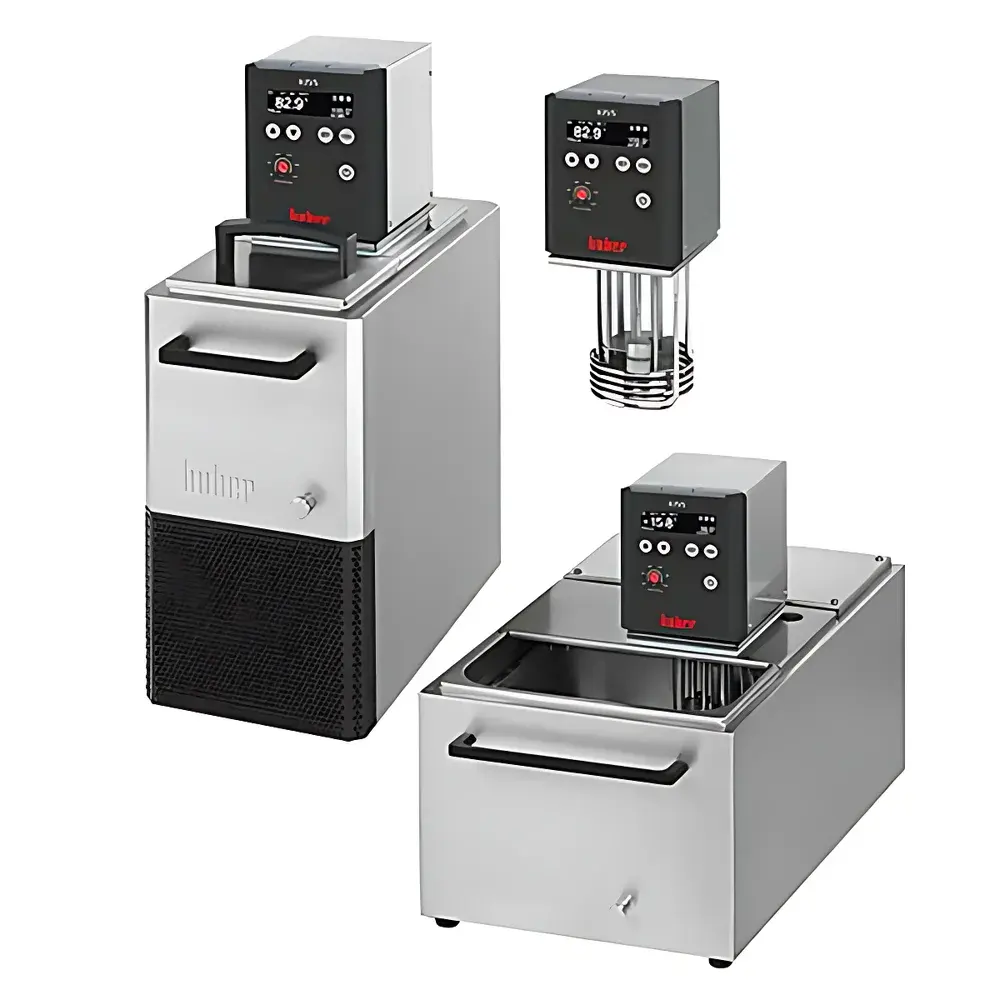
Huber CC & KISS Series Heating/Cooling Circulators with Internal and External Temperature Control
| Brand | Huber |
|---|---|
| Origin | Germany |
| Model | CC-K6, CC-K6s, KISS K6, KISS K6s |
| Temperature Range | –25 °C to +200 °C |
| Heating Power | 1.6–2.1 kW |
| Cooling Power (at 20 °C) | 0.72 kW (CC-K6), 0.25 kW (KISS K6), 0.40 kW (CC-K6s), 0.26 kW (KISS K6s) |
| Bath Volume | 4.5 L |
| Bath Opening Dimensions | 140 × 120 mm |
| Bath Depth | 150 mm |
| Pump Flow Rate (Pressure/Suction) | up to 27 L/min @ 0.4 bar / 22 L/min @ 0.15 bar (CC-K6) |
| External Circulation Interface | Yes |
| Temperature Stability | ±0.02 K (CC series), ±0.05 K (KISS series) |
| Refrigerant | Natural (R744 / CO₂ or R290 / propane, per model configuration) |
| Safety Class | DIN 12876 Class III / FL (flammable liquid compatible) |
| Controller | Pilot ONE with 7″ capacitive touchscreen, 11-language UI, RS232 interface, Pt100 sensor input, 2-point calibration, calendar-based scheduling, overtemperature & low-level protection |
Overview
The Huber CC and KISS series heating/cooling circulators are precision-engineered laboratory temperature control systems designed for both internal bath applications and external closed- or open-loop circulation. Based on thermodynamic principles of forced convection and vapor-compression refrigeration using natural refrigerants (CO₂ or propane), these units deliver stable, repeatable thermal environments across a wide operational range from –25 °C to +200 °C. Their dual-mode architecture supports direct immersion of samples in the stainless-steel insulated bath—ideal for material testing, reaction calorimetry, and analytical instrument temperature stabilization—as well as external temperature control of reactors, jacketed vessels, or test fixtures via integrated high-head pressure and suction pumps. The use of natural refrigerants ensures compliance with F-Gas Regulation (EU No. 517/2014) and significantly reduces global warming potential (GWP) without compromising cooling capacity or thermal response time.
Key Features
- Stainless-steel insulated bath construction (AISI 316L) for chemical resistance, long-term durability, and minimal thermal drift
- Natural refrigerant operation (R744 or R290) meeting stringent environmental and safety standards including EN 378-1 and DIN 12876 Class III / FL
- High-precision temperature stability: ±0.02 K (CC series) and ±0.05 K (KISS series) under static bath conditions, verified per ISO/IEC 17025-accredited methods
- Pilot ONE controller with 7-inch capacitive touchscreen, intuitive navigation, and configurable multi-language interface (11 languages)
- Integrated dual-pump system: high-pressure delivery (up to 27 L/min at 0.4 bar) and robust suction capability (up to 22 L/min at 0.15 bar), enabling reliable external circulation with minimal head loss
- Intelligent power modulation: real-time adaptation of compressor and heater output to load demand, reducing energy consumption by up to 30% compared to fixed-output systems
- Comprehensive safety architecture: redundant overtemperature cutoff, ultrasonic low-level detection, automatic shutdown on pump dry-run, and leak-tight fluid path design
- RS232 serial interface supporting remote monitoring, data logging, and integration into LIMS or SCADA environments; Pt100 sensor input for external probe feedback control
- Programmable scheduler with calendar-based start/stop, time-stamped event logging, and 2-point sensor calibration traceable to NIST standards
Sample Compatibility & Compliance
These circulators are certified for use with flammable liquids (e.g., ethanol, acetone, isopropanol) under DIN 12876 Class III / FL, permitting safe operation in environments where solvent-based baths or external jackets require precise thermal management. The stainless-steel wetted parts comply with FDA 21 CFR Part 11 requirements when paired with validated software configurations, supporting GLP/GMP workflows in pharmaceutical QC labs. Units meet electromagnetic compatibility (EMC) per EN 61326-1 and electrical safety per EN 61010-1. All models are CE-marked and manufactured in accordance with ISO 9001:2015 quality management systems at Huber’s German production facility.
Software & Data Management
The Pilot ONE controller provides embedded data acquisition capabilities, recording temperature setpoints, actual bath values, pump status, and alarm events at user-defined intervals (1–300 seconds). Logged data can be exported via USB or RS232 to CSV format for post-processing in MATLAB, Excel, or LabVIEW. Optional Huber Connect software enables centralized fleet monitoring, firmware updates, and audit-trail generation compliant with 21 CFR Part 11 Annex 11 requirements—including electronic signatures, role-based access control, and immutable change history. Calibration records, maintenance logs, and performance verification reports are stored internally with timestamp and operator ID tagging.
Applications
- Temperature control of analytical instruments: HPLC column ovens, viscometers, DSC sample stages, and FTIR accessories
- Material testing: tensile strength evaluation at controlled temperatures, polymer crystallization studies, and thermal expansion coefficient measurement
- Chemical synthesis: exothermic/endothermic reaction control in jacketed glass reactors and pilot-scale bioreactors
- Pharmaceutical QA/QC: dissolution testing apparatus calibration, stability chamber validation, and accelerated aging protocols
- Automotive R&D: battery thermal management simulation, lubricant viscosity profiling, and coolant loop characterization
- Academic research: cryogenic sample preparation, enzyme kinetics assays, and phase-transition analysis in soft matter physics
FAQ
What natural refrigerants are used in the CC and KISS series?
The CC series typically employs carbon dioxide (R744), while the KISS series uses propane (R290), selected based on application-specific pressure/temperature requirements and regional regulatory frameworks.
Can these units operate with silicone oil or other high-boiling-point heat transfer fluids?
Yes—both series support heat transfer media with flash points ≥60 °C and kinematic viscosity ≤50 cSt at 20 °C, including silicone oils, glycol-water mixtures, and specialized synthetic fluids.
Is external circulation possible without modification?
Yes—each unit includes standardized G¼” BSP male ports for inlet and outlet connections, compatible with standard PTFE-reinforced hoses and quick-connect fittings.
How is temperature uniformity maintained across the bath volume?
Optimized impeller geometry, baffled bath design, and PID-controlled pump speed ensure laminar flow distribution and minimize thermal stratification, achieving ≤0.05 K axial gradient (measured per ASTM E1137).



