

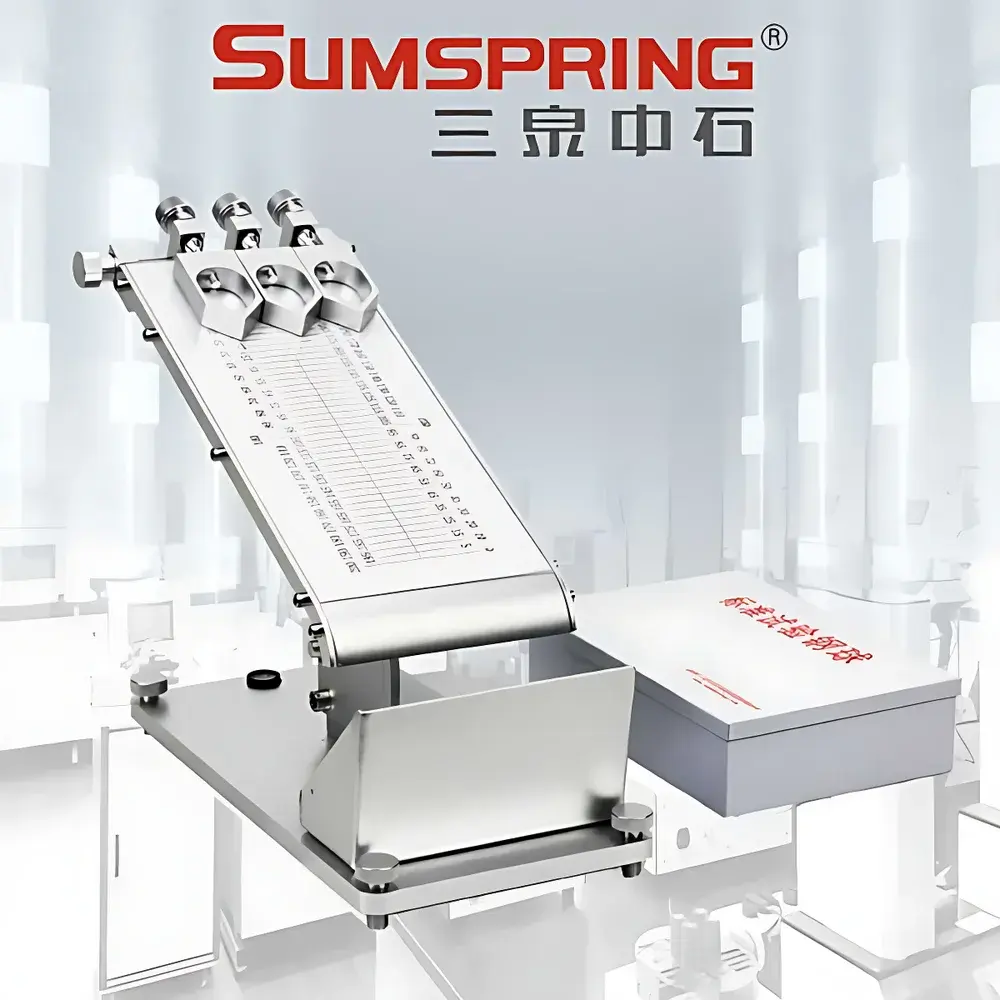

SumSpring CNY-1 Initial Adhesion Tester (Rolling Ball Method)
| Brand | SumSpring |
|---|---|
| Model | CNY-1 |
| Measurement Principle | Rolling Ball Method per FINAT Test Method No. 9 & GB/T 31125–2014 |
| Load Capacity Options | 20 N or 300 N (selectable) |
| Force Accuracy Class | Class 1 |
| Test Speed Range | 1–500 mm/min (standard operating speed: 300 mm/min) |
| Speed Accuracy | ±2% |
| Specimen Dimensions | 180 mm (L) × 25 mm (W) |
| Test Plate Dimensions | 25 mm × 72 mm × 3 mm (L × W × H) |
| Overall Dimensions | 310 mm × 400 mm × 560 mm (L × W × H) |
| Weight | 26 kg |
| Operating Environment | 23 ± 2 °C, RH ≤ 80% (non-condensing) |
| Power Supply | 220 V, 50 Hz |
| Compliance | FINAT TM9, GB/T 31125–2014 |
| Standard Configuration | Main Unit, Micro Thermal Printer, Fixture Set, Stainless Steel Test Plates |
Overview
The SumSpring CNY-1 Initial Adhesion Tester is an engineered instrument designed for quantitative evaluation of the initial tack—the instantaneous adhesive force developed upon brief, light contact between a pressure-sensitive adhesive (PSA) surface and a standardized steel ball. It implements the rolling ball method, a widely accepted empirical test principle defined in FINAT Test Method No. 9 and standardized in China as GB/T 31125–2014. Unlike peel or shear adhesion tests that assess sustained bond strength, this method specifically characterizes the early-stage interfacial interaction governed by viscoelastic compliance, surface energy, and micro-roughness—critical parameters for applications such as medical transdermal patches, labeling tapes, protective films, and disposable hygiene products. The instrument operates on a precisely inclined plane where a calibrated stainless-steel ball (typically Ø 1/4″ or Ø 5/32″ per specification) is released from a fixed height; its rolling distance along the adhesive-coated specimen determines the “ball roll distance,” which inversely correlates with initial tack magnitude. This physical measurement avoids subjective operator interpretation and delivers repeatable, comparative data suitable for QC release testing and formulation development.
Key Features
- Modular inclined-plane assembly with adjustable angle (0°–30° range), enabling precise control over contact dwell time and normal force component during ball impact.
- Dual-load capacity design (20 N or 300 N selectable) supports both low-tack film substrates and high-performance industrial adhesives without mechanical overload risk.
- High-resolution linear encoder and closed-loop stepper motor drive ensure velocity stability within ±2% across the full 1–500 mm/min test speed range—essential for cross-laboratory reproducibility.
- Integrated micro thermal printer provides immediate hard-copy output of test ID, ball diameter, roll distance, ambient conditions, and pass/fail status per preconfigured acceptance criteria.
- Rigid aluminum alloy frame with vibration-damped base minimizes environmental interference, supporting stable measurements in shared lab environments.
- Compliant test plate geometry (25 × 72 × 3 mm, AISI 304 stainless steel) meets dimensional tolerances specified in FINAT TM9 to eliminate substrate-induced variability.
Sample Compatibility & Compliance
The CNY-1 accommodates standard PSA specimens measuring 180 mm × 25 mm, compatible with common backing materials including PET, BOPP, paper, and nonwovens. Specimens are mounted using spring-loaded clamps ensuring uniform tension and edge alignment. The system conforms strictly to FINAT Test Method No. 9 (2021 edition) and GB/T 31125–2014, both of which mandate controlled temperature (23 ± 2 °C) and humidity (≤80% RH, non-condensing) during testing. While not inherently 21 CFR Part 11 compliant, audit-ready operation is achievable when paired with validated laboratory information management systems (LIMS); raw data files (CSV/ASCII) retain timestamps, operator IDs, and instrument calibration metadata. The device satisfies GLP documentation requirements for raw material qualification and process validation studies in pharmaceutical and medical device manufacturing.
Software & Data Management
The CNY-1 operates via embedded firmware with no external PC dependency for basic functionality. Optional USB-to-PC connectivity enables export of test logs—including ball ID, roll distance (mm), test date/time, ambient T/RH, and operator code—to CSV format for integration into Excel-based trending dashboards or validated LIMS platforms. All stored records include immutable timestamps and firmware version identifiers. Calibration certificates (traceable to NIST-equivalent national metrology institutes) are retained internally and printable on demand. Firmware updates are delivered via secure USB key, with version rollback capability and change-log documentation provided for regulatory audit support.
Applications
- Quality control of pressure-sensitive adhesives used in surgical tapes, wound dressings, and ECG electrodes.
- Formulation screening of acrylic, rubber, and silicone-based PSAs during R&D.
- Batch-to-batch consistency verification for label stock manufacturers (e.g., facestock-adhesive combinations).
- Evaluation of aging effects on tack retention under accelerated storage conditions (e.g., 40 °C/75% RH for 14 days).
- Academic research on polymer chain mobility, surface wetting kinetics, and interfacial fracture initiation at microsecond timescales.
FAQ
What steel ball diameters are supported per FINAT TM9?
Standardized balls include Ø 5/32″ (3.97 mm) and Ø 1/4″ (6.35 mm); ball selection must be documented per test protocol and maintained consistently within a study.
Is calibration traceable to international standards?
Yes—load cell and encoder calibrations are performed using reference standards certified to ISO/IEC 17025-accredited laboratories, with full uncertainty budgets available upon request.
Can the instrument be integrated into automated production lines?
Not natively; the CNY-1 is a benchtop manual-load tester. However, its digital I/O port supports external trigger signals for semi-automated sample loading sequences in pilot-scale environments.
Does it support ASTM D3121 or PSTC-6 equivalents?
No—the CNY-1 implements only the rolling ball method (FINAT TM9 / GB/T 31125). For loop tack or probe tack per ASTM D6195 or PSTC-6, separate instrumentation is required.
What maintenance intervals are recommended?
Monthly visual inspection of ball track surface finish and annual verification of incline angle accuracy using a certified digital inclinometer (±0.1° tolerance).



