
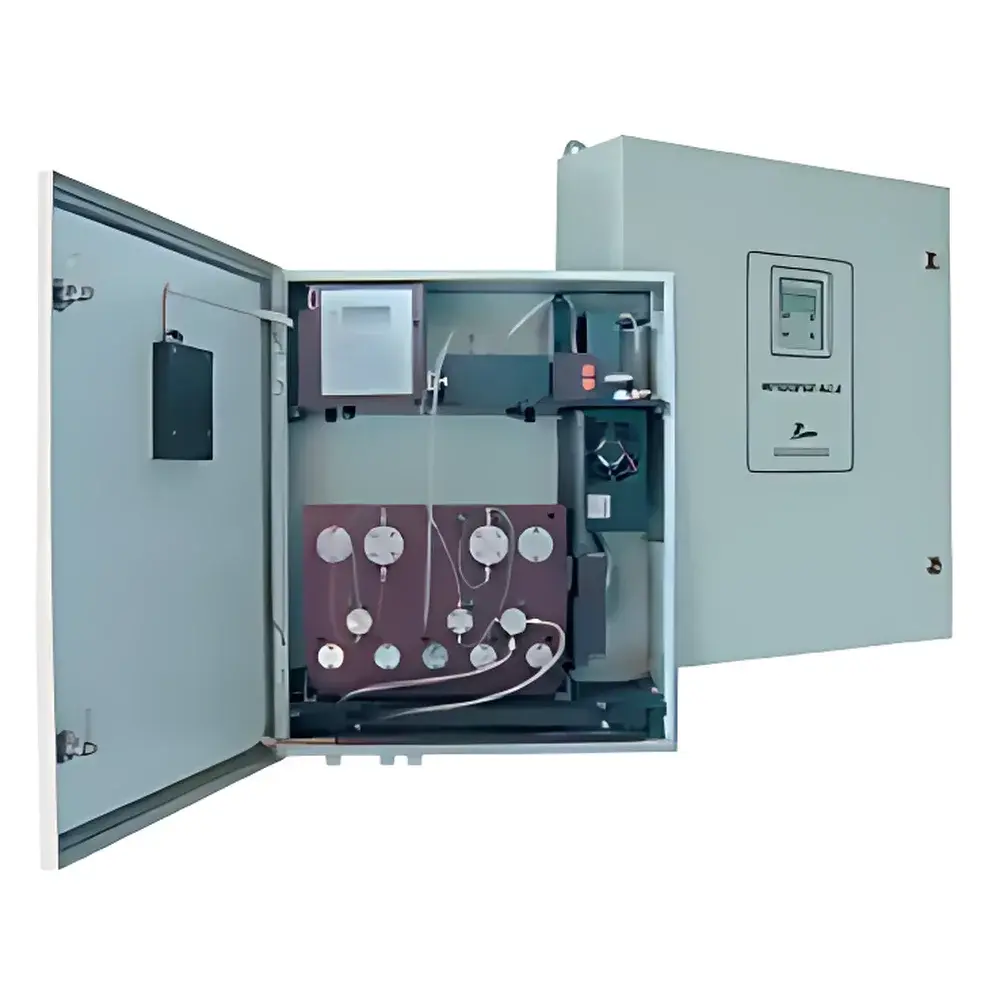
LUMEX FLUORAT® AA-2 Online Aluminum Analyzer for Water
| Brand | LUMEX |
|---|---|
| Model | FLUORAT® AA-2 |
| Origin | Russia |
| Detection Range | 0.04–2 mg/L Al |
| Operating Temperature | +5 to +50 °C |
| Sample Flow Pressure | 0.1–10 atm |
| Cycle Time | 10–30 min |
| Output Interfaces | RS-485, RS-232, 4–20 mA (0–20 mA) |
| Power Supply | 187–242 V, 50 Hz ±1%, 12 V DC |
| Power Consumption | 100 W |
| Dimensions | 600 × 600 × 250 mm |
| Weight | ≤ 50 kg |
| MTBF | ≥ 10,000 h |
| IP Rating | Dust-protected and splash-resistant |
| Compliance | PND F 14.1:2.4.181-02, PND F 14.1:4.1.1255-03 |
Overview
The LUMEX FLUORAT® AA-2 Online Aluminum Analyzer is a dedicated continuous-flow spectrophotometric instrument engineered for real-time, unattended quantification of dissolved aluminum (Al³⁺) in potable water, industrial process water, and wastewater streams. It operates on the principle of catalytic fluorimetric detection following complexation with a highly selective chromogenic reagent—typically 8-hydroxyquinoline or a derivative—under precisely controlled pH and temperature conditions. The system integrates automated liquid handling, reaction timing, optical measurement, and digital signal processing to deliver trace-level aluminum monitoring with high reproducibility and minimal operator intervention. Designed for integration into centralized SCADA or DCS environments, the FLUORAT® AA-2 supports regulatory compliance in drinking water treatment plants where aluminum coagulant dosing must be dynamically adjusted to meet WHO and national guideline values (e.g., ≤0.2 mg/L in finished water per WHO Guidelines for Drinking-water Quality, 4th ed.). Its fixed-installation architecture ensures long-term stability in continuous operation, with calibration verification traceable to certified reference materials.
Key Features
- Continuous, fully automated analysis with configurable cycle intervals of 10–30 minutes
- High-selectivity fluorimetric detection optimized for aqueous Al³⁺, minimizing interferences from Fe³⁺, Cu²⁺, and organic colloids
- Integrated microfluidic hydraulic system featuring diaphragm pumps and solenoid valves for precise sample/reagent metering and flow control
- Multi-point calibration capability with user-defined standard curves and drift compensation algorithms
- Dual-output interface support: analog 4–20 mA (or 0–20 mA) and digital RS-485/RS-232 for PLC, HMI, or data acquisition systems
- Onboard alarm logic with visual status indicators (NORMAL / ALARM / LIMIT) and relay-triggered outputs upon threshold violation
- Robust enclosure rated for dust protection and water splashing (IP54-equivalent), suitable for indoor utility rooms or outdoor kiosk installations with climate control
- Non-volatile memory for secure archival of raw measurements, calibration logs, and system events—retained across power cycles
Sample Compatibility & Compliance
The FLUORAT® AA-2 is validated for use with clarified, low-turbidity water matrices typical of post-filtration or final effluent streams. It accommodates samples within pH 4.5–8.5 and suspended solids < 10 mg/L; turbid or particulate-rich samples require optional inline filtration (e.g., 5-µm cartridge). Method performance aligns with Russian sanitary standards PND F 14.1:2.4.181-02 and PND F 14.1:4.1.1255-03, which specify continuous flow analysis protocols for aluminum in drinking water and environmental monitoring applications. While not pre-certified to ISO 10566 or ASTM D3919, its measurement principle and validation framework are compatible with GLP-aligned laboratory practices. Data integrity meets foundational requirements for audit-ready records under GMP-relevant operational contexts, including time-stamped calibration entries, operator ID logging (via external authentication), and immutable result archives.
Software & Data Management
The analyzer operates via embedded firmware with no external PC dependency. All configuration—including measurement range selection, alarm thresholds, relay behavior, and communication protocol settings—is managed through a local LCD interface with tactile navigation buttons. Measurement data are timestamped and stored internally in binary format with cyclic overwrite protection. Export options include serial transmission (Modbus RTU over RS-485) for integration into industrial historian systems (e.g., Ignition, Siemens Desigo CC, or Wonderware). Optional LUMEX-provided software tools enable remote diagnostics, firmware updates, and batch export of CSV-formatted datasets for QA/QC review. Audit trails record all parameter changes, calibration events, and fault codes—supporting internal quality audits and regulatory readiness.
Applications
- Real-time optimization of aluminum sulfate or polyaluminum chloride (PACl) dosing in coagulation/flocculation basins
- Compliance monitoring at drinking water treatment plant (DWTP) intake, intermediate, and finished water points
- Effluent surveillance at municipal wastewater treatment plants (WWTPs) receiving alum-based tertiary treatment
- Industrial pretreatment verification for electroplating, anodizing, or semiconductor rinse water discharge
- Environmental monitoring of reservoirs or rivers downstream from mining or metallurgical facilities
- Process control feedback loops integrated with PID controllers for automatic coagulant feed adjustment
FAQ
What is the minimum detectable concentration for aluminum using the FLUORAT® AA-2?
The instrument achieves a lower limit of quantification (LLOQ) of 0.04 mg/L Al, verified per PND F 14.1:2.4.181-02 under routine operating conditions.
Does the analyzer require daily maintenance or reagent replenishment?
Reagents (buffer, complexing agent, reducing agent) are supplied in sealed cartridges with shelf life ≥6 months; typical consumption supports 30–60 days of continuous operation at 15-min cycle intervals. No daily mechanical maintenance is required beyond periodic inlet filter inspection.
Can the FLUORAT® AA-2 be connected to a central SCADA system?
Yes—native Modbus RTU support over RS-485 enables seamless integration with major SCADA platforms without gateway hardware.
Is temperature compensation applied during measurement?
The optical cell and reaction chamber are thermostatically stabilized to ±0.5 °C at 25 °C; raw absorbance signals are corrected using embedded thermal drift coefficients derived from factory characterization.
What documentation is provided for regulatory validation?
LUMEX supplies a Factory Acceptance Test (FAT) report, metrological verification certificate referencing NIST-traceable Al standards, and a full technical manual with uncertainty budgeting methodology per GUM (JCGM 100:2008).
Related Products







