
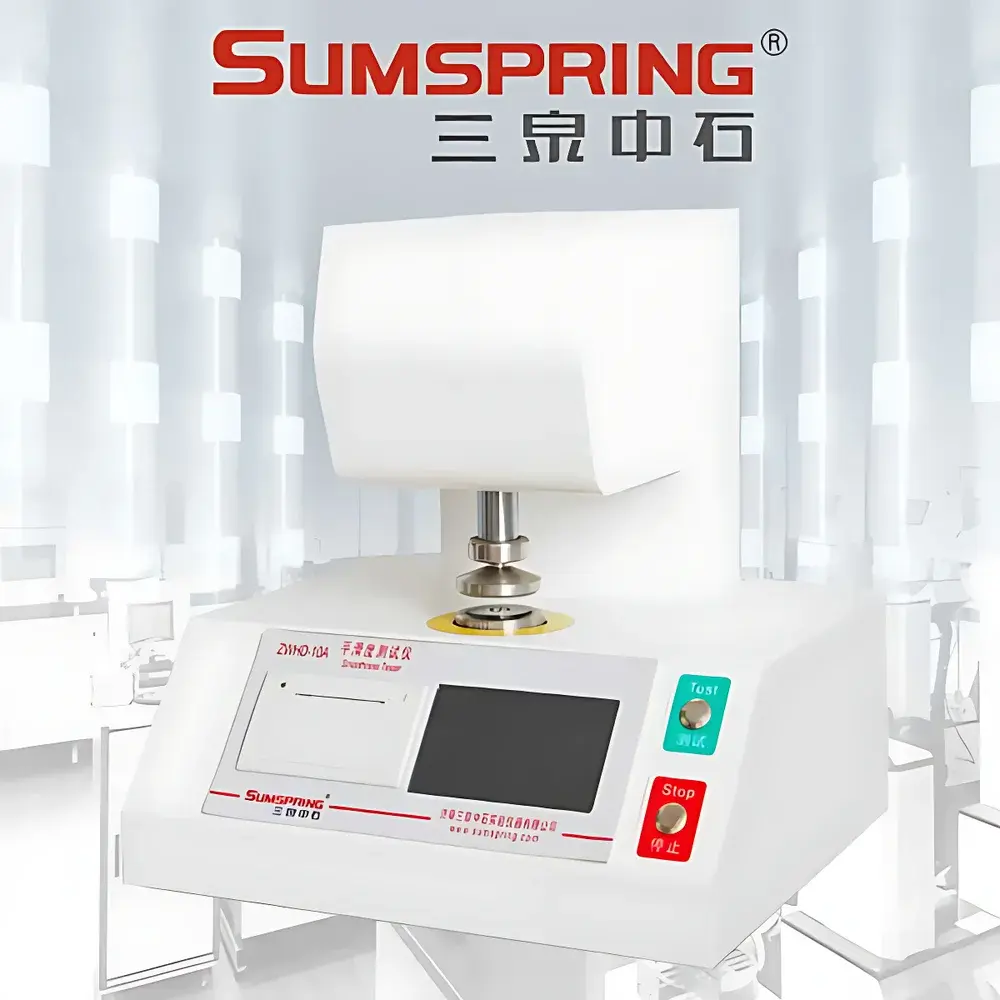
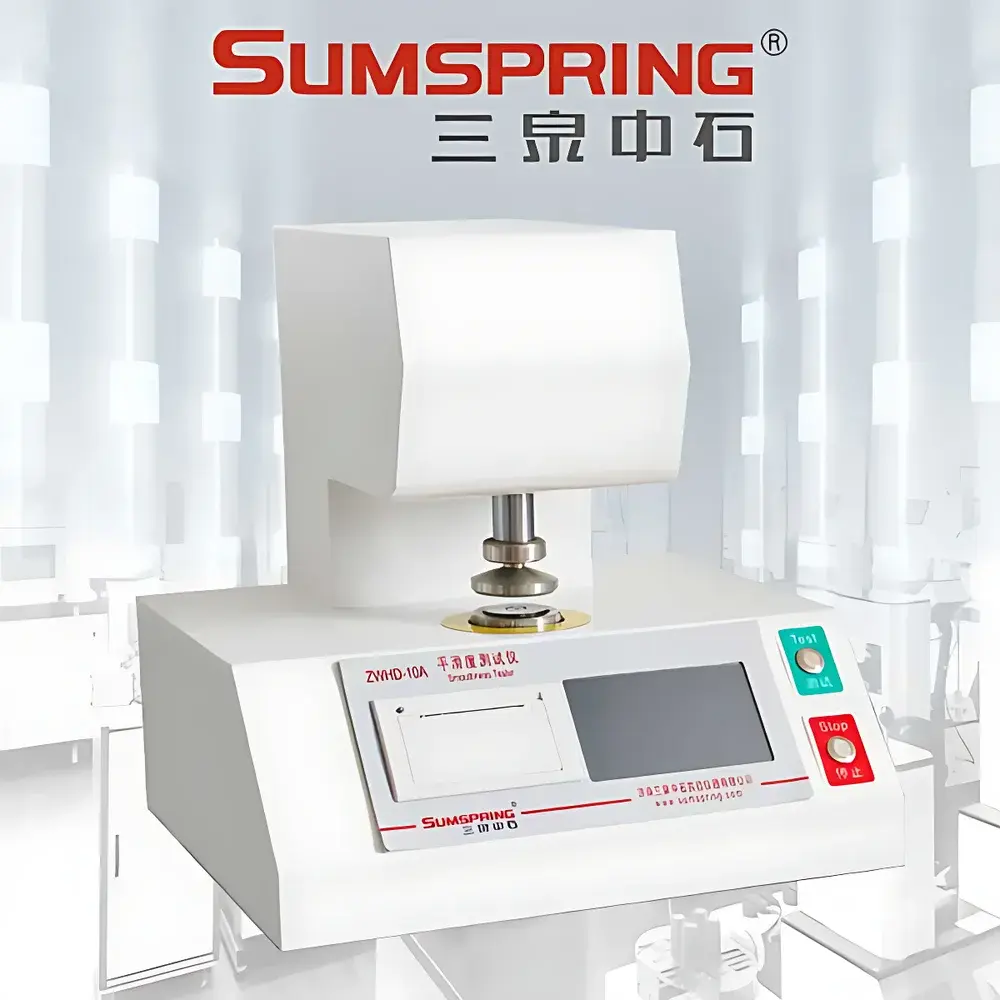
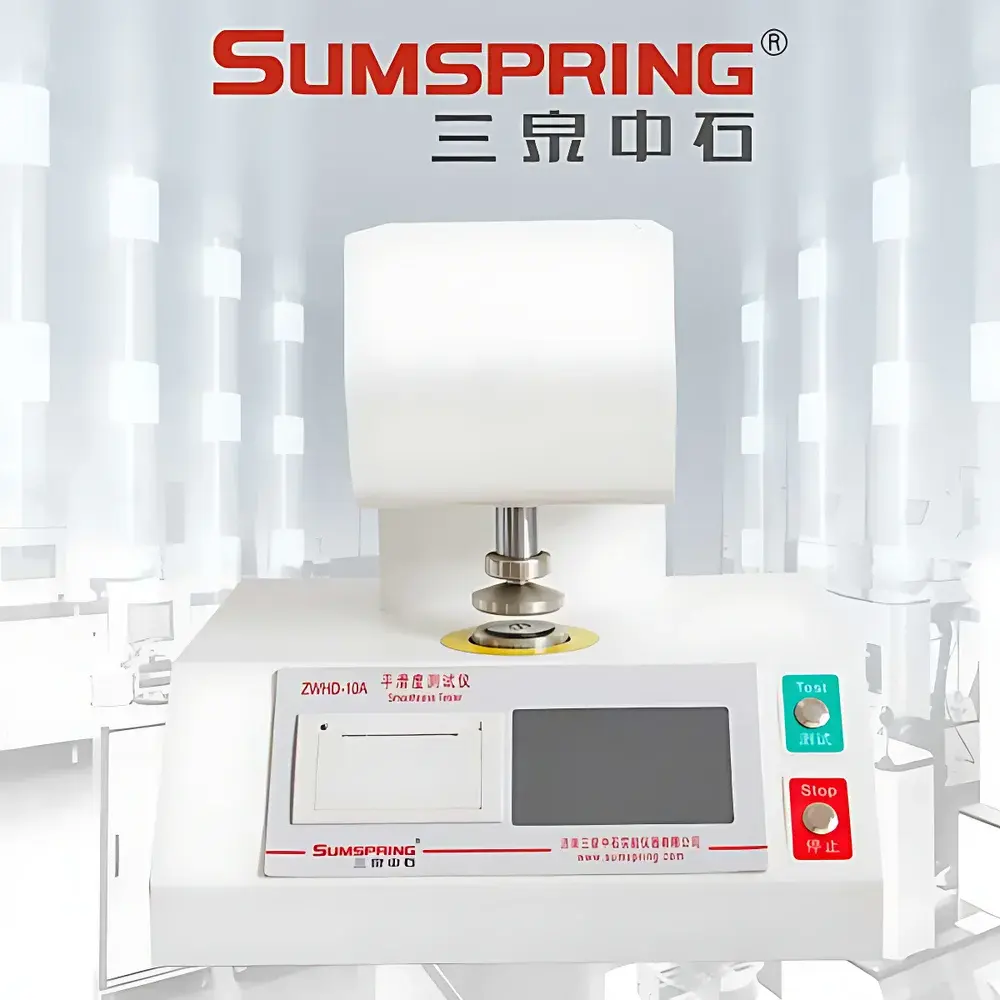
SumSpring ZWHD-10A Paperboard Smoothness Tester
| Brand | SumSpring |
|---|---|
| Origin | Shandong, China |
| Manufacturer Type | Direct Manufacturer |
| Country of Origin | China |
| Model | ZWHD-10A |
| Price | Upon Request |
| Measurement Range | 0–99999.9 s |
| Accuracy | ±0.1 s |
| Test Area | 10.0 ± 0.05 cm² |
| Applied Pressure | 100 kPa ± 2 kPa |
| Pre-compression Duration | 60 s (compliant with GB/T 456, ISO 8791-2, TAPPI T479) |
| Display | Chinese-character dot-matrix LCD |
| Interface | RS232 serial port |
| Dimensions (L×W×H) | 370 × 330 × 390 mm |
| Weight | 30 kg |
| Operating Temperature | 5–35 °C |
| Relative Humidity | ≤80% RH (non-condensing) |
| Power Supply | 220 V AC, 50 Hz |
Overview
The SumSpring ZWHD-10A Paperboard Smoothness Tester is a precision pneumatic instrument engineered for quantitative evaluation of surface smoothness in paperboard, corrugated board, and high-basis-weight packaging substrates. It operates on the principle of air-leakage time measurement—specifically, the duration required for a defined volume of air to pass between a standardized glass anvil and the test specimen under controlled pressure (100 kPa ± 2 kPa). This method conforms to internationally recognized standards including ISO 8791-2 (determination of smoothness by the Bendtsen method), GB/T 456 (Chinese national standard equivalent to ISO 8791-2), and TAPPI T479 (air-leakage smoothness testing). Unlike optical or profilometric approaches, this pneumatic technique directly correlates with printing performance—particularly ink transfer efficiency, dot gain control, and tonal fidelity—making it indispensable for QC laboratories in packaging manufacturing, prepress validation, and supplier qualification workflows.
Key Features
- Automated range selection and dynamic airflow regulation ensure optimal resolution across the full measurement span (0–99999.9 s), eliminating manual scale switching errors.
- Integrated pre-compression module applies and maintains 100 kPa pressure for exactly 60 seconds prior to test initiation—fully compliant with GB/T 456 Clause 6.3 and ISO 8791-2 Section 7.2.
- High-stability pneumatic circuitry with calibrated orifice design guarantees repeatability better than ±0.1 s (standard deviation over ten consecutive measurements on certified reference material).
- Rugged cast-aluminum frame and precision-ground glass anvil (Ø 10.0 ± 0.05 cm test area) minimize thermal drift and mechanical deformation during extended operation.
- RS232 serial interface supports bidirectional communication with LIMS or Excel-based data logging systems; firmware includes configurable baud rate (9600/19200 bps) and ASCII output protocol.
- Self-diagnostic startup sequence verifies pressure integrity, seal integrity, and sensor linearity before each test cycle—reducing operator-dependent variability.
Sample Compatibility & Compliance
The ZWHD-10A accommodates specimens up to 150 mm × 150 mm, with thickness ranging from 0.1 mm to 6.0 mm—covering solid bleached sulfate (SBS), recycled fiberboard, laminated cartonboard, and coated duplex board. Specimen conditioning follows ISO 187 (23 °C ± 1 °C, 50 % RH ± 2 % RH, minimum 24 h equilibration). Instrument compliance extends to regulatory frameworks governing packaging quality assurance: test procedures align with FDA guidance for food-contact material characterization (21 CFR Part 176.170), support GLP audit trails via external data capture, and satisfy internal QA requirements under ISO 9001:2015 clause 8.5.2 (identification and traceability of monitoring equipment).
Software & Data Management
While the ZWHD-10A operates as a standalone benchtop unit with embedded firmware, its RS232 interface enables seamless integration into enterprise-level quality management infrastructure. Raw test outputs include timestamp, sample ID (user-input), measured smoothness value (s), pressure confirmation flag, and system status code. When paired with SumSpring’s optional PC software (v3.2+), users gain access to statistical process control (SPC) charts (X̄-R, Cpk), batch trending, comparative analysis across material lots, and automated report generation compliant with ISO/IEC 17025 documentation requirements. All data files are stored in CSV format with UTF-8 encoding—ensuring compatibility with Minitab, JMP, and LabWare LIMS platforms.
Applications
- Verification of smoothness consistency across production rolls—critical for gravure and flexographic printing lines where substrate variability causes ink starvation or mottle.
- Supplier qualification testing per contractual specifications (e.g., “Smoothness ≥ 300 s Bendtsen, min.” for premium folding cartons).
- Correlation studies between smoothness values and print density (ISO 12647-3), halftone reproduction accuracy, and gloss uniformity (ASTM D2457).
- Root-cause analysis of print defects such as scumming, fill-in, or poor highlight definition—especially when combined with surface energy (dyne level) and porosity data.
- Validation of calendering or supercalendering process parameters in converting facilities.
FAQ
What standards does the ZWHD-10A comply with?
It meets the technical and procedural requirements of GB/T 456–2002, ISO 8791-2:2017, and TAPPI T479 om-19.
Can the instrument test corrugated board with fluting?
Yes—flat-faced specimens (flute compressed and stabilized) within 0.1–6.0 mm thickness and ≤150 mm edge length are supported.
Is calibration traceable to national metrology institutes?
SumSpring provides factory calibration certificates traceable to CNAS-accredited labs (certificate included); annual recalibration is recommended per ISO/IEC 17025.
Does the device require compressed air or vacuum supply?
No—it uses an integrated, oil-free diaphragm pump and sealed pneumatic chamber; only mains power (220 V AC) is required.
How is sample placement verified for consistent contact area?
The instrument features a spring-loaded centering guide and illuminated alignment reticle on the glass anvil to ensure repeatable 10.0 cm² coverage without operator interpretation error.




