
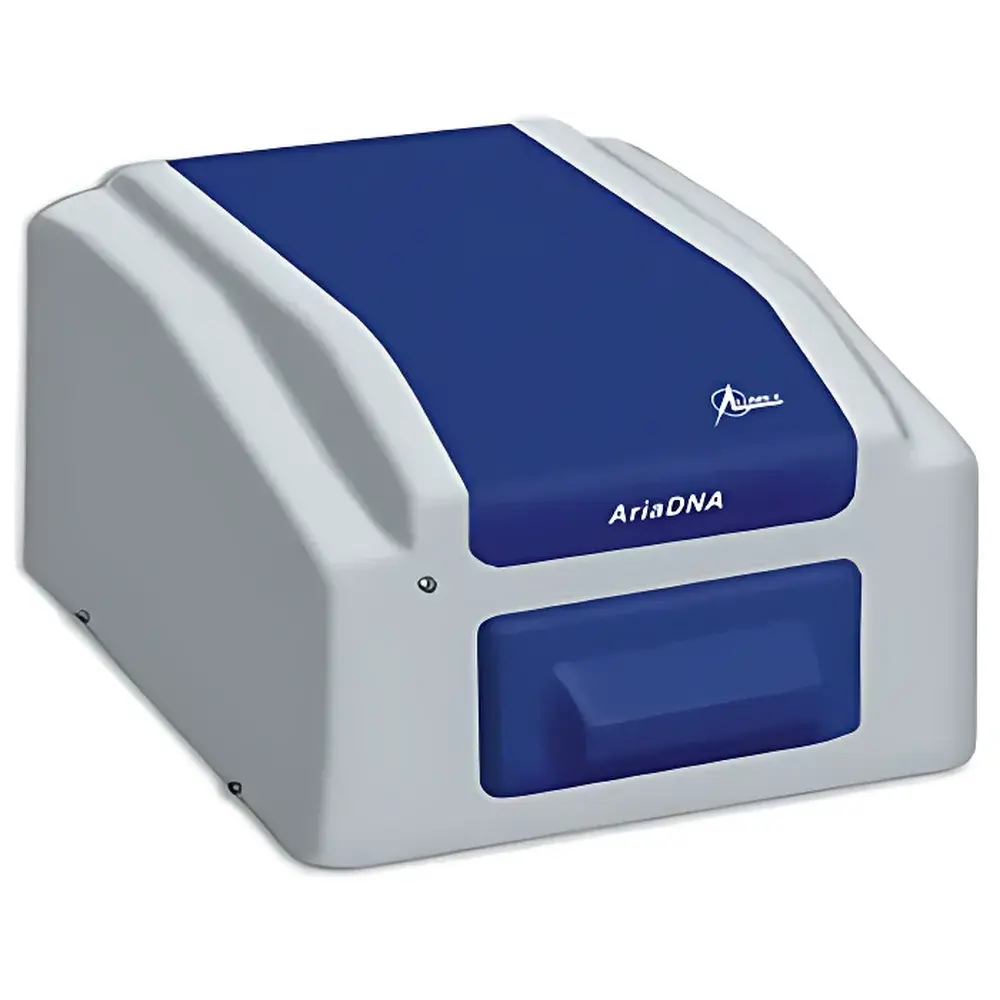
LUMEX AriaDNA® Real-Time Fluorescent Quantitative Microchip PCR System
| Brand | LUMEX |
|---|---|
| Origin | Canada |
| Model | AriaDNA® |
| Instrument Type | Real-Time Fluorescent Quantitative PCR System |
| Sample Throughput | 48-well or 32-well microchip format |
| Heating Rate | 12 °C/s |
| Temperature Accuracy | ±0.1 °C |
| Inter-well Temperature Uniformity | ±0.1 °C |
| Cooling Rate | 10 °C/s |
| Minimum Detectable DNA Copies per Microreactor | 1–5 |
| Total Reaction Time for 45 Cycles | ≤20 min |
| Microreactors per Chip | 16–48 |
| Reagent Volume per Reaction | 0.5–1 µL (2× PCR mix) |
| Integrated Dried-Down Reagents | Yes |
| Detection Channels | Channel 1 (FAM, SYBR Green) |
| Control Interface | External PC with Dedicated PCR Analysis Software & Database |
| Power Consumption | 80 W |
| Dimensions (W×D×H) | 250 × 300 × 190 mm |
| Weight | 5 kg |
Overview
The LUMEX AriaDNA® Real-Time Fluorescent Quantitative Microchip PCR System is an integrated, benchtop nucleic acid amplification and detection platform engineered for high-fidelity quantitative polymerase chain reaction (qPCR) using solid-phase microchip technology. Unlike conventional tube-based qPCR instruments, the AriaDNA® employs patented monolithic silica-glass microchips containing pre-patterned, spatially isolated microreactors—each functioning as an independent amplification chamber. This architecture eliminates cross-contamination risks inherent in multi-well plates and pipetting workflows. The system operates on the principle of real-time fluorescence monitoring during thermal cycling: target-specific amplicons are detected via sequence-specific probes (e.g., FAM-labeled hydrolysis probes) or intercalating dyes (e.g., SYBR Green), with emitted fluorescence captured by high-sensitivity photodetectors synchronized to thermal ramping. Quantification is achieved by determining the cycle threshold (CT)—the thermal cycle at which fluorescence crosses a statistically defined baseline—enabling absolute or relative quantitation of initial nucleic acid copy number with high reproducibility and low inter-run variability.
Key Features
- Monolithic microchip platform with 16–48 individually addressable microreactors per chip, fabricated from optically transparent, thermally stable fused silica
- Ultra-fast thermal control: heating rate up to 12 °C/s and cooling rate up to 10 °C/s, enabling full 45-cycle qPCR runs in ≤20 minutes
- Exceptional thermal precision: ±0.1 °C temperature accuracy and ±0.1 °C inter-microreactor uniformity across the entire chip surface
- Integrated lyophilized reagents pre-deposited in each microreactor—eliminating cold-chain dependency and minimizing manual handling errors
- Low-volume reaction architecture: consumes only 0.5–1 µL of 2× master mix per microreactor, reducing reagent costs by >70% versus standard 96-well formats
- Dual-channel optical detection optimized for common fluorophores (Channel 1: FAM/SYBR Green; Channel 2: ROX passive reference)
- Compact footprint (250 × 300 × 190 mm) and low power draw (80 W), suitable for biosafety cabinets, field laboratories, and mobile diagnostic units
Sample Compatibility & Compliance
The AriaDNA® supports diverse nucleic acid templates—including genomic DNA, cDNA, and RNA (with prior reverse transcription)—across clinical, agricultural, food safety, and environmental matrices. Its microchip design accommodates crude lysates, purified extracts, and direct swab eluates without requiring column-based purification in many validated assays. The system meets ISO/IEC 17025 requirements for testing laboratory competence when operated under documented SOPs. Data integrity is maintained through audit-trail-enabled software compliant with FDA 21 CFR Part 11 principles (electronic signatures, user access controls, immutable data logging). Assay kits developed for the platform have been independently verified by institutions including the Canadian Food Inspection Agency, China Academy of Agricultural Sciences, and the Russian Federal Service for Veterinary and Phytosanitary Surveillance against ISO 13843, ISO 22118, and AOAC Official Methods of Analysis standards.
Software & Data Management
Control, acquisition, and analysis are performed via the dedicated AriaDNA® PCR Analysis Suite running on Windows-based external PCs. The software provides real-time visualization of amplification curves, automatic CT calling with adjustable baseline and threshold settings, multi-sample comparative ΔΔCT analysis, and MIQE-compliant reporting templates. All raw fluorescence intensity values, thermal profiles, and user annotations are stored in encrypted SQLite databases with version-controlled backups. The suite supports GLP/GMP-aligned workflow modules, including electronic lab notebook (ELN) integration, instrument calibration logs, and QC flagging for outlier wells. Export options include CSV, PDF, and XML formats compatible with LIMS environments.
Applications
- Clinical Diagnostics: Quantitative detection of viral load (HBV, HCV, HIV, influenza A/B), bacterial pathogens (Chlamydia trachomatis, Neisseria gonorrhoeae), and antimicrobial resistance markers
- Veterinary & Aquaculture Health: Field-deployable testing for avian influenza virus (AIV), Newcastle disease virus (NDV), foot-and-mouth disease virus (FMDV), viral hemorrhagic septicemia virus (VHSV), and zoonotic agents (Brucella spp., Salmonella enterica)
- Food Safety & Authenticity: Rapid screening of foodborne pathogens (Salmonella, Listeria monocytogenes, Shigella), GMO quantification (e.g., MON810, NK603), allergen detection (soy, peanut, gluten), and species identification (meat adulteration)
- Plant Health & Seed Certification: Detection of potato pathogens (Phytophthora infestans, Clavibacter michiganensis subsp. sepedonicus), RNA viruses (PLRV, PVY), and nematode DNA (Globodera pallida, G. rostochiensis)
- Environmental Microbiology: Enumeration of indicator organisms (E. coli, Enterococcus spp.) and waterborne protozoa (Cryptosporidium parvum, Giardia lamblia) in drinking and recreational water
FAQ
Does the AriaDNA® require cold-chain storage for chips?
No—lyophilized reagent chips are stable at ambient temperature (15–30 °C) for ≥12 months and do not require refrigeration or freezing.
Can I develop custom assays on the AriaDNA® platform?
Yes—the open microchip architecture supports user-defined primer/probe sets; blank microchips (without dried reagents) are available for assay development and optimization.
Is the system compatible with existing qPCR assay protocols?
Standard TaqMan and SYBR Green chemistries are fully supported; however, reaction volumes and thermal profiles must be adapted to the microchip’s low-volume, rapid-cycling kinetics.
How is contamination risk mitigated during chip loading?
Each microchip is single-use and sealed post-manufacturing; microreactors are physically isolated with no shared fluidic pathways, eliminating carryover between samples.
What regulatory documentation is provided for validation?
LUMEX supplies IQ/OQ documentation packages, traceable calibration certificates (NIST-traceable thermocouples and photometric standards), and performance qualification reports aligned with CLSI EP17-A2 and ISO 13843 guidelines.




