
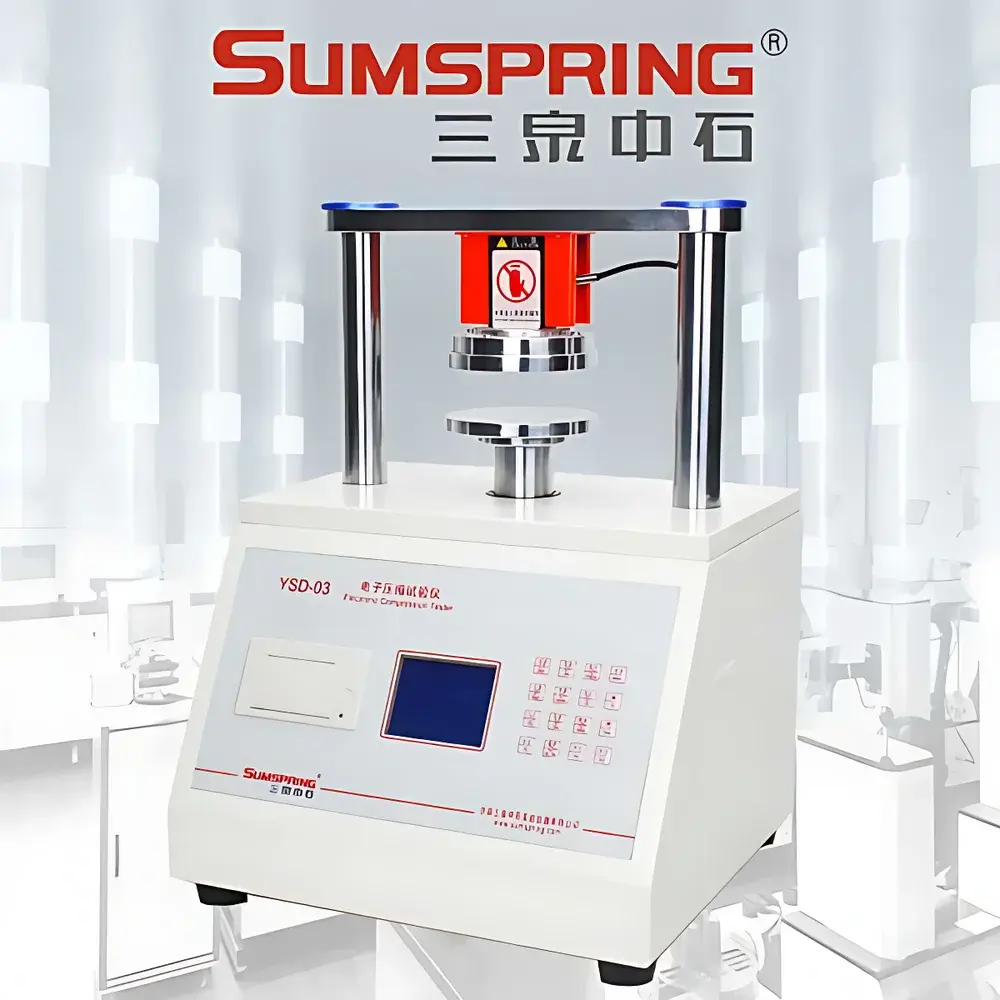
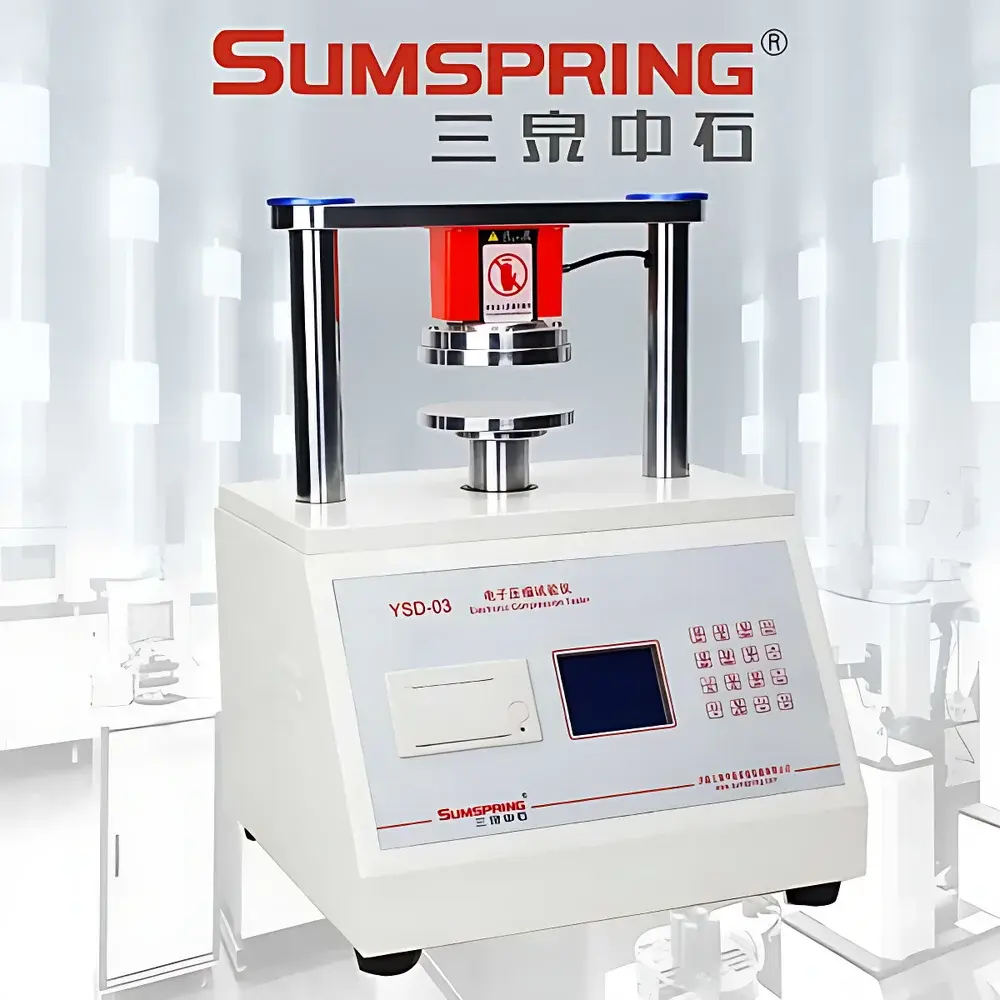
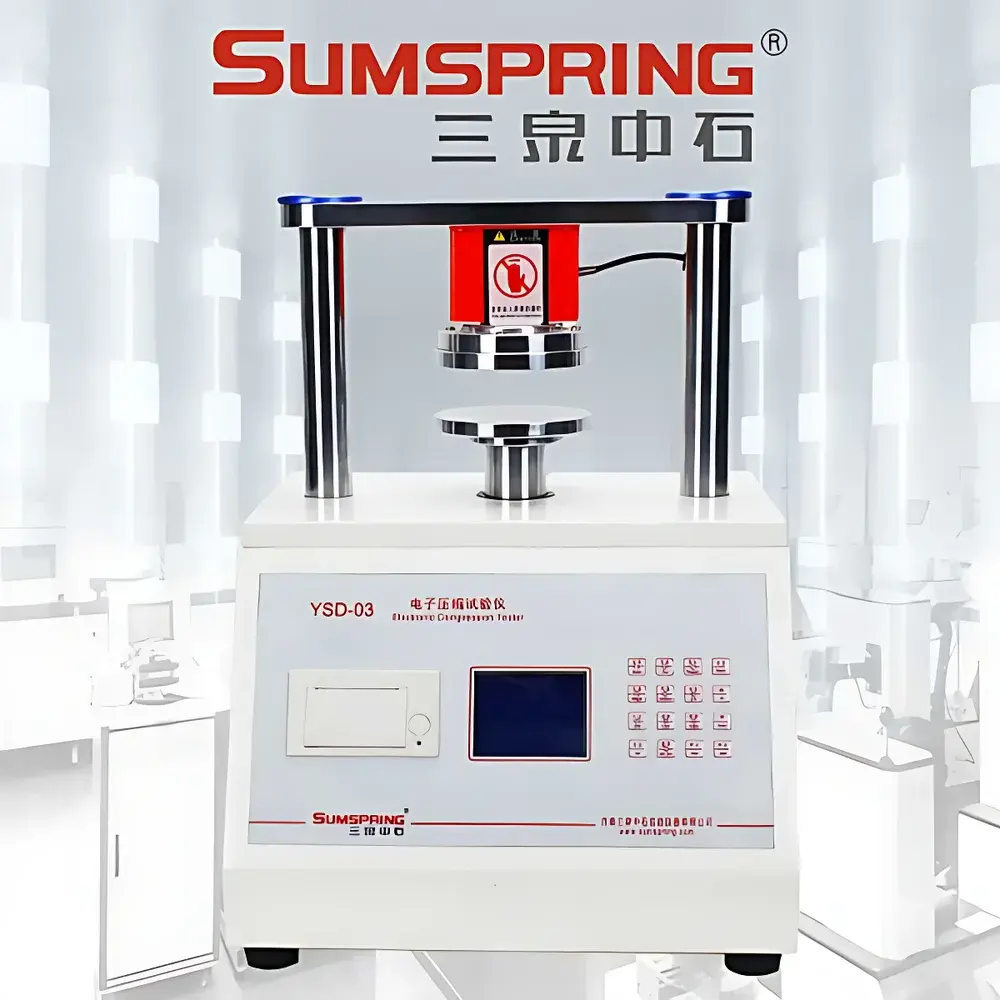
SumSpring YSD-03 Electronic Compression Testing Machine
| Brand | SumSpring |
|---|---|
| Origin | Shandong, China |
| Manufacturer Type | Direct Manufacturer |
| Country of Origin | China |
| Model | YSD-03 |
| Price | Upon Request |
| Load Capacity | 0–3000 N |
| Accuracy | ±1% FS |
| Platen Diameter | φ120 mm |
| Resolution | 1/10000 |
| Compression Speed | 12.5 ± 2.5 mm/min |
| Dimensions (L×W×H) | 390 × 350 × 690 mm |
| Weight | 56 kg |
| Operating Temperature | 15–50 °C |
| Relative Humidity | ≤70% RH |
| Power Supply | 220 V, 50 Hz |
Overview
The SumSpring YSD-03 Electronic Compression Testing Machine is a precision-engineered mechanical testing system designed specifically for static compressive strength evaluation of packaging-grade paper-based materials. It operates on the fundamental principle of uniaxial compression under controlled displacement rate, conforming to standardized mechanical test methodologies defined in ISO 3037 (board—determination of edge crush resistance), ISO 12048 (corrugated fibreboard—determination of compression resistance), and TAPPI T 811 (edge crush test for corrugated board) and TAPPI T 826 (flat crush resistance of corrugated board). The instrument applies a continuously increasing axial load via motor-driven upper platen against a fixed lower platen, while simultaneously capturing real-time force-displacement data. Its closed-loop servo-controlled actuation ensures consistent speed regulation and high reproducibility across repeated measurements—critical for quality assurance in packaging R&D, production line verification, and supplier qualification programs.
Key Features
- High-resolution load measurement with 1/10000 internal resolution and ±1% full-scale accuracy, traceable to national metrological standards;
- Fixed-diameter (φ120 mm) parallel platens engineered for uniform stress distribution and minimal eccentric loading during compression;
- Precisely regulated compression speed of 12.5 ± 2.5 mm/min—aligned with TAPPI and ISO-defined test velocities for edge crush and flat crush testing;
- Integrated digital control interface with programmable test parameters (preload, target displacement, dwell time, stop criteria);
- Robust structural frame constructed from high-rigidity steel alloy, minimizing deflection under maximum 3000 N load;
- Compliance-ready design supporting audit trails, user access levels, and manual calibration log retention per GLP/GMP documentation requirements;
- Compact footprint (390 × 350 × 690 mm) optimized for integration into QC laboratories with space constraints.
Sample Compatibility & Compliance
The YSD-03 accommodates a broad range of planar and cylindrical paper-based specimens without modification: solid fiber tubes (e.g., core winding tubes), single- or multi-ply paper sheets, solid bleached board (SBB), corrugated fiberboard (including A-, B-, C-, E-, and F-flute configurations), and laminated edge-compression samples prepared per ASTM D642 or ISO 12048 protocols. Specimen conditioning follows ISO 187 (standard atmosphere: 23 °C ± 1 °C, 50% RH ± 2%) prior to testing unless otherwise specified by customer or regulatory method. All mechanical outputs—including peak load (N), deformation at yield (mm), and compressive modulus (N/mm)—are reported in SI units and fully compatible with LIMS integration via RS232 or optional USB-to-serial interface. The system meets CE marking requirements for machinery safety (2006/42/EC) and electromagnetic compatibility (2014/30/EU).
Software & Data Management
Standard firmware supports direct data export in CSV format for post-processing in Excel, MATLAB, or statistical analysis platforms (e.g., Minitab, JMP). Optional PC-based software provides enhanced functionality including multi-curve overlay, pass/fail threshold mapping, batch reporting with automatic certificate generation (PDF), and configurable electronic signatures compliant with FDA 21 CFR Part 11 Annex 11 requirements. Audit trail records capture operator ID, timestamp, parameter changes, calibration events, and result modifications—enabling full traceability during internal audits or regulatory inspections. Data storage is local (on-device memory) with optional cloud backup via secure FTP or TLS-enabled API endpoints.
Applications
- Edge crush resistance (ECT) testing of corrugated board for shipping container design validation;
- Flat crush resistance (FCT) assessment of flutes under static load to predict stacking performance;
- Ring crush test (RCT) for paperboard stiffness and fiber bonding strength evaluation;
- Compression strength verification of paper cores used in textile, film, and adhesive roll manufacturing;
- In-process quality control of recycled fiberboard and molded pulp packaging components;
- Material comparison studies for sustainable packaging development (e.g., bamboo-fiber composites, mycelium-based substrates);
- Supplier qualification testing per contractual specifications aligned with ISTA 3A or ASTM D4169 protocols.
FAQ
What standards does the YSD-03 comply with for packaging compression testing?
The instrument supports test execution per ISO 3037, ISO 12048, TAPPI T 811, TAPPI T 826, ASTM D642, and GB/T 6546—covering edge crush, flat crush, ring crush, and general compression resistance of fiber-based packaging materials.
Can the YSD-03 be calibrated internally without external service?
Yes—it includes built-in zero-point adjustment and accepts certified deadweight calibration kits (up to 3000 N) for routine verification; full calibration certificates are issued upon request with NIST-traceable reference standards.
Is the compression speed adjustable beyond the standard 12.5 mm/min setting?
No—the YSD-03 is factory-configured to maintain strict compliance with international standard velocities; variable-speed operation is not supported to ensure method equivalence and inter-laboratory comparability.
Does the system support automated sample handling or robotic integration?
Not natively; however, the RS232 interface enables third-party PLC or pick-and-place robot synchronization via custom command protocol—subject to integration engineering review.
What maintenance intervals are recommended for long-term accuracy retention?
Platen surface inspection and cleaning every 200 tests; load cell verification quarterly; annual full mechanical and metrological recalibration recommended for GMP-regulated environments.




