
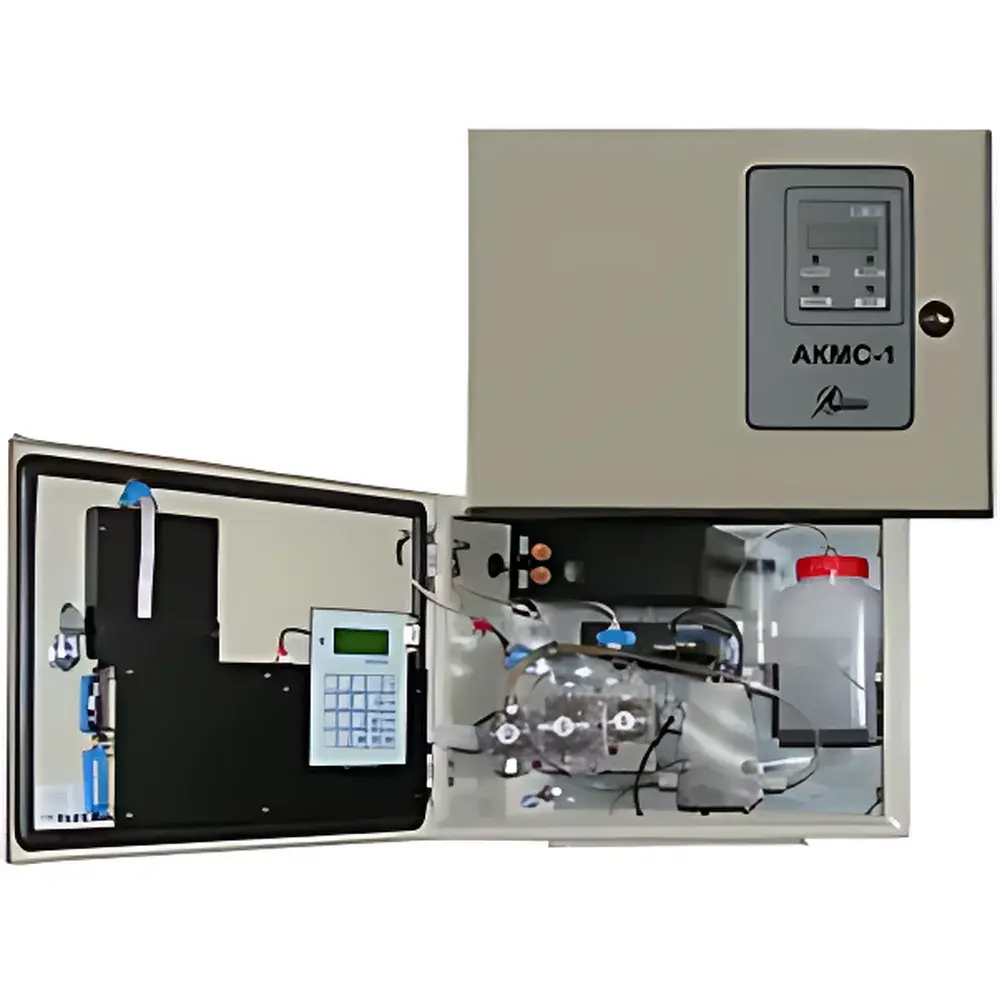
LUMEX AKMC-1 Online Water Hardness Analyzer
| Brand | LUMEX |
|---|---|
| Origin | Russia |
| Manufacturer Type | Authorized Distributor |
| Origin Category | Imported |
| Model | AKMC-1 |
| Price Range | USD 13,500 – 40,500 |
| Measurement Principle | Potentiometric Titration |
| Detection Range | 0.25–250 ppm (as CaCO₃) |
| Sampling Frequency | 1–4 times/hour |
| Operating Temperature | +10 to +35 °C |
| Relative Humidity (at +25 °C) | <80% |
| Sample Pressure | 0.1–10 atm |
| Sample Temperature | +5 to +40 °C |
| Power Supply | 110/220 VAC, 50/60 Hz |
| Power Consumption | 100 W |
| Dimensions | 300 × 400 × 150 mm |
| Weight | 20 kg |
Overview
The LUMEX AKMC-1 Online Water Hardness Analyzer is an industrial-grade, fully automated system engineered for continuous, reagent-free determination of total water hardness—expressed as calcium carbonate (CaCO₃) equivalent—in real time. It employs potentiometric titration with a solid-state ion-selective electrode to quantify the combined concentration of calcium (Ca²⁺) and magnesium (Mg²⁺) ions in aqueous streams. Unlike colorimetric or complexometric methods requiring consumable reagents, the AKMC-1 operates without chemical dosing, eliminating reagent calibration drift, waste generation, and operational downtime associated with reagent replenishment. Designed for integration into process-critical infrastructure, it delivers high reproducibility in dynamic flow environments typical of power plant feedwater circuits, municipal softening facilities, food-grade process loops, and environmental compliance monitoring stations. Its architecture conforms to IEC 61508 functional safety principles for continuous emission and process monitoring systems.
Key Features
- Reagent-free operation using potentiometric titration with integrated solid-state reference and indicator electrodes
- Automatic temperature compensation across the full operational sample temperature range (+5 to +40 °C)
- Dynamic flow-path optimization ensuring stable hydrodynamic conditions for consistent electrode response
- Single-point calibration protocol with user-definable calibration intervals and traceable standard reference materials
- Configurable sampling frequency (1–4 analyses per hour) synchronized with process control logic
- Onboard self-diagnostic routines including electrode potential stability verification, fluidic path integrity checks, and signal-to-noise ratio monitoring
- Digital signal processing engine with adaptive filtering to suppress electromagnetic interference in industrial settings
- IP65-rated enclosure suitable for installation in non-hazardous indoor technical rooms or weather-protected outdoor cabinets
Sample Compatibility & Compliance
The AKMC-1 is validated for use with low-turbidity, non-oily, non-suspended-solids water matrices—including demineralized boiler feedwater, reverse osmosis permeate, softened municipal supply, and condensate return streams. It complies with ISO 6059 (water quality — determination of hardness — titrimetric method) for method equivalence and supports audit-ready data generation aligned with GLP and GMP documentation requirements. While not intrinsically certified for hazardous area installation, its electrical interface meets EN 61000-6-2 (immunity) and EN 61000-6-4 (emissions) standards. Data output protocols are compatible with Modbus RTU/TCP and OPC UA for seamless integration into SCADA, DCS, and MES platforms used in utility and manufacturing environments.
Software & Data Management
The embedded firmware provides local HMI navigation via a 4.3-inch resistive touchscreen with multilingual UI (English, Russian, German, Chinese). All measurement events—including raw mV signals, calculated hardness values, calibration timestamps, diagnostic flags, and environmental metadata—are timestamped with UTC synchronization and stored in non-volatile memory for ≥30 days. Export options include CSV over USB host port or Ethernet, supporting periodic archival to network-attached storage. Audit trail functionality records all configuration changes, calibration actions, and user logins with operator ID tagging—meeting foundational requirements for FDA 21 CFR Part 11 electronic record integrity when deployed in regulated pharmaceutical or beverage production contexts.
Applications
- Real-time monitoring of pretreatment efficiency in thermal power plant make-up water systems
- Performance validation of ion exchange softeners and nanofiltration units in municipal desalination plants
- Boiler drum water quality assurance to prevent scale formation in subcritical and supercritical steam cycles
- Turbine condensate purity surveillance to detect cooling water leakage and minimize corrosion risk
- In-line hardness verification for rinse water in dairy processing, brewery CIP circuits, and bottled water filling lines
- Long-term trend analysis for regulatory reporting under EU Bathing Water Directive (2006/7/EC) and US EPA Clean Water Act Section 305(b)
FAQ
Does the AKMC-1 require daily reagent refills or standard solution replacements?
No. The system performs potentiometric titration without liquid titrants; only periodic electrode maintenance and single-point calibration are required.
Can the AKMC-1 be installed directly in pressurized pipeline networks?
Yes—it accepts inlet pressures from 0.1 to 10 atm and includes pressure-regulated flow control to maintain optimal laminar flow across the sensor cell.
Is remote firmware update supported?
Firmware updates are performed locally via USB drive; remote update capability is not implemented to ensure deterministic system behavior in safety-critical applications.
What is the minimum detectable hardness level, and how is accuracy verified?
The lower detection limit is 0.25 ppm CaCO₃, validated using NIST-traceable hardness standards (SRM 1643e); accuracy is maintained within ±5% of reading across the full 0.25–250 ppm range.
How does the system handle temperature fluctuations in unconditioned technical rooms?
An integrated Pt100 sensor continuously monitors sample temperature and applies real-time correction to the Nernst equation slope, preserving measurement fidelity across the +5 to +40 °C operating window.
Related Products







