
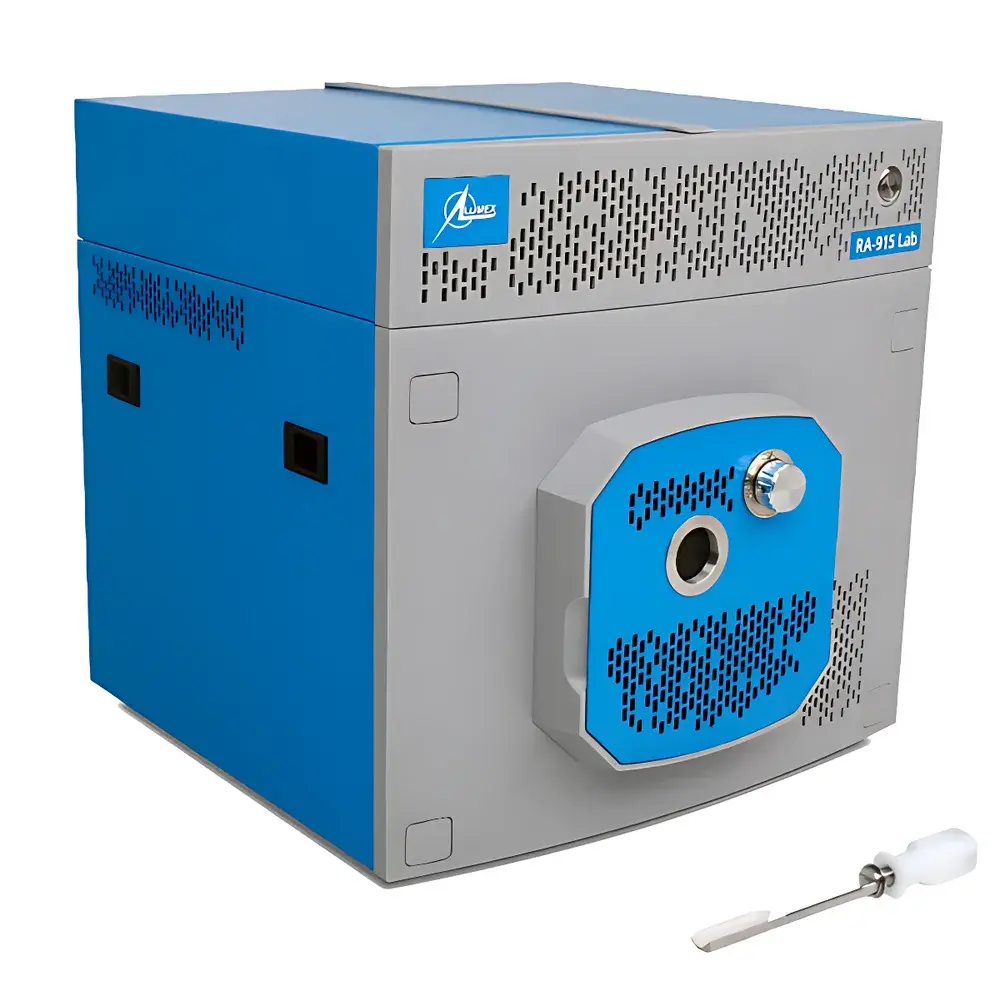
LUMEX RA-915Lab Automated Mercury Analyzer
| Brand | LUMEX |
|---|---|
| Origin | Canada |
| Model | RA-915Lab |
| Instrument Type | Benchtop Laboratory Analyzer |
| Measurement Principle | Cold Vapor Atomic Absorption Spectrometry (CVAAS) |
| Repeatability | <1.5% RSD |
| Linearity Error | ±5% |
| Sample Throughput | Up to 45 samples unattended |
| Analysis Time | ≤3 minutes per sample |
| Linear Range | 0–2,000,000 µg/kg (ppb–ppm equivalent across matrices) |
| Detection Capability | Sub-ng absolute sensitivity (matrix-dependent) |
| Compliance | EPA Method 7473, EPA 1631, EPA 30B, EPA SW-846 |
Overview
The LUMEX RA-915Lab Automated Mercury Analyzer is a benchtop cold vapor atomic absorption spectrometer engineered for high-precision, direct mercury quantification in solid, liquid, and gaseous samples without chemical pretreatment. It employs Zeeman-effect background correction coupled with high-frequency modulation of a high-intensity, electrodeless discharge mercury lamp — a configuration that eliminates spectral interferences and suppresses memory effects inherent in conventional CVAAS systems. Unlike traditional mercury analyzers requiring gold amalgamation traps, carrier gas purification, or acid digestion, the RA-915Lab integrates a thermally controlled pyrolysis module with gradient heating profiles (up to 900 °C) and fully heated sample transfer lines, ensuring complete mercury release from refractory matrices while preventing adsorption or carryover. Its optical path is optimized for stability and long-term signal reproducibility, supported by real-time baseline monitoring and automatic lamp alignment diagnostics.
Key Features
- Direct analysis of solids, liquids, and gases — no digestion, no derivatization, no drying or moisture removal required
- 45-position modular autosampler with bidirectional communication to analytical balances (RS-232/USB), enabling automated mass import and sample ID synchronization
- Thermally isolated pyrolysis furnace with programmable multi-step temperature ramping and feedback-controlled thermal scanning to maximize Hg liberation and minimize matrix-induced volatilization artifacts
- Zeeman-corrected CVAAS detection system with dual-beam referencing, delivering sub-ng absolute detection limits and <1.5% repeatability (RSD) across heterogeneous sample types
- Integrated air-compressor-free operation — uses ambient air as carrier gas; eliminates dependency on compressed argon or nitrogen cylinders
- Self-diagnostic firmware with lamp intensity logging, optical alignment verification, and thermal profile validation for audit-ready instrument performance tracking
Sample Compatibility & Compliance
The RA-915Lab accommodates diverse environmental, industrial, and biological matrices including soils, sediments, fly ash, coal, cement, petroleum products (crude oil, distillates), foodstuffs (fish, rice, dairy), pharmaceutical excipients, clinical specimens (urine, hair, whole blood), and air filters. It is validated for use in accordance with U.S. EPA Methods 7473 (solid/liquid), 1631 (aqueous), 30B (stack emissions), and SW-846 Chapters; Chinese standard methods HJ 923–2017 (soils), HJ 917–2017 (stationary source emissions), and HJ 910–2017 (ambient air); as well as ISO 17294-2:2016 (water), ASTM D6722–22 (petroleum), and pharmacopeial guidelines aligned with USP / elemental impurities requirements. All calibration and system suitability protocols support GLP/GMP traceability and 21 CFR Part 11-compliant electronic record integrity when paired with optional LUMEX Mercury Control Software v5.x.
Software & Data Management
Mercury Control Software provides full instrument control, method development, calibration curve generation (linear, quadratic, or weighted regression), and automated QC flagging (e.g., drift correction, blank threshold violation, peak asymmetry alerts). Raw absorbance spectra, thermal profiles, and temporal signal traces are stored in vendor-neutral .csv and .xml formats. Audit trail functionality logs all user actions, parameter changes, and calibration events with timestamps and operator IDs. Data export supports LIMS integration via ODBC and HL7 interfaces. Optional 21 CFR Part 11 compliance package includes electronic signatures, role-based access control, and immutable archival of raw data files.
Applications
- Environmental Monitoring: Quantification of total mercury in soils, river sediments, landfill leachates, wastewater effluents, and ambient air particulate filters
- Industrial Emissions: Continuous compliance testing of flue gas, cement kiln dust, biomass combustion residues, and activated carbon sorbents
- Food & Pharma Safety: Screening for mercury contamination in seafood, infant formula, herbal supplements, and injectable drug substances per ICH Q3D and USP regulatory thresholds
- Petroleum & Geochemistry: Total mercury determination in crude oil, shale gas condensates, drilling muds, and geological core samples per API RP 97 and ISO 17294
- Clinical & Forensic Toxicology: Rapid assessment of mercury exposure biomarkers in human biofluids and tissues under CLIA- or CAP-accredited workflows
FAQ
Does the RA-915Lab require gold traps or amalgamation steps?
No — it uses direct thermal decomposition and atomic absorption detection without pre-concentration or trapping stages.
Can it analyze mercury in high-salt or sulfur-rich matrices like seawater or sulfide ores?
Yes — the Zeeman background correction and gradient pyrolysis effectively mitigate chloride and sulfide interferences common in such samples.
Is method validation support available for regulatory submissions?
Yes — LUMEX provides IQ/OQ documentation templates, certified reference material test reports (NIST SRM 2710a, ERM-CC580), and application notes aligned with EPA and HJ method requirements.
What maintenance intervals are recommended for routine operation?
Lamp replacement every 12–18 months; quartz cell cleaning every 200–300 analyses; annual optical alignment verification and furnace calibration using NIST-traceable standards.
How is data integrity ensured during multi-user laboratory deployment?
Through configurable user roles, encrypted database logging, electronic signature workflows, and immutable raw data archiving — all compliant with FDA 21 CFR Part 11 and EU Annex 11 expectations.





