
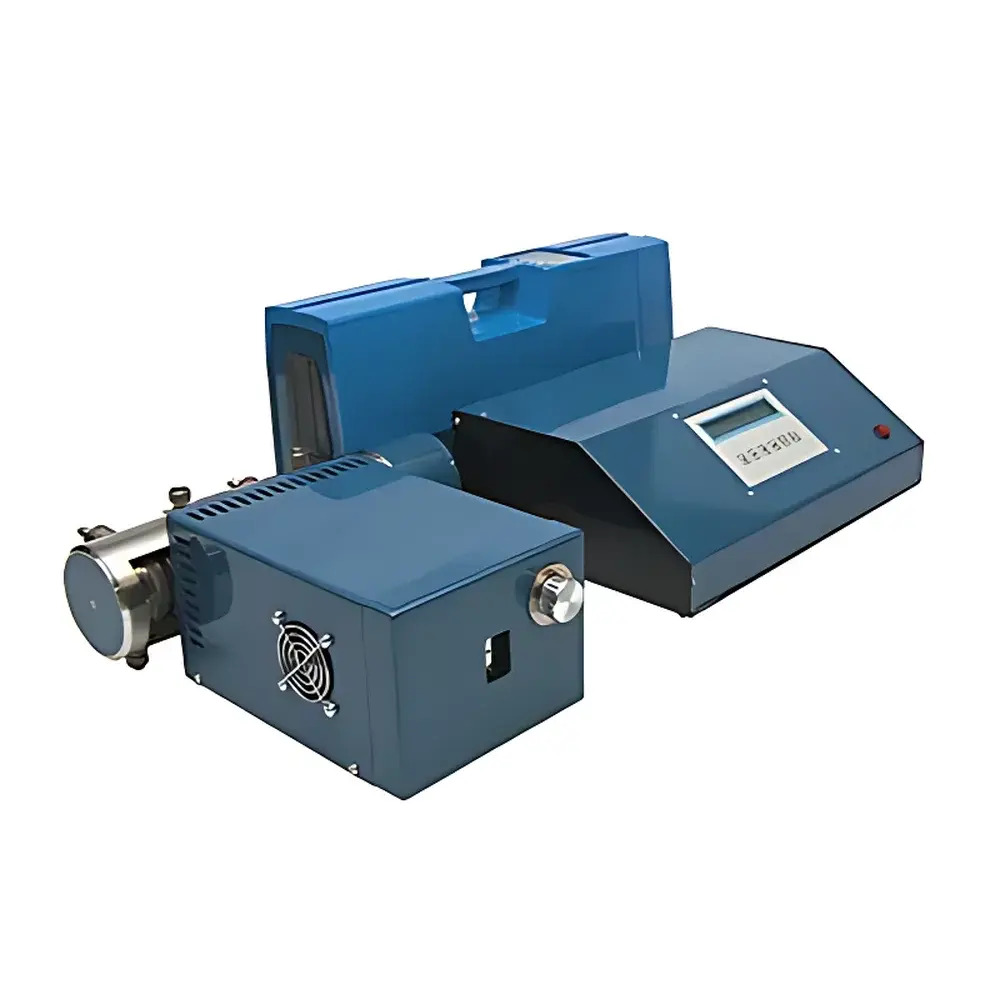
LUMEX Pyro-915+ High-Temperature Thermal Decomposition Unit for Mercury Analysis (Mercury Analyzer)
| Brand | LUMEX |
|---|---|
| Origin | Canada |
| Model | Pyro-915+ |
| Instrument Type | Portable |
| Principle | Cold Vapor Atomic Absorption Spectrometry (CVAAS) with Zeeman Background Correction |
| Detection Limit | 0.05 ng/mL (liquid) / 0.05 µg/kg (solid) |
| Repeatability | ±2% RSD |
| Linearity Error | ±1% |
| Sample Throughput | <2 min per sample |
| Operating Temperature Range | Programmable up to 950 °C |
| Air Monitoring LOD | 0.5 ng/m³ (10-s response) / 2 ng/m³ (1-s response) |
| Power Supply | 100–240 VAC, 50/60 Hz |
| Power Consumption | 700 W |
| Weight | 17.5 kg |
| Dimensions (Controller) | 400 × 280 × 135 mm |
| Dimensions (Furnace) | 430 × 340 × 135 mm |
| Continuous Operation | Up to 8 h |
| Carrier Gas Flow | 1.0–3.0 L/min |
| Sample Mass Range | 10–1500 mg |
| Upper Detection Limit | 200 mg/kg (based on 20 mg sample) |
Overview
The LUMEX Pyro-915+ is a high-temperature thermal decomposition accessory designed exclusively for integration with the RA-915 series mercury analyzers. It enables direct, reagent-free quantification of total mercury in complex solid and semi-solid matrices—such as biological tissues, coal, sediments, foodstuffs, and industrial catalysts—without acid digestion, solvent extraction, or chemical pre-treatment. The unit operates on the principle of controlled pyrolysis followed by cold vapor atomic absorption spectrometry (CVAAS) with Zeeman-effect background correction. Mercury species in the sample are thermally liberated as elemental mercury vapor at precisely regulated temperatures (up to 950 °C), swept into a quartz absorption cell, and quantified via absorption of 254 nm resonance radiation. This methodology complies fully with U.S. EPA Method 7473 (for solids) and EPA Method 30B (for stack emissions), ensuring regulatory acceptability in environmental monitoring, industrial compliance, and food safety applications.
Key Features
- Integrated programmable pyrolysis furnace with eight pre-optimized thermal ramp profiles—each tailored for specific matrix types (e.g., fish tissue, coal, soil, hair, catalysts) to maximize Hg release efficiency and minimize interferences.
- Zeeman-background-corrected CVAAS detection eliminates reliance on gold amalgamation traps, removing sensitivity drift caused by trap saturation, temperature instability, or mechanical wear—enhancing long-term measurement reproducibility.
- True field-deployable architecture: self-contained design with internal power management supports 8-hour continuous operation; no external gas cylinders, compressed air, or auxiliary vacuum systems required.
- Ultra-low detection capability: 0.05 µg/kg in solid samples (equivalent to 0.5 ppb); sub-ng/m³ real-time air monitoring (2 ng/m³ at 1-second response time; 0.5 ng/m³ at 10-second integration).
- Wide dynamic range: spans five orders of magnitude—from trace-level environmental monitoring to high-concentration industrial process control (up to 200 mg/kg).
- No consumables beyond standard quartz boats and disposable sample cups—eliminates recurring costs associated with gold-coated traps, carrier gas refills, or chemical reagents.
Sample Compatibility & Compliance
The Pyro-915+ accommodates heterogeneous, high-matrix-load samples including but not limited to: fish fillets, liver homogenates, human hair/nails, coal and fly ash, cement clinker, activated carbon, petroleum coke, sludge, and agricultural soils. Its robust thermal decomposition protocol ensures complete volatilization of organomercurials (e.g., methylmercury), inorganic Hg²⁺, and Hg⁰ without loss or artifact formation. Analytical performance meets ISO 17025 requirements for accredited laboratories and satisfies data integrity criteria under FDA 21 CFR Part 11 when used with compliant RA-915 software. Method validation documentation aligns with ASTM D6722, EN 1483, and EU Commission Regulation (EU) No 2017/478 for mercury in food.
Software & Data Management
Controlled via the RA-915’s embedded Windows-based interface, the Pyro-915+ supports method-driven operation with full audit trail logging—including user ID, timestamp, thermal program parameters, calibration history, and raw absorbance spectra. Data export is compatible with LIMS via CSV, XML, or direct ODBC connection. Software includes GLP/GMP-compliant features: electronic signatures, password-protected method editing, automatic recalibration prompts, and tamper-evident report generation. All spectral acquisitions retain original Zeeman-split signal traces for retrospective interference diagnostics.
Applications
- Environmental Monitoring: Total Hg in soils, sediments, biota, atmospheric particulates, and wastewater sludges—supporting site remediation verification and regulatory reporting under RCRA and Clean Water Act frameworks.
- Fuel & Petrochemical Analysis: Mercury speciation screening in natural gas feedstocks, crude oil, LNG condensates, and refinery catalysts—critical for protecting downstream equipment from amalgamation-induced corrosion.
- Food Safety & Public Health: Routine screening of fish, dairy, infant formula, and wine for compliance with FDA/EU maximum residue limits (MRLs) and EFSA tolerable weekly intake (TWI) guidelines.
- Occupational Hygiene: Real-time workplace air monitoring in chlor-alkali plants, dental clinics, and waste incineration facilities—meeting OSHA PEL and ACGIH TLV requirements.
- Research & Method Development: Reference-grade mercury speciation studies where thermal stability profiles and matrix-specific release kinetics must be characterized prior to ICP-MS or CVAFS coupling.
FAQ
Does the Pyro-915+ require gold amalgamation traps or carrier gas cylinders?
No. It operates without gold traps, compressed gases, or vacuum pumps—relying solely on ambient air or laboratory-grade nitrogen as carrier gas.
Can it quantify methylmercury directly?
The Pyro-915+ measures total mercury only. Speciation requires prior chromatographic separation (e.g., GC-CVAFS) or validated oxidative digestion protocols.
Is EPA Method 30B validation available for stack testing?
Yes—full method validation reports, including spike recovery, blank assessment, and inter-laboratory comparison data, are supplied with each system.
What sample preparation is needed for soil or coal analysis?
None. Homogenized solids are weighed directly into quartz boats and loaded—no drying, sieving, or acid treatment is necessary.
How is calibration verified during extended field deployments?
Built-in solid Hg standards (e.g., NIST SRM 2710a simulants) and automated multi-point calibration routines ensure traceability and compliance with ISO/IEC 17025 Clause 7.7.
Related Products





