
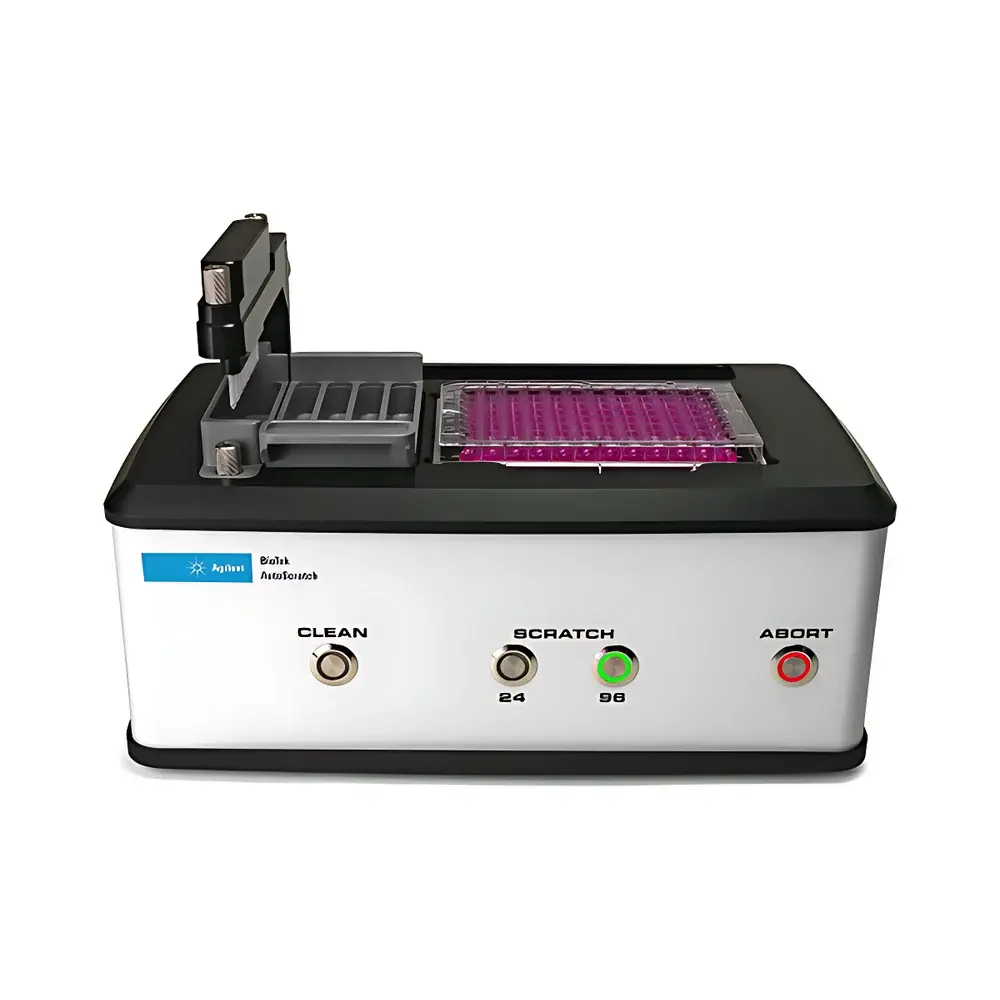
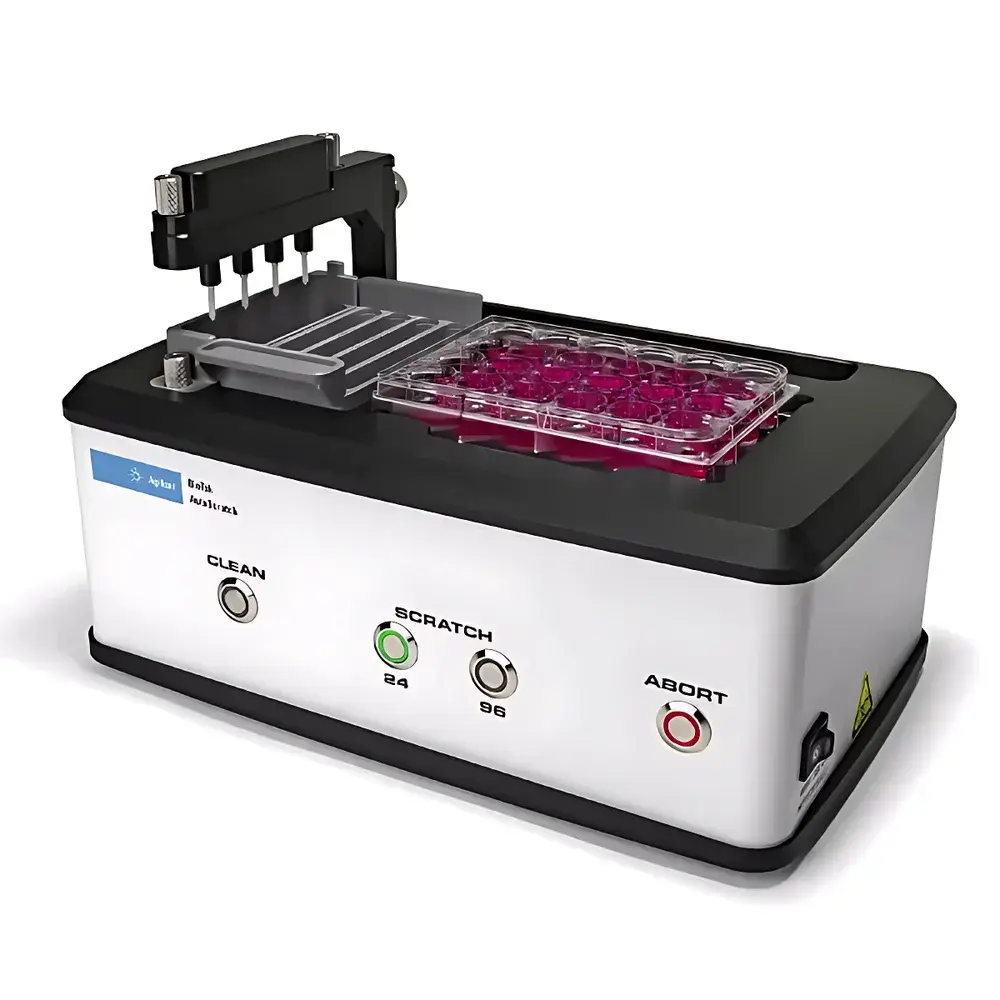
Agilent BioTek AutoScratch Automated Wound Healing Assay System
| Brand | Agilent Technologies |
|---|---|
| Origin | USA |
| Manufacturer | Agilent Technologies (BioTek Division) |
| Product Type | Imported Instrument |
| Model | AutoScratch |
| Pricing | Available Upon Request |
Overview
The Agilent BioTek AutoScratch Automated Wound Healing Assay System is an integrated, precision-engineered platform designed to standardize and automate the in vitro scratch (wound healing) assay—a foundational functional assay for quantifying cellular migration and collective cell behavior. Unlike manual pipette-based or sterile-scratch methods, which introduce high inter- and intra-experimental variability due to inconsistent force, depth, and geometry, the AutoScratch employs motorized, calibrated scratch heads that apply reproducible mechanical displacement across confluent monolayers grown in standard 24-well or 96-well microplates. The system operates under controlled environmental conditions when coupled with BioTek’s Cytation™ multimode readers or Lionheart™ FX automated live-cell imagers—enabling seamless transition from wound induction to time-lapse imaging and quantitative analysis without plate handling or user intervention. Its core measurement principle relies on high-resolution brightfield or phase-contrast imaging combined with algorithmic edge detection and confluence mapping, delivering objective metrics of wound closure kinetics grounded in pixel-level spatial analysis.
Key Features
- Motor-driven, interchangeable scratch heads optimized for both 24-well and 96-well plate formats—ensuring consistent scratch width, depth, and linearity across all wells.
- Integrated environmental control compatibility (CO₂, temperature, humidity) when used with Cytation or Lionheart platforms—preserving physiological relevance during long-term kinetic assays.
- Automated post-scratch cleaning cycle using programmable aspiration and rinse protocols to remove cellular debris and prevent cross-well contamination between runs.
- Pre-configured, validated assay templates for common wound healing applications—including baseline migration, inhibitor screening, and co-culture models—with support for custom protocol development via Gen5® software.
- Real-time image acquisition synchronization with scratch initiation—eliminating timing drift and enabling precise t0 alignment across multi-plate experiments.
- On-instrument calibration routine with traceable reference plates to maintain scratch head positioning accuracy over extended operational lifetimes.
Sample Compatibility & Compliance
The AutoScratch supports adherent mammalian cell lines (e.g., HeLa, MCF-7, NIH/3T3, HUVEC) cultured as uniform monolayers on standard tissue-culture-treated polystyrene microplates. It is compatible with coated surfaces (fibronectin, collagen I, Matrigel™) and accommodates both serum-containing and serum-free migration media formulations. All hardware and software components comply with ISO 13485:2016 (medical device quality management) and are validated per Good Laboratory Practice (GLP) and Good Manufacturing Practice (GMP) documentation requirements. Data integrity features—including electronic signatures, audit trails, and secure user access levels—meet FDA 21 CFR Part 11 compliance standards when deployed with Gen5 3.12 or later.
Software & Data Management
Controlled exclusively through BioTek’s Gen5 Microplate Reader and Imager Software (v3.12+), the AutoScratch enables end-to-end workflow automation: from scratch head selection and plate mapping to image capture scheduling and kinetic parameter extraction. The built-in Wound Healing Application Module performs automated confluence calculation using adaptive thresholding, dynamic mask generation, and sub-pixel edge interpolation. Exported metrics include absolute wound area (µm²), relative wound width (% of initial width), confluence percentage over time, and maximum wound closure rate (µm/h), all traceable to raw image stacks stored in TIFF or OME-TIFF format. Data files are structured according to MIAME-compliant metadata conventions and support direct integration with downstream analysis tools including Python-based scikit-image pipelines or commercial platforms such as ImageJ/Fiji and MATLAB.
Applications
- Quantitative evaluation of chemokine- or growth factor-stimulated migration in cancer, fibroblast, and endothelial cell models.
- High-throughput screening of small-molecule inhibitors targeting Rho GTPases, FAK, or actin polymerization pathways.
- Functional validation of CRISPR/Cas9-mediated gene knockouts affecting cytoskeletal dynamics or focal adhesion turnover.
- Comparative analysis of epithelial–mesenchymal transition (EMT) states using paired parental vs. transformed isogenic lines.
- Co-culture wound assays modeling stromal–tumor interactions or immune cell infiltration dynamics.
- Regulatory submission–ready data generation for preclinical toxicology and mechanistic pharmacology studies aligned with ICH S7B and S8 guidelines.
FAQ
Does the AutoScratch require dedicated space inside a CO₂ incubator?
No—it is designed for benchtop operation and integrates with Cytation or Lionheart systems equipped with on-board environmental control modules.
Can scratch parameters (e.g., number of lines, spacing, depth) be customized per well?
Yes—Gen5 software allows full definition of scratch pattern geometry, including line count, inter-line distance, and directional orientation, with independent configuration per plate region.
Is the system compatible with 384-well plates?
Not natively—the current scratch head design supports only 24-well and 96-well formats; however, alternative migration assays (e.g., transwell or spheroid-based) can be performed on the same imaging platforms.
How is scratch reproducibility validated across instruments?
Each unit undergoes factory calibration using NIST-traceable dimensional standards, and users may run quarterly verification with BioTek’s AutoScratch Validation Kit (PN: 7280000), which includes reference plates and SOPs.
Does the software support batch processing of multiple plates acquired over different days?
Yes—Gen5’s experiment grouping and normalization engine enables cross-experiment comparison using internal controls or reference wells, with automatic time-zero alignment based on actual scratch timestamp metadata.




