
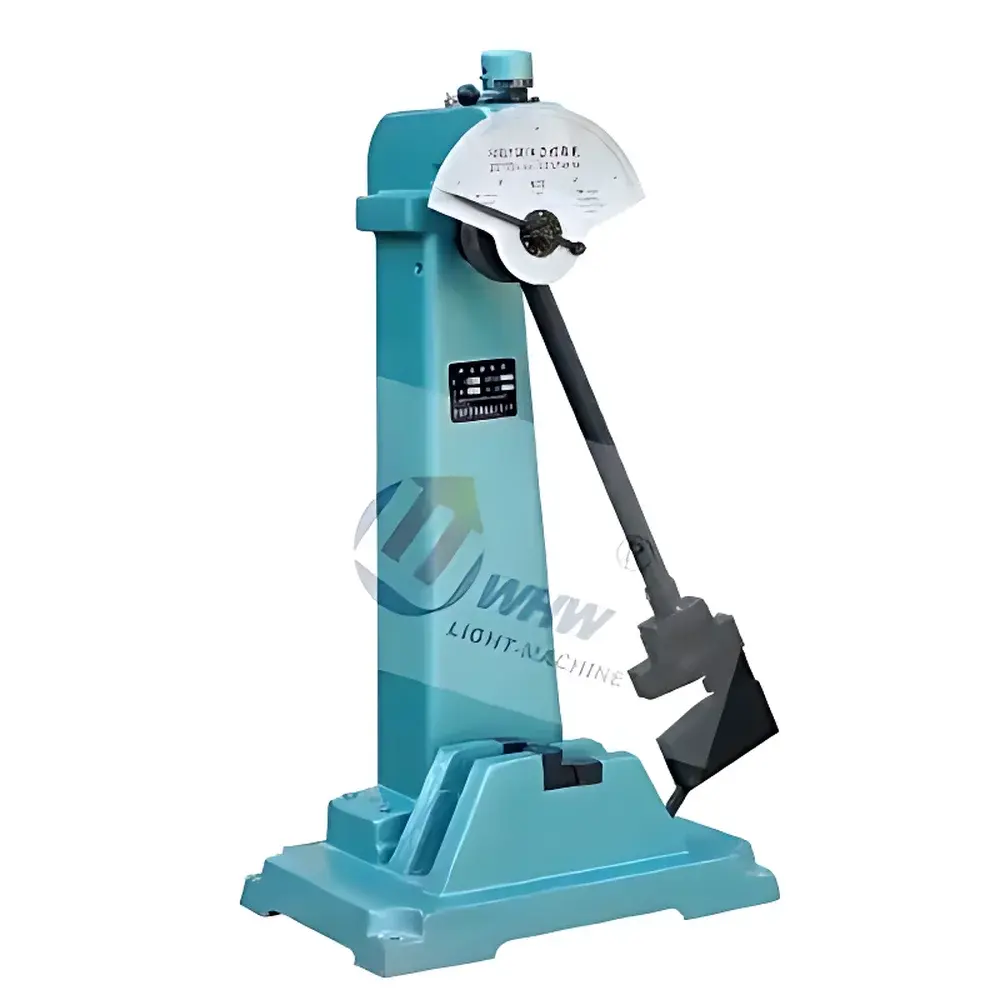
MC009-JB-300 Manual Charpy Impact Testing Machine
| Origin | Shanghai, China |
|---|---|
| Manufacturer Type | Authorized Distributor |
| Origin Category | Domestic (PRC) |
| Model | MC009-JB-300 |
| Quotation | Upon Request |
| Impact Energy | 150/300 J |
| Impact Velocity | 5.0 m/s |
| Pendulum Pre-lift Angle | 135° |
| Anvil Span | 40 mm |
| Anvil Radius (Notch Support) | R1.0–R1.5 mm |
| Striking Edge Radius | R2.0–R2.5 mm |
| Standard Specimen Dimensions | 10 × 10 × 55 mm |
| Pendulum Arm Length | 800 mm |
| Overall Dimensions (L×W×H) | 1000 × 630 × 1520 mm |
| Net Weight | 320 kg |
Overview
The MC009-JB-300 Manual Charpy Impact Testing Machine is a precision-engineered mechanical testing system designed for the standardized determination of impact toughness in ferrous metals under dynamic loading conditions. Based on the principle of pendulum-type potential-to-kinetic energy conversion, the instrument measures the energy absorbed by a notched specimen during fracture—quantified as the difference between the initial potential energy of the raised pendulum and its residual energy after impact. This method conforms to internationally recognized standards including ASTM E23, ISO 148-1, and GB/T 229, enabling direct comparison of material ductile-brittle transition behavior, notch sensitivity, and structural integrity under sudden loading. The machine operates exclusively in manual mode: the operator manually lifts and locks the pendulum at a fixed pre-lift angle of 135°, initiates release, observes fracture propagation, and manually engages the brake post-impact. Its robust cast-iron frame and calibrated pendulum assembly ensure mechanical stability and repeatable energy delivery—critical for laboratories requiring traceable, operator-controlled test execution without automated actuation or digital triggering.
Key Features
- Manually operated pendulum mechanism with dual selectable impact energies (150 J and 300 J), optimized for Charpy V-notch and U-notch specimens per standard configurations.
- Precision-machined anvil assembly featuring a fixed 40 mm span and controlled support radius (R1.0–R1.5 mm) to minimize lateral deflection and ensure consistent stress concentration at the notch root.
- Hardened striking edge with certified radius tolerance (R2.0–R2.5 mm) aligned to ASTM E23 requirements, minimizing edge wear-induced measurement drift over extended service life.
- Stable base structure with vibration-damping foot mounts and rigid 320 kg mass, reducing environmental interference during high-energy impact events.
- Dedicated specimen holder with centering guide grooves and positive clamping to maintain 10 × 10 × 55 mm standard specimen alignment within ±0.1 mm positional tolerance.
- Calibrated angular scale and mechanical locking pin for repeatable 135° pendulum elevation—ensuring consistent gravitational potential energy input across sequential tests.
Sample Compatibility & Compliance
The MC009-JB-300 is validated for use with standardized metallic specimens meeting ASTM E23 Type A (Charpy V-notch) and Type B (Charpy U-notch) geometries. It supports routine testing of carbon steels, low-alloy steels, and other black metals exhibiting moderate to low impact toughness—particularly suited for quality control in foundries, heat treatment facilities, and small-scale manufacturing labs where batch volumes remain limited. All mechanical components—including pendulum arm (800 mm effective length), anvil geometry, and striker alignment—comply with dimensional tolerances specified in ISO 148-2 for verification fixtures. While the system itself does not incorporate electronic data logging, its mechanical design enables full auditability: energy values are derived directly from physical pendulum parameters (mass, center-of-gravity offset, and lift angle), satisfying GLP documentation requirements when paired with calibrated manual readout scales and standardized test logs.
Software & Data Management
This is a fully mechanical, non-electronic impact tester; no embedded firmware, onboard software, or digital interface is included. Data acquisition relies on manual observation and recording of pendulum rebound angle via the integrated angular scale, followed by calculation using the manufacturer-provided energy calibration chart or standardized formulae (E = mgL(cosβ − cosα)). Laboratories integrating the MC009-JB-300 into regulated environments (e.g., ISO/IEC 17025-accredited testing labs) routinely document each test in structured paper-based or LIMS-linked electronic forms, capturing operator ID, specimen ID, ambient temperature, notch orientation, observed rebound angle, calculated absorbed energy, and pass/fail status against acceptance criteria. Optional external USB-connected digital angle sensors or high-speed photogate systems may be retrofitted for enhanced repeatability—but such modifications fall outside factory calibration scope and require independent validation per ISO/IEC 17025 Clause 5.5.
Applications
- Quality assurance of raw materials and finished components in forging, casting, and rolling operations.
- Evaluation of temper embrittlement, weld heat-affected zone (HAZ) toughness, and cold-work effects in structural steels.
- Batch conformance testing against procurement specifications referencing Charpy impact minimums (e.g., API RP 2A, EN 10025).
- Teaching laboratories demonstrating fundamental fracture mechanics principles—including elastic-plastic transition, cleavage vs. ductile rupture modes, and temperature-dependent toughness shifts.
- Pre-compliance screening prior to formal certification testing on fully automated impact systems (e.g., Zwick Roell PSW series or Instron CEAST 9350).
FAQ
Is the MC009-JB-300 compliant with ASTM E23 and ISO 148-1?
Yes—the mechanical configuration, specimen dimensions, anvil geometry, and striker specifications meet all mandatory requirements of ASTM E23-22 and ISO 148-1:2016 for manual Charpy testers.
Can it test subsize specimens?
No—it is configured exclusively for full-size 10 × 10 × 55 mm specimens. Subsize geometries require dedicated fixtures not supplied with this model.
What maintenance is required to retain calibration validity?
Annual verification of pendulum mass distribution, anvil parallelism, and striker edge radius by an accredited metrology lab is recommended. Daily visual inspection of notch alignment and brake pad wear is mandatory per internal QA procedures.
Does it support temperature-controlled testing?
No—environmental temperature control (e.g., cryogenic or elevated-temperature chambers) requires external integration and is not part of the base system design.
Is operator training provided?
Comprehensive installation and operational training—including specimen preparation, pendulum handling safety protocols, energy calculation methodology, and record-keeping compliance—is delivered on-site by authorized application engineers prior to commissioning.
Related Products



