
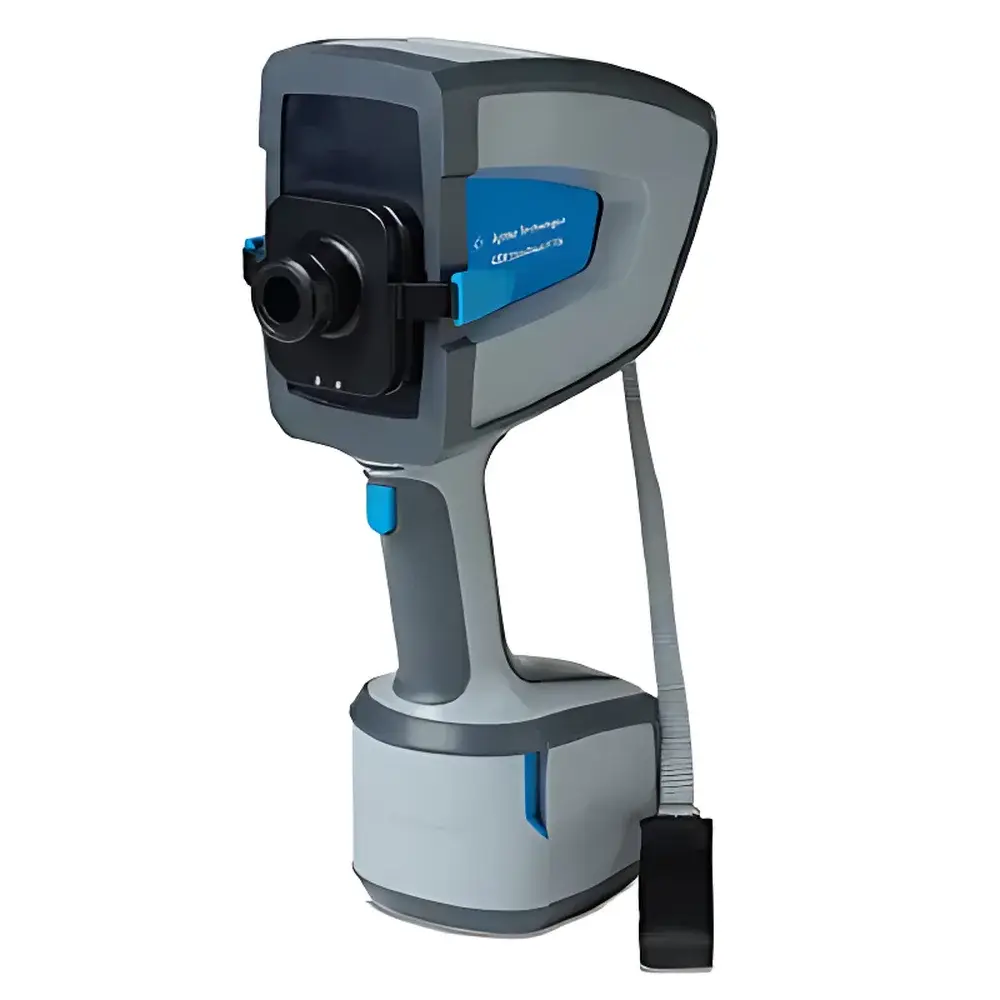
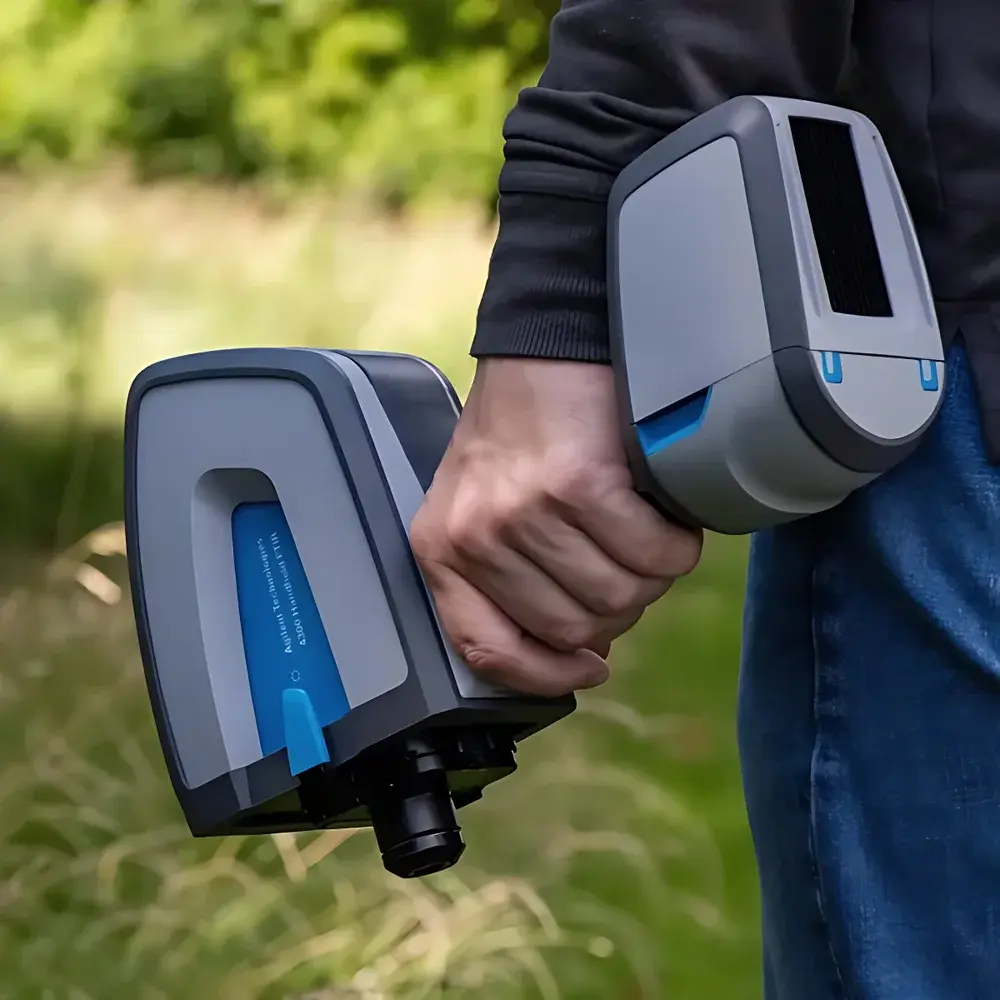
Agilent 4300 Handheld FTIR Spectrometer
| Brand | Agilent Technologies |
|---|---|
| Origin | Malaysia |
| Manufacturer Type | Manufacturer |
| Origin Category | Imported |
| Model | 4300 |
| Instrument Type | Handheld |
| Instrument Class | Fourier Transform Infrared (FTIR) |
| Spectral Range | 5,200–650 cm⁻¹ |
| Resolution | 4 cm⁻¹ (standard) |
| Detector | DTGS with Diamond ATR option |
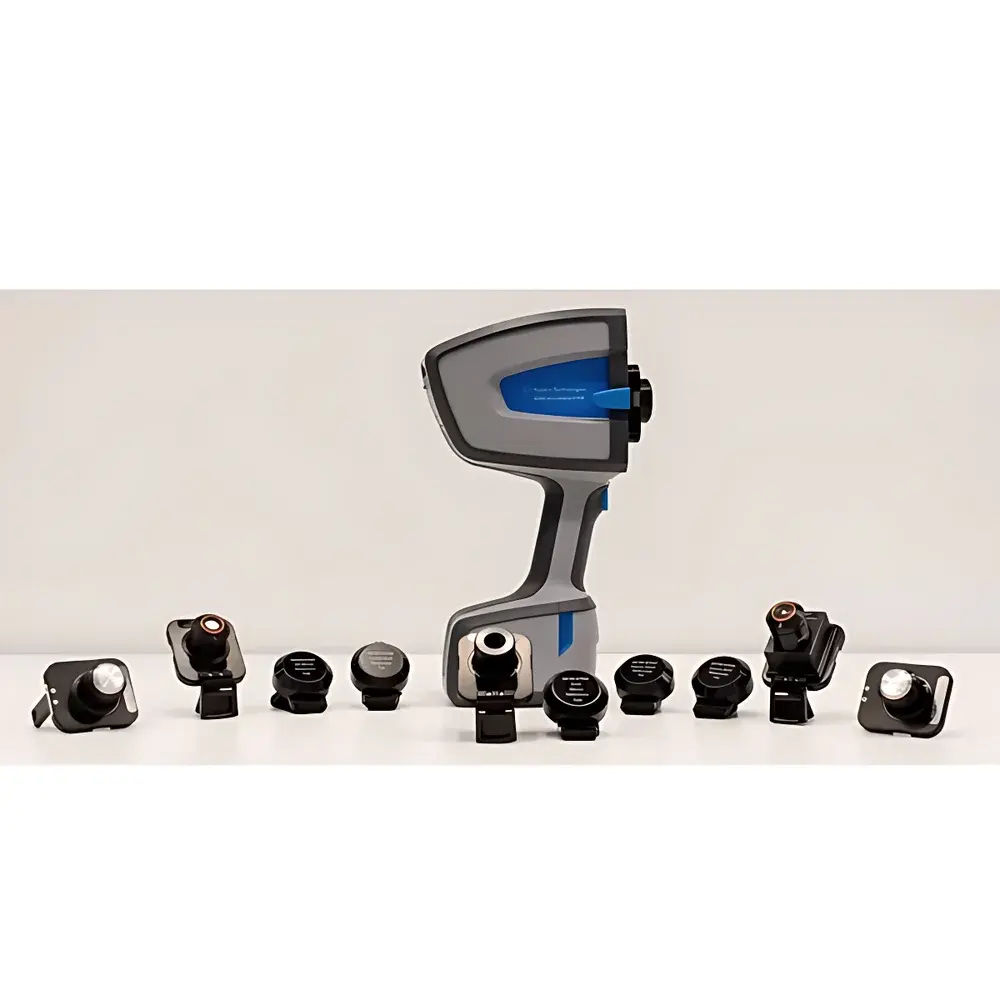
| Sampling Modes | Diamond-ATR, Ge-ATR, Specular Reflectance, Diffuse Reflectance, Grazing Angle, Retro-reflector |
| Dimensions | 35 cm (H) × 19 cm (D) |
| Weight | 2.2 kg |
| Power Supply | Hot-swappable Li-ion battery (4 h typical runtime) / 100–240 VAC, 50/60 Hz |
| Software Platform | MicroLab Mobile, MicroLab Expert, optional MicroLab Pharma (21 CFR Part 11 & EU Annex 11 compliant) |
| Sample Types | Solids, Pellets, Liquids, Pastes, Powders, Gels |
| Library Options | Preloaded application-specific spectral libraries (ATR, geological minerals), customizable library creation |
Overview
The Agilent 4300 Handheld FTIR Spectrometer is a field-deployable, laboratory-grade Fourier Transform Infrared (FTIR) instrument engineered for in-situ, non-destructive molecular identification and quantitative analysis. Unlike conventional benchtop FTIR systems, the 4300 integrates a compact Michelson interferometer, high-stability laser reference, and thermoelectrically cooled DTGS detector into a ruggedized handheld architecture—enabling real-time spectral acquisition without sample removal or preparation. Its optical design adheres to ISO 17025-aligned performance criteria for spectral accuracy, wavenumber reproducibility (< ±0.1 cm⁻¹), and photometric stability across environmental gradients (10–40 °C, 20–80% RH). The system operates on the principle of interferometric modulation: infrared light from a broadband source is split, recombined after path-length variation, and detected as an interferogram, which is then Fourier-transformed to yield absorbance/transmittance spectra. This enables precise functional group identification (e.g., C=O, O–H, N–H, C–F) and structural fingerprinting across diverse matrices—from polymer coatings on aircraft fuselages to mineral phases in geological outcrops.
Key Features
- Ruggedized ergonomic housing rated IP54 for dust and splash resistance, validated per MIL-STD-810G for shock, vibration, and thermal cycling
- Modular sampling interface system: interchangeable, auto-recognized ATR (diamond or germanium crystal), specular/diffuse reflectance, grazing-angle, and retro-reflector modules—requiring no recalibration between swaps
- Real-time spectral acquisition at 4 cm⁻¹ resolution (standard); supports user-defined apodization and zero-filling for enhanced signal-to-noise ratio
- Integrated MicroLab Mobile software with guided workflows for method setup, spectral acquisition, baseline correction, peak integration, and library search—optimized for touch-screen operation under glove use
- Onboard spectral library matching against >25,000 reference spectra (including ATR-specific, pharmaceutical excipient, polymer, and geological mineral databases)
- Optional MicroLab Pharma edition with full audit trail, electronic signatures, role-based user permissions, and 21 CFR Part 11/EU Annex 11 compliance for regulated environments
Sample Compatibility & Compliance
The Agilent 4300 accommodates heterogeneous sample geometries and physical states without destructive preparation: flat or curved surfaces (e.g., composite panels, painted walls), granular soils, viscous pastes, thin films, and irregular artifacts. Its ATR modules enable direct contact analysis of solids and liquids; reflectance accessories support non-contact interrogation of fragile or inaccessible surfaces. All hardware and firmware comply with IEC 61010-1 (safety), IEC 61326-1 (EMC), and RoHS directives. When configured with MicroLab Pharma, the system meets GLP/GMP data integrity requirements—including time-stamped, immutable electronic records, change control logs, and secure archive export (PDF/A-2, CSV, JCAMP-DX).
Software & Data Management
Data acquisition, processing, and reporting are unified within the MicroLab software suite. MicroLab Mobile provides offline spectral capture and preliminary identification; MicroLab Expert enables advanced chemometric modeling (PCA, PLS regression), spectral subtraction, and custom method deployment. All spectral files conform to ASTM E1421-22 (Standard Practice for Describing and Exchange of FTIR Spectral Data). Raw interferograms and processed spectra are stored in vendor-neutral formats with embedded metadata (instrument ID, operator, timestamp, sampling mode, environmental conditions). Network-enabled units support secure FTP/SFTP upload to LIMS or ELN platforms. Audit trails record every user action—including spectrum modification, library search parameters, and report generation—with cryptographic hashing to prevent tampering.
Applications
- Pharmaceutical: Cleaning verification of manufacturing equipment surfaces (residue detection down to µg/cm² level), raw material identity testing (API vs. excipient), counterfeit drug screening
- Aerospace & Automotive: Coating thickness estimation, corrosion product identification on airframes, polymer degradation assessment in composites
- Cultural Heritage: Non-invasive pigment and binder analysis on paintings, manuscripts, and archaeological ceramics
- Geology & Mining: In-field mineralogical mapping of outcrops and drill cores using diffuse reflectance and ATR modes
- Environmental: Soil contaminant screening (hydrocarbons, pesticides, microplastics), industrial spill characterization
- Forensics: Trace evidence analysis (fibers, adhesives, paints) with spectral library matching and statistical confidence scoring
FAQ
What spectral resolution options are available on the Agilent 4300?
The standard configuration delivers 4 cm⁻¹ resolution; higher resolution (2 cm⁻¹) is achievable via software settings with extended scan time—subject to SNR trade-offs in field conditions.
Can the instrument perform quantitative analysis without external calibration standards?
Yes—MicroLab Expert supports partial least squares (PLS) and classical least squares (CLS) modeling using user-generated calibration sets. Quantitative accuracy depends on matrix-matched standards and spectral preprocessing rigor.
Is spectral data export compatible with third-party chemometric software?
All spectra are exportable in JCAMP-DX v5.01 and ASCII formats, fully interoperable with Unscrambler, Pirouette, MATLAB, and Python (SciPy/NumPy) environments.
How is measurement traceability maintained across field deployments?
Each unit includes factory-certified NIST-traceable polystyrene and polyethylene reference films. Daily verification protocols (per ASTM E1421) are embedded in MicroLab Mobile with pass/fail reporting.
Does the system support regulatory audits under FDA or EMA guidelines?
With MicroLab Pharma licensed and properly configured, the system satisfies 21 CFR Part 11 (electronic records/signatures), EU Annex 11 (computerized systems), and ISO/IEC 17025 documentation requirements—including full audit trail review and electronic record retention.





