
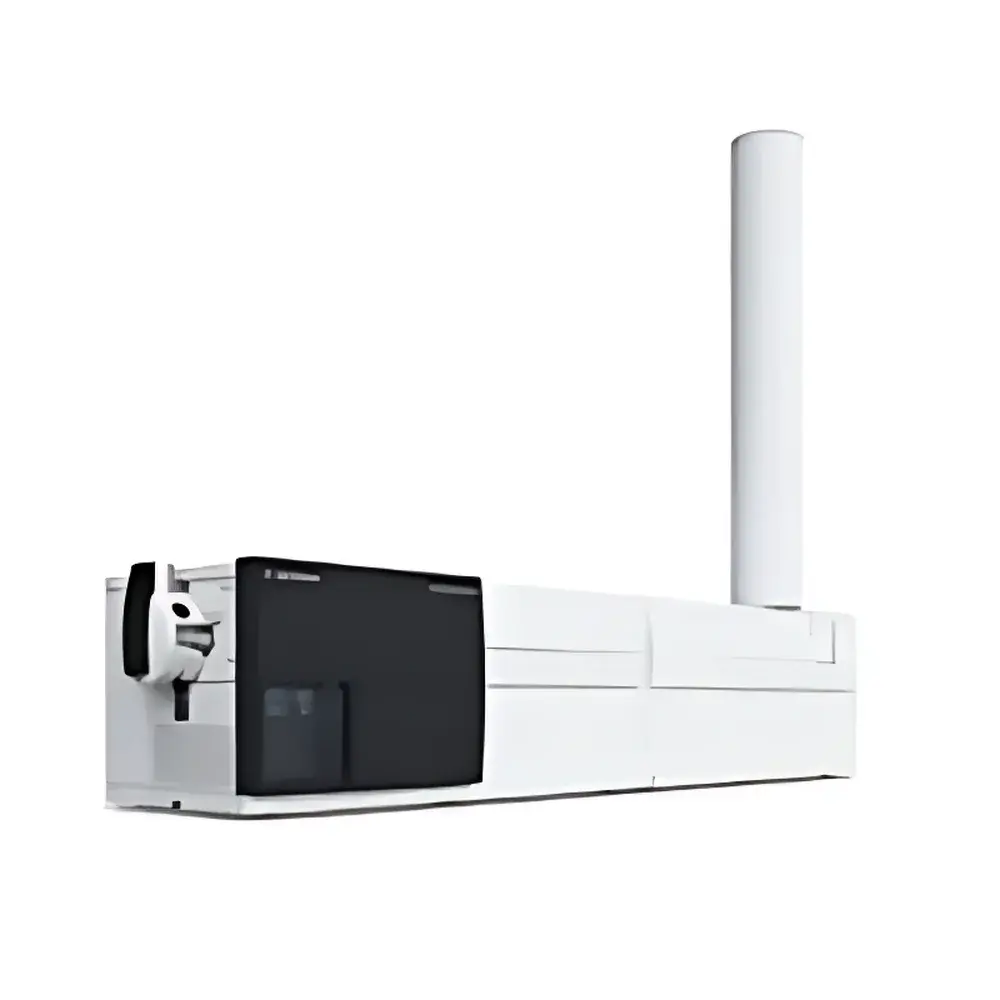

Agilent 6560 LC/Q-TOF Ion Mobility Quadrupole Time-of-Flight Liquid Chromatography Mass Spectrometry System
| Brand | Agilent Technologies |
|---|---|
| Origin | Singapore |
| Manufacturer Type | Original Equipment Manufacturer (OEM) |
| Import Status | Imported |
| Model | 6560 LC/Q-TOF |
| Instrument Type | Quadrupole-Time-of-Flight (Q-TOF) |
| Application Field | General-Purpose |
| Mass Range | m/z 20–20,000 |
| Sensitivity | S/N (RMS) > 50:1 (measured with 1 pg reserpine on-column) |
| Resolution | >42,000 FWHM at m/z 2722, acquisition-rate independent |
| Ion Mobility Resolution (FWHM) | >200 |
| Quadrupole Mass Range | m/z 20–4000 |
| Quadrupole Resolution (FWHM) | 1.3 Da (auto-tuned) |
| Mass Accuracy (MS, positive mode) | <1 ppm RMS |
| MS/MS Mass Accuracy (positive mode) | <2 ppm RMS |
| MS Acquisition Rate | 50 spectra/sec |
| MS/MS Acquisition Rate | 30 spectra/sec |
| Dynamic Range (within-spectrum) | 5 orders of magnitude |
| Ion Sources | Dual AJSM, MultiMode (ESI/APCI), Dual ESI, GC/APCI, APCI, NanoESI |
Overview
The Agilent 6560 LC/Q-TOF Ion Mobility Quadrupole Time-of-Flight Liquid Chromatography Mass Spectrometry System integrates ultra-high-performance liquid chromatography (UHPLC), traveling wave ion mobility spectrometry (TWIMS), and high-resolution, accurate-mass Q-TOF mass spectrometry into a single analytical platform. Engineered for structural biology, metabolomics, lipidomics, and biopharmaceutical characterization, the system leverages orthogonal separation dimensions—chromatographic retention, collision cross-section (CCS)-based ion mobility drift time, and precise m/z measurement—to resolve co-eluting isobaric and isomeric species that remain inseparable by conventional LC/MS alone. Its core architecture employs a low-field drift tube design that preserves native-like gas-phase conformations, enabling reproducible CCS determination without calibration standards via first-principles calculation. This capability supports quantitative conformational analysis, including collision-induced unfolding (CIU) experiments for probing protein folding dynamics and stability under controlled activation conditions.
Key Features
- Integrated ion mobility separation with CCS measurement accuracy <1% RSD, traceable to NIST-traceable calibrants and validated against theoretical CCS databases (e.g., MOBCAL, IMPACT)
- Electron-driven dissociation (ExD) compatibility via optional e-MSion ECD cell, enabling selective backbone cleavage for disulfide bond mapping, labile PTM localization (e.g., O-GlcNAc, phosphorylation), and isomeric amino acid differentiation
- Agilent VacShield vacuum isolation technology allows capillary exchange and source maintenance without breaking high-vacuum conditions, minimizing instrument downtime and preserving calibration stability
- Dual AJSM (Advanced Jet Stream) ion source with integrated temperature-controlled nebulizer gas and sheath gas optimization for enhanced ion transmission across diverse polarity and volatility ranges
- High-fidelity quadrupole mass filter with auto-tuned resolution (1.3 Da FWHM) and extended low-mass transmission for efficient precursor selection in data-dependent and data-independent acquisition (DDA/DIA)
- Real-time HRdm 2.0 processing engine delivering up to 200 mobility resolution units (RU) per spectrum, enabling deconvolution of overlapping mobility envelopes in complex biological matrices
Sample Compatibility & Compliance
The 6560 LC/Q-TOF supports broad sample classes—including intact proteins, monoclonal antibodies, oligonucleotides, glycans, lipids, small-molecule metabolites, and synthetic polymers—across aqueous, organic, and mixed-solvent mobile phases compatible with UHPLC gradients (0.05–2 mL/min flow rates). It meets key regulatory requirements for analytical method validation under ICH Q2(R2), supports audit trails and electronic signatures compliant with FDA 21 CFR Part 11, and enables full traceability through GLP/GMP-aligned workflows in MassHunter software. All CCS values are reported with uncertainty estimates aligned with ISO/IEC 17025 guidelines for measurement reliability. The system has been verified for compliance with ASTM E3298-22 (Standard Practice for Reporting Ion Mobility Spectrometry Data) and supports submission-ready data packages for regulatory filings (e.g., FDA BLA, EMA MAA).
Software & Data Management
Data acquisition, processing, and interpretation are unified within the Agilent MassHunter platform, featuring modules certified for regulated environments: MassHunter BioConfirm (for intact mass and higher-order structure assessment), MassHunter Vista (for label-free quantitation and CIU kinetics modeling), MassHunter Classifier (for automated lipid class annotation), Lipid Annotator (for sn-position and double-bond localization), and Mass Profiler Professional (for multivariate statistical analysis of large-scale omics datasets). All software components enforce role-based access control, full audit trail logging, and secure data archiving. Raw data files (.d format) retain native mobility drift time metadata, enabling retrospective reprocessing with updated calibration models or advanced algorithms without re-acquisition.
Applications
- Structural proteomics: Conformational heterogeneity mapping of therapeutic mAbs, detection of aggregation intermediates, and domain-specific unfolding pathways via CIU-MS
- Lipidomics: Separation of regioisomeric phospholipids (e.g., PC 16:0_18:1 vs. PC 18:1_16:0) and sphingomyelin isomers using CCS as an orthogonal identifier
- Glycomics: Differentiation of linkage isomers (e.g., α2,3- vs. α2,6-sialylation) and branching patterns in N-glycans based on mobility-derived compactness metrics
- Metabolomics: Annotation of isomeric drug metabolites (e.g., hydroxylation position isomers) in plasma or urine extracts without reference standards
- Polymers & biomaterials: Characterization of polydispersity, end-group distribution, and cyclization in synthetic and natural macromolecules using CCS–m/z correlation plots
FAQ
Does the 6560 support untargeted CCS database searching?
Yes—CCS values are embedded in .d files and searchable via MassHunter’s CCS Library Search module against curated libraries (e.g., HMDB, LipidMaps, GlycoStore) with tolerance settings adjustable from ±0.5% to ±3%.
Can mobility-resolved spectra be exported for third-party processing?
Yes—raw mobility-separated spectra (drift time × m/z matrices) are exportable in open formats (mzML 1.1.0 with IMS extensions) for use in Python-based tools (e.g., SciPy, PyIMSBin) or MATLAB-based mobility deconvolution pipelines.
Is the system compatible with nanoLC and microfluidic chip-based separations?
Yes—the dual AJSM source supports nano-flow (50–500 nL/min) and capillary-flow (1–10 µL/min) configurations; optional chip-based interfaces (e.g., Agilent 1200 Series Chip-Cube) integrate seamlessly with hardware-triggered mobility gating.
How is mass calibration maintained during long-duration mobility experiments?
The system performs real-time internal calibration using lock-mass ions (e.g., purine, HP-0921) injected continuously at sub-nanogram levels, ensuring <1 ppm RMS mass accuracy over 72-hour continuous runs.
What level of IT infrastructure is required for HRdm 2.0 real-time processing?
A minimum of 64 GB RAM, dual Xeon Gold CPUs (or equivalent), and NVMe SSD storage is recommended; cloud-deployable MassHunter Virtual Edition (VE) supports distributed processing across HPC clusters for large-scale mobility-resolved datasets.




