
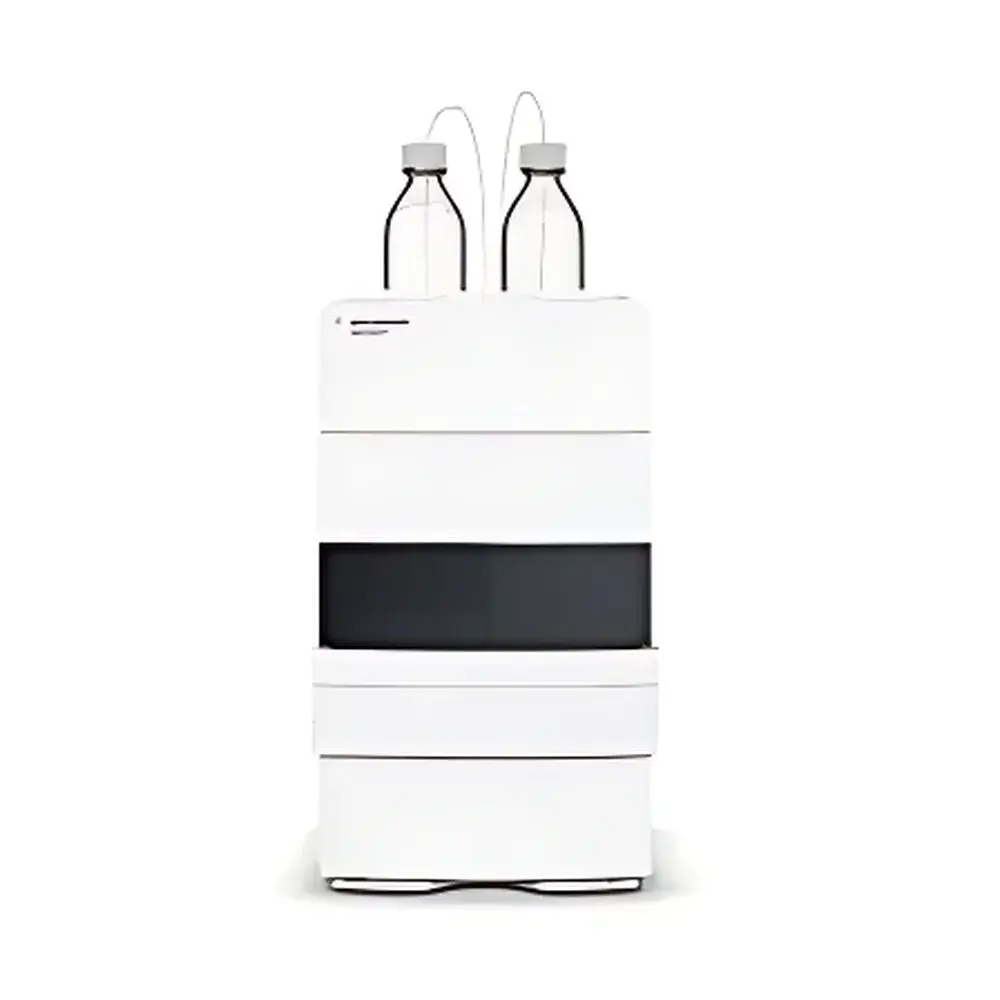
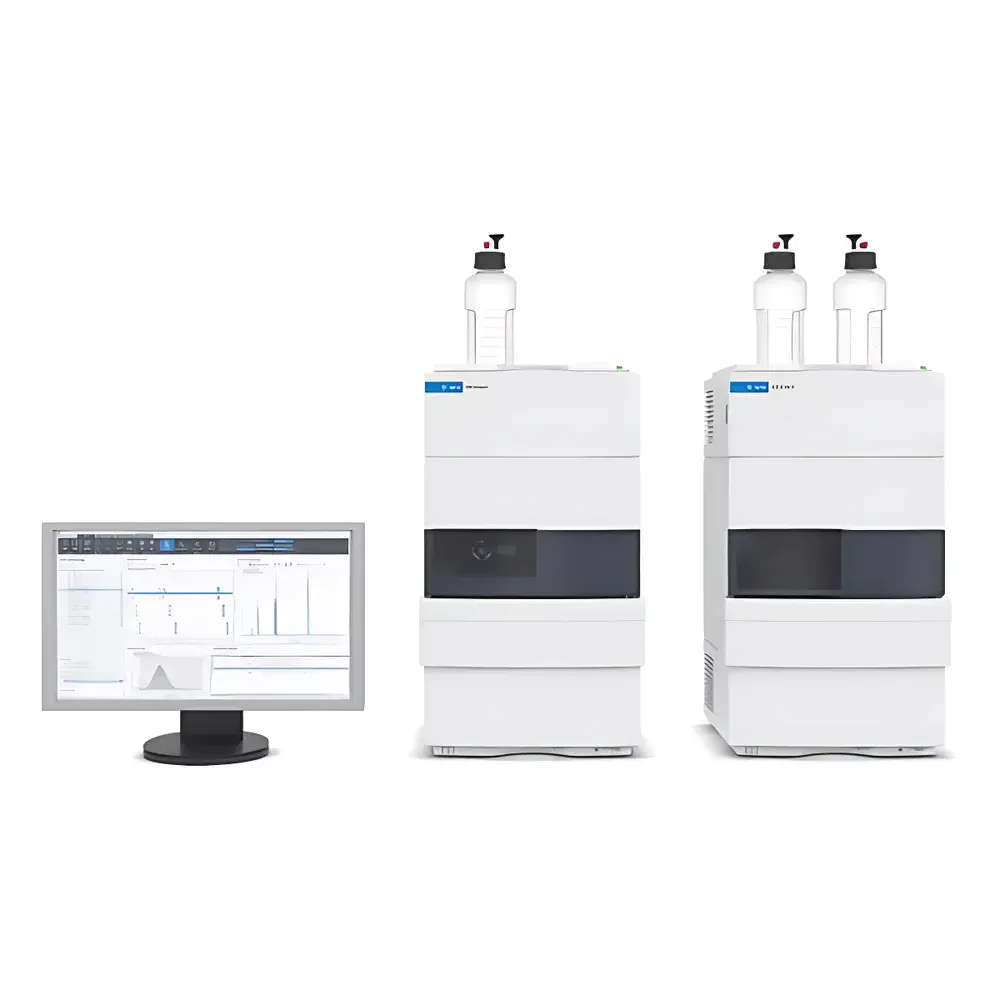
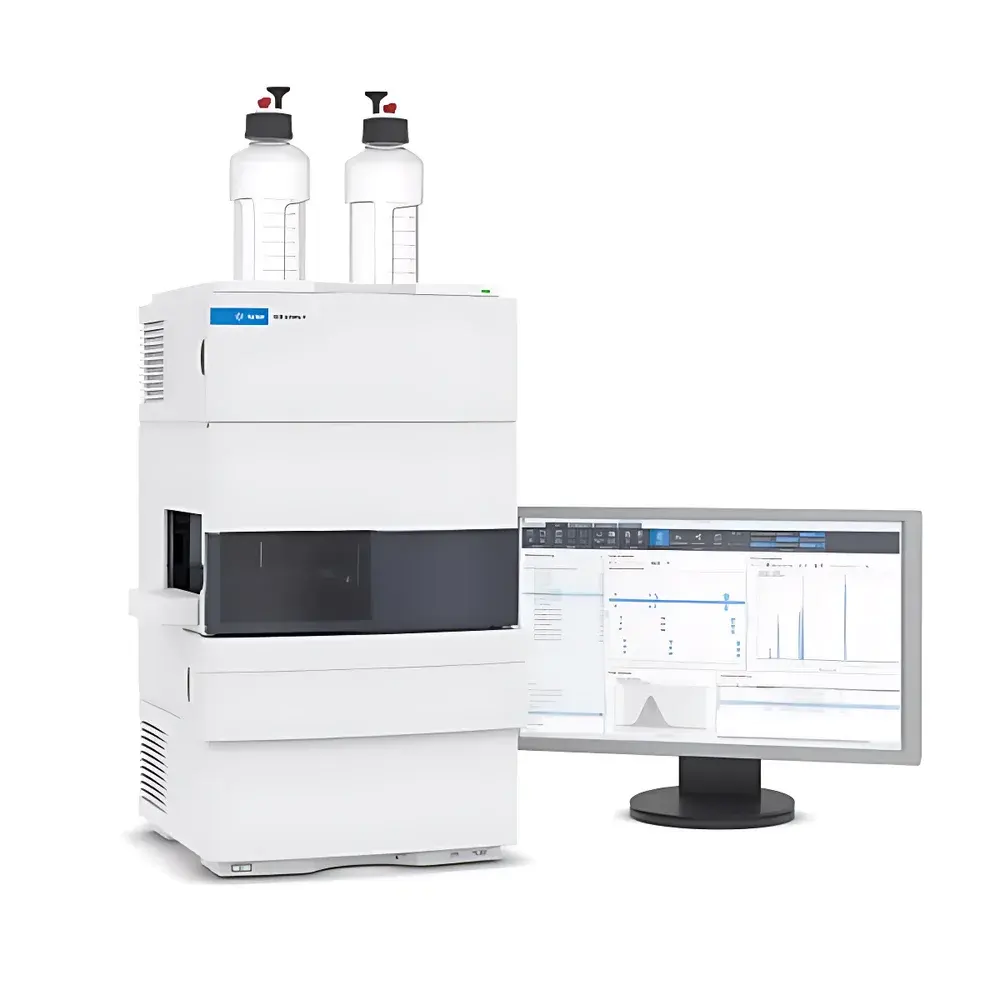
Agilent 1220 Infinity II Liquid Chromatograph
| Brand | Agilent Technologies |
|---|---|
| Origin | Germany |
| Manufacturer Type | Original Equipment Manufacturer (OEM) |
| Origin Category | Imported |
| Model | 1220 Infinity II |
| Instrument Type | Conventional High-Performance Liquid Chromatograph (HPLC) |
| Application Scope | General-purpose analytical use in QA/QC and research laboratories |
| Flow Range | 0.2–10 mL/min |
| Injection Volume Range | 0.1–100 µL |
| Width | 370 mm |
| Pump Configuration | Isocratic or Binary Gradient Pump (optional Quaternary configuration) |
| Maximum Number of Temperature-Controlled Zones | 1 (with optional column oven) |
| Maximum Solvent Channels | 4 (with Solvent Selection Valve, SSV) |
| Power Supply | 100–240 VAC, 50/60 Hz |
| Column Oven Compatibility | Yes (optional) |
| Detector Options | Variable Wavelength Detector (VWD), Diode Array Detector (DAD), Refractive Index (RID), Fluorescence (FLD), Evaporative Light Scattering (ELSD), Mass Selective Detector (MSD) |
| Software Platforms | OpenLab CDS (ChemStation Edition, EZChrom Edition, or modern OpenLab CDS workstation) |
| Regulatory Compliance | Designed for GLP/GMP environments |
| Sustainability Certification | My Green Lab ACT Label (verified lifecycle environmental impact assessment) |
Overview
The Agilent 1220 Infinity II Liquid Chromatograph is a modular, high-reliability HPLC system engineered for routine analysis in regulated quality control (QC), quality assurance (QA), and academic research laboratories. Built on the proven architecture of the InfinityLab LC platform, it delivers consistent retention time stability, low carryover, and high injection precision across thousands of injections—critical attributes for method transfer, long-term system suitability, and compliance-driven workflows. Its core separation principle relies on high-pressure liquid mobile phase delivery through packed analytical columns, enabling robust isocratic or gradient elution with precise solvent composition control. The system operates at pressures up to 600 bar, supporting sub-2-µm particle-packed columns for enhanced resolution and faster analysis cycles without compromising peak shape or reproducibility. Designed as a foundational LC platform, it integrates seamlessly with Agilent’s broader InfinityLab ecosystem—including detectors, autosamplers, column ovens, and mass spectrometers—ensuring scalability from basic quantitation to advanced hyphenated techniques.
Key Features
- Modular architecture compatible with all InfinityLab LC series modules: VWD, DAD, RID, FLD, ELSD, and LC/MSD detectors
- Pump options include isocratic, binary gradient, and quaternary configurations—with solvent selection valve (SSV) support for up to four solvents
- Injection precision of ≤0.3% RSD over 100 µL range; programmable injection volumes from 0.1 to 100 µL
- Column oven optional for temperature stabilization between 5 °C and 80 °C (±0.15 °C accuracy), improving retention time reproducibility
- Integrated hardware diagnostics and self-test routines reduce downtime and simplify preventive maintenance scheduling
- Compact footprint (370 mm width) optimized for benchtop deployment in space-constrained labs
- Walkup-ready configuration available with dedicated sample tray and intuitive software interface for multi-user environments
- Mobile laboratory deployment enabled via ruggedized mounting kits and vibration-dampened transport solutions
Sample Compatibility & Compliance
The 1220 Infinity II accommodates standard 4.6 × 150 mm, 3.0 × 100 mm, and microbore column formats, with compatibility extending to UHPLC-capable columns (e.g., 2.1 mm ID) when paired with low-dead-volume tubing and fittings. It supports aqueous, organic, and mixed-phase mobile phases, including aggressive solvents such as trifluoroacetic acid (TFA) and ammonium acetate buffers. For regulatory compliance, the system meets key requirements of ISO/IEC 17025, USP , and ICH Q2(R2) guidelines for method validation. When operated with OpenLab CDS software configured for 21 CFR Part 11 compliance—including electronic signatures, role-based access control, and full audit trail logging—it satisfies GxP documentation standards required by FDA, EMA, and PMDA inspections. Routine performance qualification (PQ) protocols are supported through built-in system suitability test (SST) templates and automated reporting.
Software & Data Management
Agilent provides three validated software pathways: OpenLab CDS ChemStation Edition (for legacy method continuity), OpenLab CDS EZChrom Edition (for chromatographers transitioning from older platforms), and the modern OpenLab CDS workstation (featuring cloud-enabled data backup, centralized instrument monitoring, and AI-assisted baseline correction). All versions support raw data export in open formats (e.g., .cdf, .mzML for LC/MS), metadata-rich acquisition, and customizable report generation aligned with LIMS integration standards (ASTM E1469, ANSI/NIST SP 800-90B). Audit trails record every parameter change, sequence modification, and user login event with tamper-proof timestamps. Data integrity is reinforced via write-once-read-many (WORM) storage options and periodic cryptographic hash verification.
Applications
This system is routinely deployed for pharmaceutical impurity profiling per ICH Q3B(R3), residual solvent analysis (USP ), dissolution testing (USP ), natural product fingerprinting, food additive quantification (AOAC 2012.01), and environmental contaminant screening (EPA Method 8330B). Its flexibility enables method development for small molecules, peptides, and polar metabolites—particularly where robustness under variable ambient conditions is essential. In academic settings, it serves as a teaching platform for HPLC fundamentals, detector response characterization, and column selectivity evaluation.
FAQ
Is the 1220 Infinity II suitable for GMP-regulated environments?
Yes—when configured with OpenLab CDS software in 21 CFR Part 11 mode and operated under documented SOPs, it fulfills GMP data integrity requirements.
Can it be upgraded to support LC/MS coupling?
Yes—the system’s low-flow compatibility, flexible detector interface, and pressure-rated flow cells allow seamless integration with Agilent LC/MSD Series mass spectrometers.
What is the maximum operating pressure?
The pump is rated for continuous operation up to 600 bar, enabling use of sub-2-µm particle columns for high-resolution separations.
Does it support column identification or RFID tracking?
No native column ID reader is included; however, column parameters can be manually entered and stored within method files for traceability.
Is remote monitoring supported?
Yes—OpenLab CDS enables secure web-based instrument status viewing, queue management, and real-time alarm notification via enterprise network infrastructure.




