
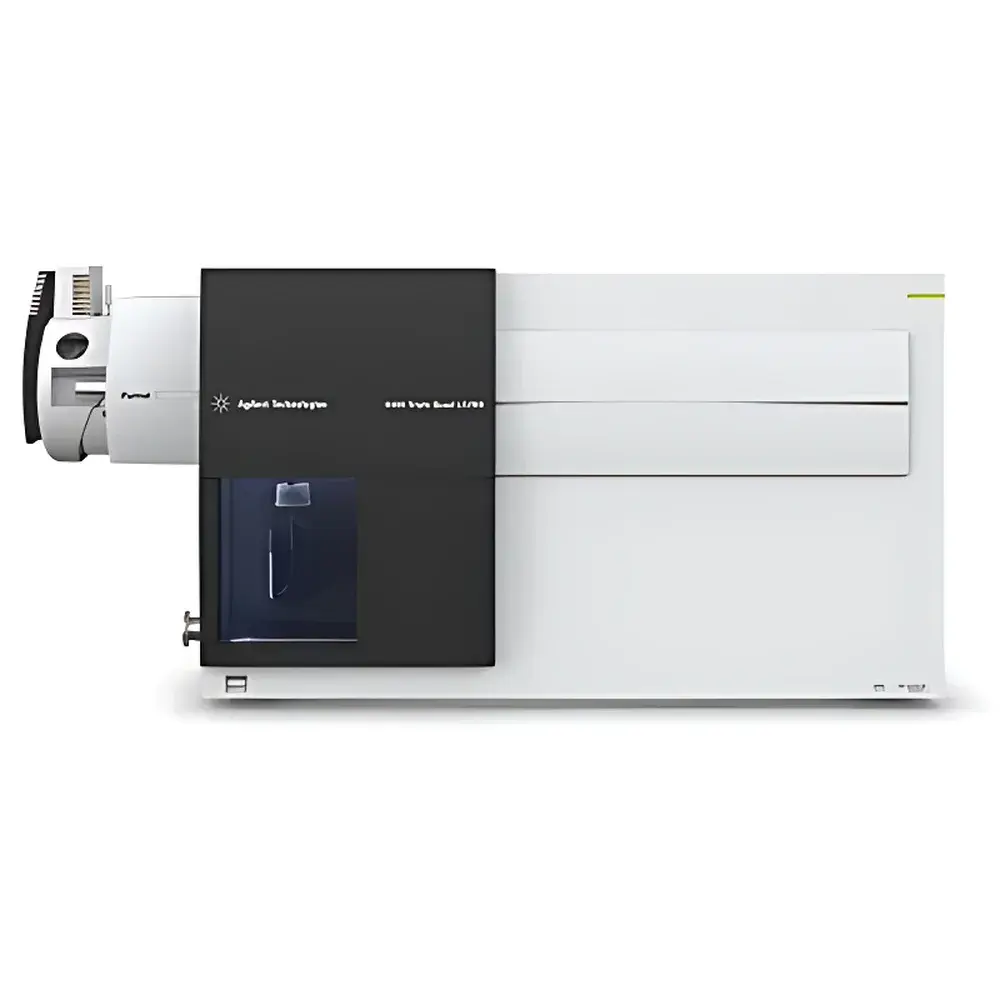
Agilent 6495 Triple Quadrupole LC/MS System
| Brand | Agilent Technologies |
|---|---|
| Origin | Singapore |
| Manufacturer Type | Original Equipment Manufacturer (OEM) |
| Origin Category | Imported |
| Model | 6495 |
| Instrument Type | Tandem Quadrupole (QqQ) Mass Spectrometer |
| LC Integration | Fully Compatible with Agilent 1200/1290 UHPLC Systems |
Overview
The Agilent 6495 Triple Quadrupole LC/MS System is a high-performance tandem quadrupole mass spectrometer engineered for demanding quantitative and qualitative analysis in regulated and research-intensive laboratories. Operating on the principle of electrospray ionization (ESI) or atmospheric pressure chemical ionization (APCI), coupled with triple quadrupole mass filtering (Q1 → q2 → Q3), the system enables highly selective multiple reaction monitoring (MRM) and enhanced product ion (EPI) scanning. Its core architecture leverages Agilent’s proprietary iFunnel ion optics — a stacked ring ion guide design that significantly improves ion transmission efficiency across a broad m/z range while maintaining robustness under variable flow rates and matrix-rich conditions. This results in superior sensitivity (sub-fg on-column detection for many analytes), wide linear dynamic range (>5 orders of magnitude), and long-term signal stability essential for high-throughput, multi-analyte assays.
Key Features
- Advanced iFunnel ion source technology delivering up to 10× higher ion transmission versus conventional RF-only funnels, enabling consistent performance from 0.1–2.0 mL/min without source reconfiguration
- Dual-jet StreamSpray ion source with integrated gas heating and optimized nebulization for enhanced desolvation and reduced adduct formation
- High-speed polarity switching (<20 ms) supporting simultaneous positive/negative mode acquisition within a single LC run
- Collision cell with nitrogen gas optimization and dynamic collision energy (DCE) control for reproducible fragmentation across diverse compound classes
- Robust vacuum architecture featuring dual-stage turbomolecular pumps and intelligent pressure regulation for stable operation over extended duty cycles
- Modular design allowing field-upgradable components including detector, collision cell, and ion optics — minimizing downtime during routine maintenance
Sample Compatibility & Compliance
The Agilent 6495 system accommodates a broad spectrum of sample matrices, including plasma, urine, tissue homogenates, food extracts, environmental water/sludge digests, and pharmaceutical formulations. It supports both reversed-phase and hydrophilic interaction liquid chromatography (HILIC) separations, with seamless integration into Agilent 1290 Infinity II UHPLC platforms for sub-2-µm particle column operation. From a regulatory perspective, the system complies with key international standards including ISO/IEC 17025:2017 (for testing laboratories), ASTM D7622 (for pesticide residue analysis), and USP (validation of compendial procedures). When operated with Agilent MassHunter Software v10.1 or later and configured with audit trail, electronic signatures, and user access controls, the platform meets FDA 21 CFR Part 11 requirements for data integrity in GLP and GMP environments.
Software & Data Management
Data acquisition, processing, and reporting are managed through Agilent MassHunter Workstation Software — a validated, modular suite supporting quantitative analysis (Quantitative Analysis), qualitative exploration (Qualitative Analysis), and method development (Method Development). The software provides automated MRM transition optimization, retention time alignment across batches, isotopic pattern matching, and batch-level QC metrics (e.g., peak area RSD, retention time shift, internal standard response). Raw data files (.d format) are stored in a secure, timestamped structure compliant with ALCOA+ principles (Attributable, Legible, Contemporaneous, Original, Accurate, Complete, Consistent, Enduring, Available). Optional integration with Agilent OpenLab CDS enables centralized instrument scheduling, electronic lab notebook (ELN) linkage, and enterprise-level LIMS connectivity.
Applications
The Agilent 6495 system serves as a cornerstone platform in multiple regulated and discovery-oriented domains. In clinical and translational research, it quantifies endogenous metabolites, therapeutic drugs, and biomarkers in biofluids with high specificity and low inter-run variability. In food safety labs, it performs multi-residue screening of >500 pesticides and veterinary drugs per run using fast-gradient UHPLC-MRM workflows. Environmental laboratories apply it to trace-level analysis of PFAS, pharmaceuticals, and brominated flame retardants in surface water and wastewater effluents. Within pharmaceutical development, the system supports pharmacokinetic (PK) studies, impurity profiling, and biotransformation pathway characterization — routinely achieving <15% CV for LLOQ measurements across 100+ compounds in a single assay.
FAQ
What ionization sources are supported on the Agilent 6495?
The system ships standard with Dual Jet StreamSpray ESI/APCI, and optional sources include multimode (MM) and nano-ESI for specialized applications.
Is the 6495 compatible with non-Agilent UHPLC systems?
Yes — via analog/digital I/O interfaces and third-party driver support; however, full synchronization and method portability are optimized with Agilent 1290 Infinity II UHPLC.
Does the 6495 meet 21 CFR Part 11 requirements out-of-the-box?
Compliance requires configuration of MassHunter Software with enabled audit trail, role-based permissions, and electronic signature modules — all available as licensed options.
What maintenance intervals are recommended for routine operation?
Ion source cleaning every 2–4 weeks depending on sample load; collision cell cleaning every 3–6 months; detector replacement typically after 2–3 years of continuous use.
Can the 6495 be upgraded from earlier 6400-series instruments?
No — the 6495 is a new-generation platform with redesigned electronics, vacuum architecture, and firmware; upgrades are not hardware-compatible with prior models.






