
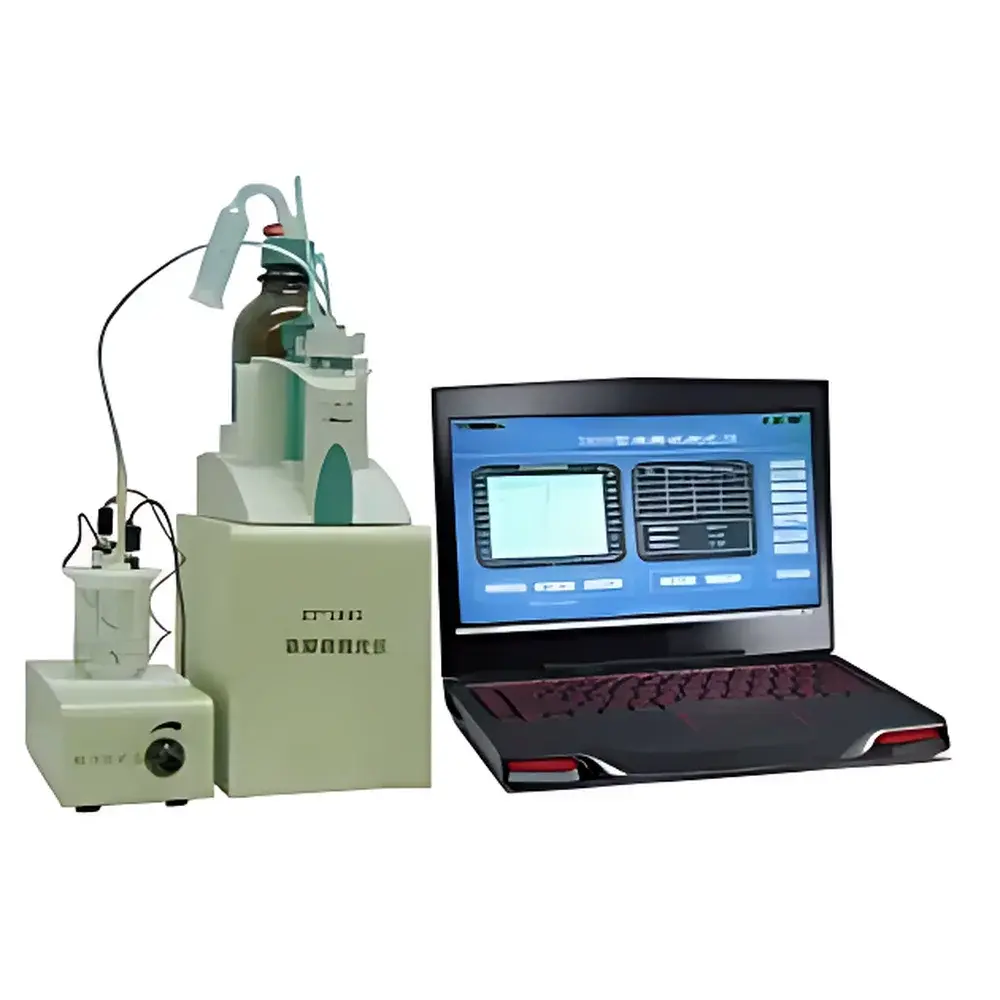
Xuxin Instrument ST-1551 Mercaptan Sulfur Analyzer
| Brand | Xuxin Instrument |
|---|---|
| Origin | Beijing, China |
| Manufacturer Type | Direct Manufacturer |
| Country of Origin | China |
| Model | ST-1551 |
| Detection Type | Total Mercaptan Sulfur |
| Compliance Standard | GB/T 1792 |
| Measurement Range | 3–100 μg/g (ppm) |
| Potentiometric Range | −1999.5 to +1999.5 mV |
| Basic Error | ±0.1% ±0.5 mV |
| Burette Volume | 10 mL |
| Burette Accuracy | ±0.1% FS |
| Operating Temperature | 5–45 °C |
| Relative Humidity | 10–80% RH |
| Power Supply | 220 V ±10%, 50 Hz |
| Software Interface | Windows-based workstation with bilingual (Chinese/English) display option |
| Automation Features | Auto-rinsing, auto-reagent replenishment, fixed-volume dispensing, automatic endpoint detection, false-endpoint filtering, manual endpoint override, real-time titration curve plotting, data storage & thermal printing |
Overview
The Xuxin Instrument ST-1551 Mercaptan Sulfur Analyzer is a dedicated potentiometric titration system engineered for the precise quantification of mercaptan sulfur (R–SH) in hydrocarbon fuels—specifically jet fuel, gasoline, kerosene, and light diesel—free of hydrogen sulfide interference. It operates in strict accordance with the Chinese national standard GB/T 1792, which defines the electrochemical methodology for determining reactive sulfur species that contribute significantly to odor, elastomer degradation, and corrosion in fuel distribution and combustion systems. Unlike total sulfur analyzers based on UV fluorescence or X-ray dispersion, the ST-1551 targets only ionizable mercaptans via silver nitrate (AgNO₃) titration in an alkaline alcoholic medium, where the formation of insoluble silver mercaptide precipitate generates a measurable potential inflection point. This selective, stoichiometric approach ensures high specificity and reproducibility in complex matrices where thiophenes, sulfides, and disulfides remain unreactive under the specified titration conditions.
Key Features
- Integrated potentiometric titration platform with imported precision burette assembly, delivering volumetric accuracy of ±0.1% full scale and electrode potential resolution of 0.1 mV across a ±1999.5 mV range.
- Automated fluid handling system supporting auto-rinsing between samples, reagent replenishment, fixed-volume dosing, and dynamic endpoint recognition using first-derivative (dE/dV) analysis with adaptive noise suppression.
- Real-time titration curve visualization on Windows-based workstation software, enabling immediate assessment of reaction kinetics, endpoint sharpness, and baseline stability.
- Bilingual interface (Chinese/English) configurable at system startup—designed for international laboratory environments and multilingual technical staff.
- Comprehensive audit trail functionality including timestamped method parameters, operator ID, raw potential vs. volume data, final result, and manual endpoint override logs—supporting GLP-compliant documentation requirements.
- Modular hardware architecture: main analyzer unit, motorized titration module, shielded Ag/Ag₂S reference-sensing electrode pair, PC host, and thermal printer—all pre-calibrated and factory-aligned.
Sample Compatibility & Compliance
The ST-1551 is validated for use with clarified, H₂S-free liquid petroleum fractions meeting ASTM D664 and ISO 8217 specifications for distillate fuel sampling preparation. Samples must be homogenized and filtered to ≤5 µm prior to analysis to prevent particulate-induced electrode fouling. The instrument satisfies metrological traceability requirements per JJG 812–2016 (Chinese verification regulation for potentiometric titrators) and aligns with data integrity expectations outlined in FDA 21 CFR Part 11 when operated with enabled electronic signature and audit log features. While GB/T 1792 remains its primary compliance anchor, method equivalence to IP 251 and ASTM D3229 has been demonstrated through interlaboratory comparison studies conducted by third-party CNAS-accredited testing centers.
Software & Data Management
The embedded Windows workstation software provides full control over titration protocol definition—including initial delay, stirring speed, addition increment, endpoint sensitivity threshold, and post-endpoint stabilization time. All raw sensor data (mV vs. mL), processed curves, and final concentration values (µg/g) are stored in encrypted .db3 database files with SHA-256 checksum validation. Export options include CSV (for LIMS integration), PDF reports with digital signature fields, and XML formats compatible with enterprise quality management systems (QMS). Data backups are scheduled automatically to network drives or USB media, and user access levels (Administrator, Analyst, Viewer) enforce role-based permissions consistent with ISO/IEC 17025 clause 7.5.2.
Applications
- Quality control of aviation turbine fuel per DEF STAN 91-91 and MIL-DTL-83133E, where mercaptan sulfur limits are set at ≤0.001 wt% to prevent copper strip corrosion and rubber seal swelling.
- Routine monitoring of refinery hydrotreater effluent streams to verify desulfurization efficiency targeting mercaptan conversion to H₂S.
- Research-grade evaluation of antioxidant additive interactions in gasoline formulations, as certain phenolic inhibitors influence mercaptan oxidation pathways during storage.
- Regulatory compliance testing for commercial import/export batches subject to China’s GB 17930–2016 and GB 19147–2016 fuel specifications.
- Method development support in university petroleum engineering laboratories studying sulfur speciation kinetics under varying pH and solvent polarity conditions.
FAQ
What sample preparation steps are required before analysis?
Samples must be degassed, filtered through a 5-µm membrane, and confirmed H₂S-free via lead acetate paper test. A minimum 50 mL volume is recommended for representative sub-sampling.
Can the ST-1551 measure other sulfur species such as sulfides or disulfides?
No. The GB/T 1792 method is chemically selective for mercaptans only. For total sulfur or sulfur speciation, complementary techniques such as ASTM D5453 (UVF) or GC-SCD are required.
Is the system compliant with 21 CFR Part 11 for regulated pharmaceutical or biofuel applications?
Yes—when configured with password-protected user accounts, electronic signatures, and immutable audit logs enabled, the ST-1551 meets predicate rule requirements for electronic records and signatures.
What maintenance intervals are recommended for the silver/silver sulfide electrode?
Electrode polishing with 0.3 µm alumina slurry is advised every 50–80 analyses; membrane replacement every 6 months or after 500 titrations, whichever occurs first.
Does the instrument support remote diagnostics or firmware updates?
Yes—via secure HTTPS-based connection to Xuxin’s authorized service portal; updates require authenticated technician credentials and generate versioned firmware change logs.




