
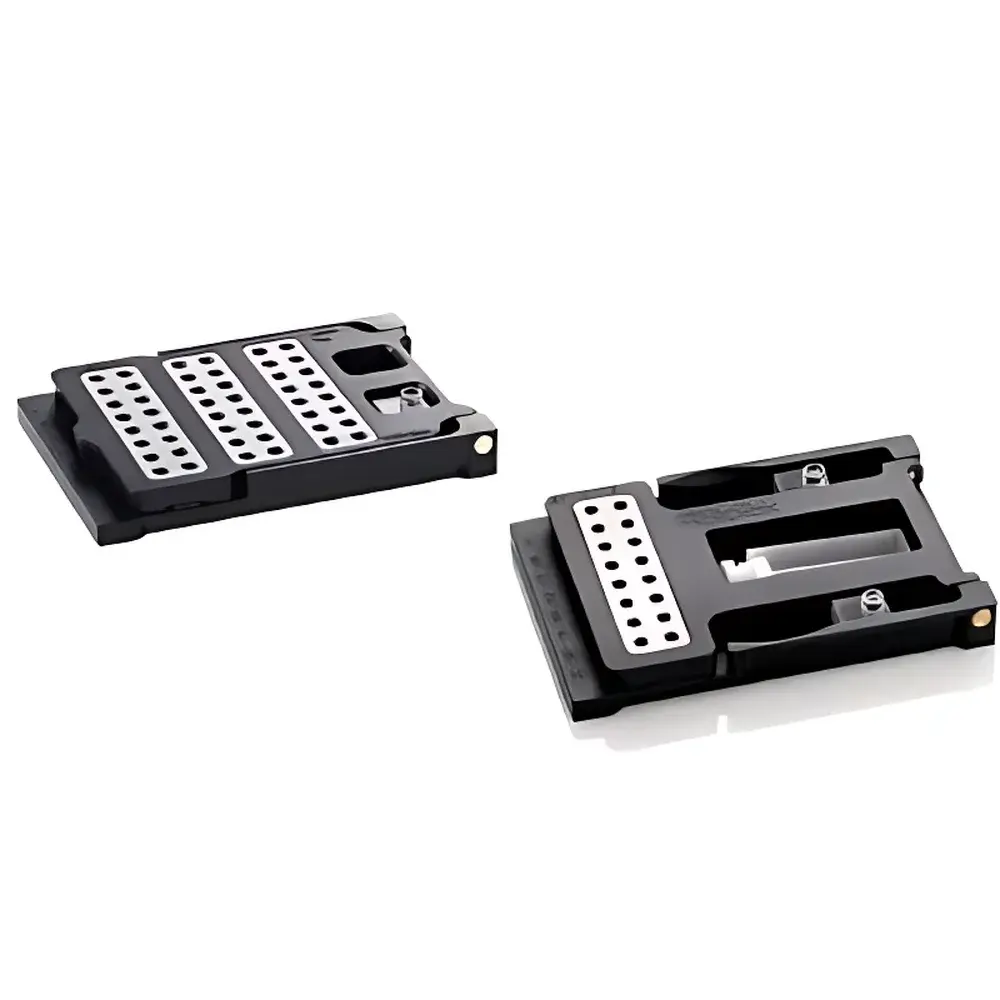
Agilent BioTek Take3 Micro-Volume Plate
| Brand | Agilent Technologies |
|---|---|
| Origin | USA |
| Manufacturer | Agilent Technologies |
| Import Status | Imported |
| Model | Take3 |
| Pricing | Upon Request |
Overview
The Agilent BioTek Take3 Micro-Volume Plate is an engineered accessory designed to extend the micro-volume quantification capabilities of Agilent BioTek’s family of multimode microplate readers—including Cytation, Synergy, and Epoch platforms. Leveraging fixed-pathlength (1 cm equivalent) absorbance and fluorescence detection geometry, the Take3 plate enables direct, dilution-free quantification of nucleic acids and proteins using only 2 µL of undiluted sample. Unlike traditional cuvette-based or capillary-based microvolume systems, the Take3 operates via surface-tension-confined sample retention on precision-machined quartz or fused-silica optical surfaces—eliminating the need for specialized fluidics, calibration curves per sample type, or instrument firmware upgrades. Its design conforms to standard SBS microplate footprint specifications, ensuring mechanical and optical compatibility across Agilent BioTek’s reader portfolio without requiring hardware modification or recalibration.
Key Features
- Micro-volume quantification with only 2 µL of sample—no dilution, no pipetting error amplification
- 16 independent micro-volume measurement spots on Take3; 48 spots on Take3 Trio variant
- Integrated support for standard 1-cm pathlength cuvettes and proprietary BioCell cuvettes (2 positions on Take3 Trio)
- Preset, application-optimized protocols in Take3 software for dsDNA, ssDNA, RNA, BSA, IgG, and lysozyme—each validated against NIST-traceable reference standards
- Optical path geometry engineered for high reproducibility (<2% CV across repeated measurements under controlled humidity and temperature conditions)
- Surface-cleanable architecture: residue removal via lint-free lab wipe or soft brush—no solvents or ultrasonic cleaning required
- Compatible with dual-mode detection (absorbance and fluorescence) on all supported Agilent BioTek readers
Sample Compatibility & Compliance
The Take3 plate supports a broad range of biological macromolecules including double-stranded DNA (260 nm), single-stranded DNA/RNA (260 nm with correction factors), and proteins (280 nm A280, A260/280 ratio analysis). It is routinely employed in laboratories adhering to GLP and GMP frameworks where traceability and procedural consistency are critical. While the Take3 itself is not a standalone regulated device, its use within Agilent BioTek readers enables compliance with analytical method validation requirements outlined in ICH Q2(R2), USP , and ISO/IEC 17025 for spectrophotometric quantification. The preloaded assay protocols are internally verified for linearity (R² ≥ 0.999 over typical working ranges), accuracy (±3% bias vs. certified reference materials), and specificity (minimal interference from common contaminants such as guanidine salts or EDTA at typical concentrations).
Software & Data Management
Quantitative analysis is performed through the Agilent BioTek Gen5 Microplate Reader Software, which includes the dedicated Take3 Application Module. This module provides automated background subtraction, pathlength normalization, concentration calculation using user-selectable extinction coefficients, and export of results in tab-delimited (.txt) format for downstream integration into LIMS or statistical analysis platforms. Audit trail functionality complies with FDA 21 CFR Part 11 requirements when Gen5 is configured in secure mode—supporting electronic signatures, user access controls, and immutable data logging. All measurement metadata—including instrument ID, date/time stamp, operator ID, and raw OD/RFU values—is embedded in exported files and retained in the local database.
Applications
- Routine nucleic acid QC in next-generation sequencing library preparation workflows
- Protein concentration verification prior to SDS-PAGE, mass spectrometry, or crystallography
- High-throughput screening of expression yields in recombinant protein production
- Quality control of oligonucleotide synthesis and CRISPR guide RNA preparations
- Stability assessment of biologics under accelerated degradation conditions
- Integration into automated liquid handling workflows using robotic arm-compatible microplate handlers
FAQ
Is the Take3 plate compatible with non-Agilent microplate readers?
No—mechanical alignment, optical coupling, and firmware-level communication are optimized exclusively for Agilent BioTek Cytation, Synergy, and Epoch series instruments.
Can the Take3 be used for fluorescence-based quantification of labeled biomolecules?
Yes—fluorescence intensity measurements (e.g., Qubit-style assays) are supported when paired with appropriate excitation/emission filters and calibrated reference standards.
What is the expected lifetime of a Take3 plate under routine laboratory use?
With proper cleaning after each use and storage in a low-humidity environment, the optical surface maintains performance for >5,000 measurements, as verified by periodic verification with NIST SRM 2034 (absorbance standard).
Does the Take3 require recalibration between sample types?
No—pathlength is physically fixed and invariant; only assay-specific extinction coefficients or calibration curves must be selected in software.
How does the Take3 handle viscous or particulate-containing samples?
Viscous samples (e.g., glycerol-stabilized enzymes) may require extended equilibration time (≤60 sec) for surface tension stabilization; particulates >5 µm should be centrifuged or filtered prior to loading to avoid spot contamination.




