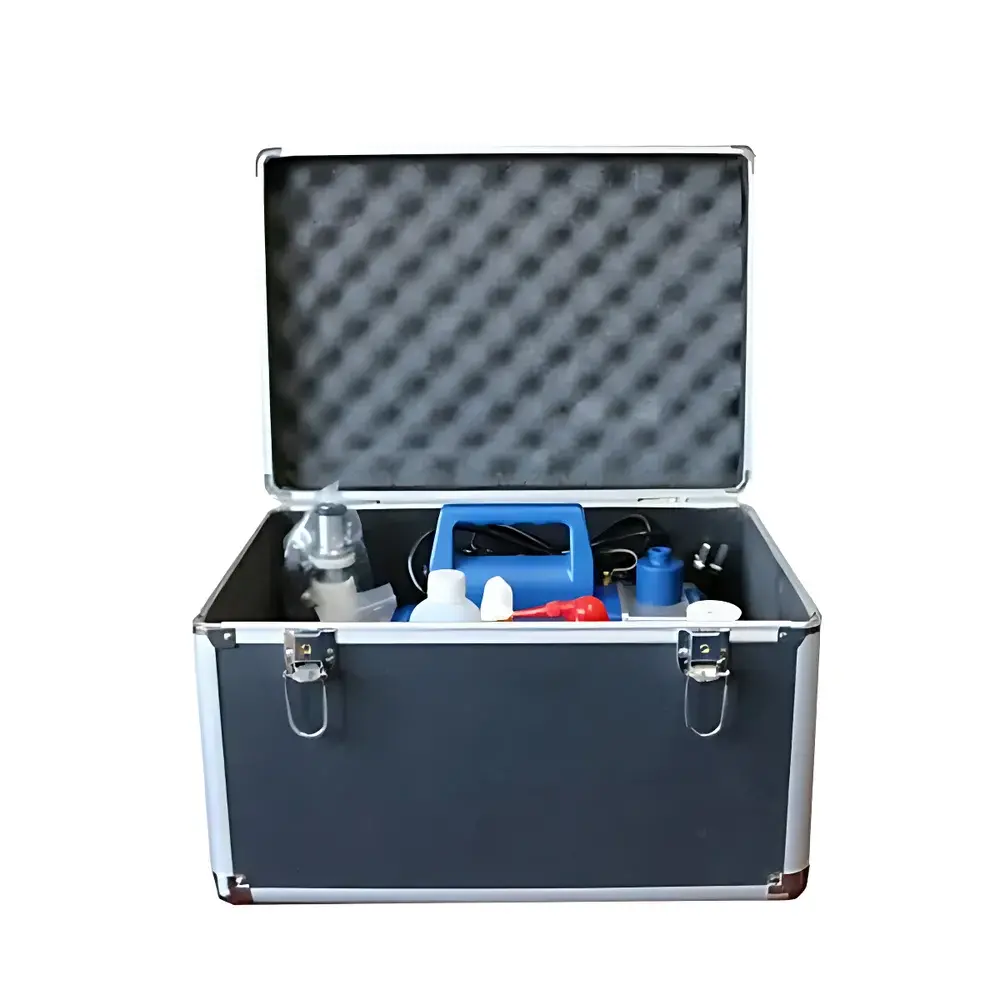
Xuxin Instrument ST-1519 Portable Oil Particle Contamination Analyzer
| Brand | Xuxin Instrument |
|---|---|
| Origin | Beijing, China |
| Manufacturer Type | Direct Manufacturer |
| Country of Origin | China |
| Model | ST-1519 |
| Pricing | Available Upon Request |
| Standard Compliance | DL/T 432, NAS 1638, ISO 4406 |
| Particle Detection Range | ≥5 µm |
| Magnification | 100× (with transmitted-light illumination) |
| Sample Volume | 12.5–100 mL per test |
| Filtration Method | Vacuum-assisted microfiltration |
| Filter Membrane | Standard pore-size polycarbonate or mixed-cellulose ester membrane |
| Dimensions | 420 × 330 × 230 mm |
| Weight | 6.64 kg |
Overview
The Xuxin Instrument ST-1519 Portable Oil Particle Contamination Analyzer is a field-deployable, gravimetric-microscopic particle counting system engineered for quantitative assessment of solid particulate contamination in industrial lubricants and insulating oils. It operates on the principle of vacuum-assisted membrane filtration followed by optical microscopic enumeration—fully aligned with the procedural requirements of DL/T 432 (Chinese electric power industry standard), NAS 1638 (U.S. aerospace specification), and ISO 4406 (international hydraulic fluid cleanliness classification). Unlike automated light-blockage or laser scattering instruments, the ST-1519 delivers traceable, operator-verified results by physically isolating particles ≥5 µm onto a defined-area filter membrane, enabling direct morphological observation, size discrimination, and comparative grading against certified reference templates. Its robust mechanical architecture and integrated high-vacuum suction pump ensure reliable filtration even for highly viscous or emulsified oil samples—such as turbine oils, phosphate ester anti-wear fluids (e.g., TSE), transformer mineral oils, and auxiliary system lubricants—where conventional inline sensors often fail due to clogging or signal attenuation.
Key Features
- Vacuum-driven filtration module with adjustable suction pressure, optimized for rapid and uniform particle deposition across the membrane surface—even for oils with kinematic viscosity exceeding 100 cSt at 40 °C
- Dedicated 100× transmitted-light microscope with Köhler illumination and calibrated stage micrometer, supporting visual identification and manual sizing of discrete particles from 5 µm to >150 µm
- Standardized comparison templates compliant with NAS 1638 (14-grade scale) and ISO 4406 (code-based reporting, e.g., 18/16/13)
- Modular filtration assembly compatible with standard 25-mm or 47-mm diameter membranes; includes solvent-resistant funnel, gasketed sealing, and vacuum hose interface
- Portable form factor (6.64 kg, 420 × 330 × 230 mm) with internal battery option (optional accessory), enabling on-site testing in substations, turbine halls, and remote maintenance depots
- No consumable electronics or calibration drift concerns—measurement traceability derives directly from physical filtration geometry and certified reference standards
Sample Compatibility & Compliance
The ST-1519 is validated for use with hydrocarbon-based, synthetic, and phosphate-ester dielectric oils commonly found in power generation and transmission infrastructure. It accommodates samples exhibiting water-in-oil emulsions, oxidation by-products, and suspended carbonaceous debris—conditions that impair optical clarity in automated counters. All procedures adhere strictly to DL/T 432–2018 (“Method for Determination of Particulate Contamination in Turbine Oil”), which mandates membrane filtration as the reference method for acceptance testing and trending. Results are fully reportable under ISO/IEC 17025-accredited laboratory workflows when coupled with documented operator training, equipment verification (e.g., vacuum gauge calibration, microscope resolution validation), and controlled environmental conditions (ISO 8573-1 Class 5 air quality recommended during membrane handling).
Software & Data Management
While the ST-1519 is a hardware-centric, non-digital instrument, it integrates seamlessly into regulated data ecosystems via structured manual documentation protocols. Users may record observations using standardized LIMS-compatible worksheets aligned with ASTM D7690 (Practice for Reporting Particle Count Data). Optional digital add-ons—including USB microscope cameras and template-matching software modules—support image capture, archiving, and side-by-side digital overlay with NAS/ISO grading charts. Audit trails comply with GLP and GMP principles when paired with controlled document management systems; all raw filter images and grading decisions are retained for retrospective review per FDA 21 CFR Part 11 requirements (when electronic records are employed).
Applications
- Turbine oil cleanliness monitoring during commissioning, routine maintenance, and post-overhaul verification in thermal and hydroelectric power plants
- Transformer oil particulate baseline establishment and degradation tracking in substation asset management programs
- Hydraulic system fluid qualification prior to equipment startup in petrochemical process units
- Research-grade particle morphology analysis in university tribology and lubrication laboratories
- Third-party inspection and certification services for ISO 4406 compliance reporting to OEMs and grid operators
FAQ
Does the ST-1519 require annual recalibration?
No—its measurement basis is geometric (membrane area, defined sample volume, standardized optics), not electronic. Annual verification of vacuum gauge accuracy and microscope resolution (e.g., using NIST-traceable stage micrometer) is recommended for ISO/IEC 17025 compliance.
Can it analyze water-contaminated or severely oxidized oils?
Yes. The vacuum filtration process effectively separates insoluble particulates from emulsified water phases and sludge precursors, making it uniquely suitable for degraded oil matrices where laser-based analyzers produce false negatives.
Is operator training required for ISO 4406 reporting?
Yes. Consistent interpretation of particle density and distribution requires formal training in NAS/ISO grading conventions, including differentiation between fiber artifacts, air bubbles, and genuine wear debris—training materials and certification pathways are available through Xuxin’s technical support portal.
What solvents are recommended for membrane rinsing?
n-Hexane, petroleum ether (40–60 °C fraction), or isopropyl alcohol—selected based on oil solubility and low residue volatility. Solvent compatibility must be verified per ASTM D2276 Annex A1.
How does it compare to automated particle counters per ISO 11171?
The ST-1519 serves as a reference method (per DL/T 432), while ISO 11171-compliant counters are primary field tools. Discrepancies are investigated via ST-1519 verification when automated results fall outside expected statistical variance or indicate sensor fouling.
Related Products