
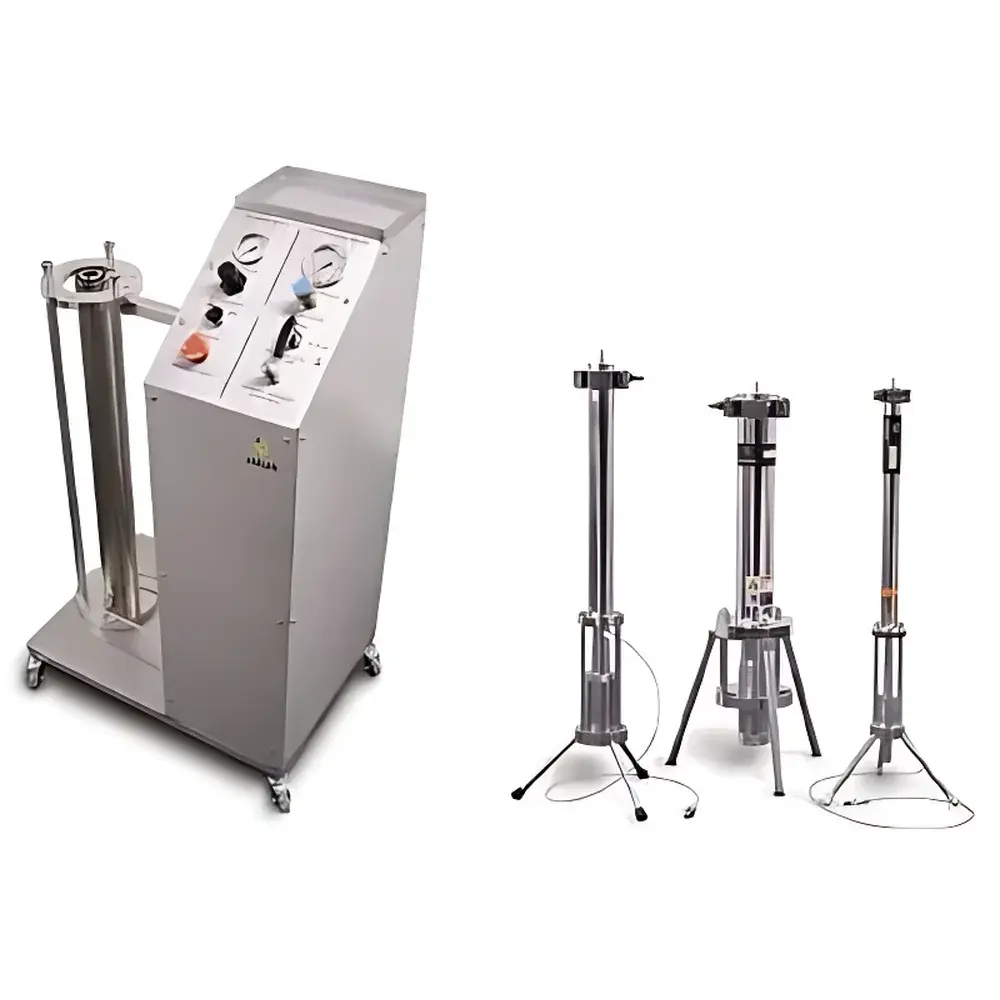
Agilent Load Lock Dynamic Axial Compression Column System
| Brand | Agilent Technologies |
|---|---|
| Origin | USA |
| Manufacturer Type | Original Equipment Manufacturer (OEM) |
| Product Origin | Imported |
| Model | Load Lock |
| Instrument Type | Dynamic Axial Compression (DAC) System |
| Power Requirement | Pneumatic (Compressed Air Only) |
| Column Compatibility | Three Standard Bore Sizes |
| Compression Mode | Dual-Mode DAC + Static Axial Compression (SAC) |
| Application Scale | Milligram to Multi-Kilogram Preparative Chromatography |
Overview
The Agilent Load Lock Dynamic Axial Compression (DAC) Column System is an engineered solution for high-efficiency, reproducible column packing in preparative liquid chromatography (Prep LC). Unlike conventional slurry packing methods that rely on manual settling or static compression, the Load Lock system implements a controlled, pneumatically actuated axial force mechanism to dynamically compress the packed bed *during* and *after* slurry introduction. This dual-phase compression—combining real-time dynamic adjustment (DAC) with post-packing mechanical locking (SAC)—ensures uniform bed density, minimizes channeling, and preserves column performance over extended operational lifetimes. Designed specifically for laboratories engaged in pharmaceutical development, peptide purification, and natural product isolation, the system bridges the gap between analytical-scale method development and multi-kilogram process-scale manufacturing while maintaining consistent resolution and recovery.
Key Features
- Dual-mode axial compression architecture: Simultaneous support for Dynamic Axial Compression (DAC) during slurry packing and Static Axial Compression (SAC) for long-term bed stabilization.
- Pneumatically driven operation: Eliminates electrical requirements; compatible with standard lab-grade compressed air (4–6 bar), enhancing safety and simplifying installation in GMP-compliant environments.
- Modular flow-through packing station: Accommodates three standard column inner diameters—typically 50 mm, 100 mm, and 200 mm—with interchangeable end-fittings and piston assemblies to maintain consistent packing dynamics across scales.
- Integrated fluid and sample distribution manifold: Ensures laminar, radially symmetric slurry delivery to prevent preferential flow paths and particle segregation during bed formation.
- Tool-free column assembly/disassembly: The Load Lock interface enables rapid column loading, compression verification, and cartridge ejection without torque wrenches or alignment fixtures—reducing operator variability and setup time to under 5 minutes per column.
Sample Compatibility & Compliance
The Load Lock system is validated for use with silica-based, polymer-based, and hybrid stationary phases commonly employed in reversed-phase, ion-exchange, and size-exclusion preparative chromatography. It supports slurries with particle sizes ranging from 5 µm to 30 µm and is routinely deployed in workflows compliant with ICH Q5A, USP , and ASTM D7892–15 (Standard Practice for Packing Preparative Liquid Chromatography Columns). Its pneumatic-only design meets intrinsic safety requirements for Class I, Division 2 hazardous locations. Documentation packages—including IQ/OQ protocols, material traceability records (ASTM F899), and stainless-steel 316L certification—support FDA 21 CFR Part 11–aligned validation in regulated biopharmaceutical settings.
Software & Data Management
While the Load Lock system operates as a hardware-centric, manually supervised platform, its operational parameters are fully traceable via Agilent’s optional PrepLC Method Transfer Suite. Compression pressure (bar), slurry volume (mL), packing duration (s), and final bed height (mm) can be logged and exported in CSV or PDF formats for audit-ready reporting. All user actions—including lock engagement, pressure release, and column ejection—are timestamped and assignable to individual operator IDs, satisfying GLP/GMP data integrity requirements for electronic records (21 CFR Part 11 Subpart B, §11.10). No embedded firmware or proprietary OS is required—data capture occurs externally through Agilent’s OpenLab ECM integration layer.
Applications
- Method translation from analytical HPLC to preparative scale using identical stationary phase chemistry and robust bed integrity.
- Rapid screening of packing solvents and slurry concentrations during early-stage process development for monoclonal antibodies and ADC intermediates.
- Reproducible re-packing of columns after regeneration cycles in continuous chromatography systems (e.g., MCSGP, PCC).
- High-yield purification of synthetic peptides (>95% purity, >5 g/batch) where bed homogeneity directly impacts fraction purity and aggregate removal efficiency.
- Natural product isolation from complex botanical extracts, where low-pressure, high-volume slurry delivery prevents shear-induced degradation of thermolabile compounds.
FAQ
Does the Load Lock system require electrical power?
No. It operates exclusively via regulated compressed air (4–6 bar), eliminating grounding, surge protection, or EMI concerns in shared laboratory infrastructure.
Can it be used with non-Agilent column hardware?
Yes—provided the column body conforms to ISO 11540:2018 flange dimensions and uses compatible O-ring grooves and piston sealing profiles. Agilent provides dimensional drawings upon request for third-party integration.
What maintenance intervals are recommended?
Pneumatic seals and filter regulators should be inspected quarterly; piston bushings and column-end gaskets are rated for ≥500 compression cycles and supplied with replacement kits (P/N 5190-XXXX).
Is method validation support available?
Agilent offers pre-qualified IQ/OQ templates aligned with ASTM E2500-13 and EU Annex 15, including test scripts for compression repeatability (±2% RSD across n=6 runs) and bed height stability (±0.3 mm over 72 h).




